
Residential Investment in Gift City Is Backed by Numbers, Not Just a Good Story
Most conversations about residential investment in GIFT City open with the story — the IFSC, the global banks, the walk-to-work city. That story is true, and it’s compelling. But what actually convinces a serious buyer is what the specific numbers show: what a configuration costs today, what it rents for, and how the return stacks up against safer, sleepier alternatives. Run those numbers, and the case for residential investment in GIFT City gets considerably stronger.
Every figure below is checked against current listings and market trackers as of mid-2026. If you’re serious about residential investment in GIFT City, this is the arithmetic that shows exactly why early movers are still in the strongest position — and why the window to enter at today’s pricing is not going to stay open indefinitely.
What Residential Property in Gift City Actually Costs Right Now
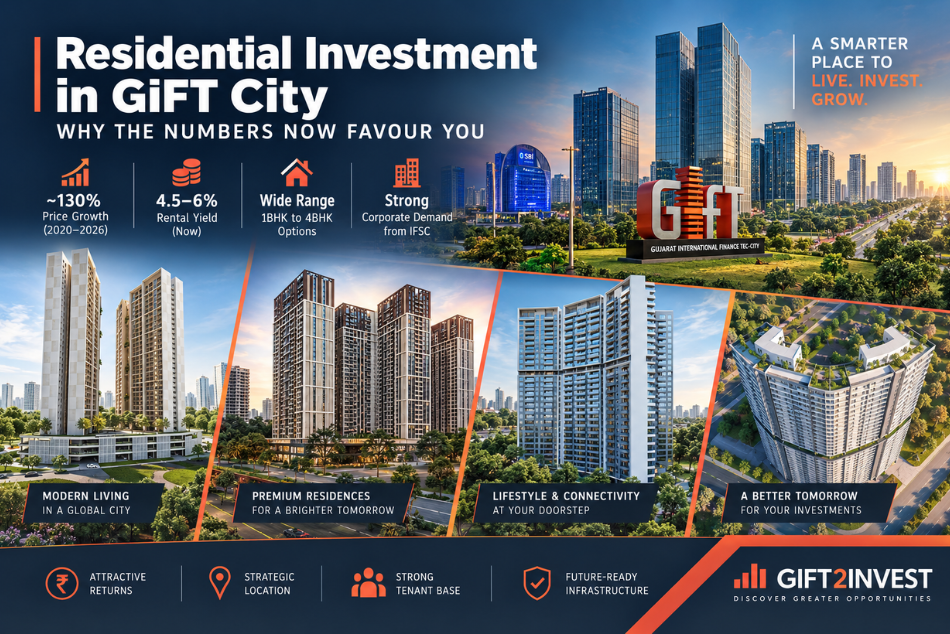
GIFT City residential has moved a long way from its early pricing. Average residential rates across the city currently sit around Rs. 10,500 per square foot, up from roughly Rs. 4,500 per square foot in 2020. That’s close to a 130 percent move in six years — a number worth sitting with before assuming today’s entry price behaves like 2021’s did.
But the average hides real variation. Standard residential — mid-rise towers a short distance from the IFSC core — currently runs Rs. 10,500 to Rs. 13,000 per square foot. Premium and high-rise product, the Sobha Elysia and similar luxury-positioned towers, runs Rs. 15,000 to Rs. 18,500 per square foot. That’s close to a 50 percent premium for the top tier over standard stock, and it’s a gap that has widened, not narrowed, over the past two years.
Price Bands by Configuration
| Configuration | Typical Size | Approx. Price Band | Approx. Cost |
|---|---|---|---|
| Studio / 1BHK | 500–800 sq ft | Rs. 10,500–13,000/sq ft | Rs. 55L–1.0 Cr |
| 2BHK | 1,100–1,300 sq ft | Rs. 10,500–13,000/sq ft | Rs. 1.15–1.7 Cr |
| 3BHK | 1,600–1,900 sq ft | Rs. 12,000–16,000/sq ft | Rs. 1.9–3.0 Cr |
| 4BHK / Premium | 2,400+ sq ft | Rs. 15,000–18,500/sq ft | Rs. 3.6 Cr+ |
These bands move with tower, developer, floor, and proximity to the operational IFSC cluster. Treat them as a starting range to sanity-check a quote against, not a ceiling or a floor for any specific unit.
The Six-Year Price Trajectory
| Year | Approx. Avg Price/sq ft | Cumulative Move from 2020 |
|---|---|---|
| 2020 | Rs. 4,500 | Baseline |
| 2022 | Rs. 6,800 | 51% |
| 2024 | Rs. 9,200 | 104% |
| 2026 (Current) | Rs. 10,500 | 133% |
The curve isn’t a straight line. The steepest years were 2021 to 2023, coinciding with the entity count crossing several hundred and the first wave of foreign bank branches confirming operations. Growth since 2024 has been steadier and slower — a sign the market is maturing rather than accelerating, and that matters for how you model the next five years.
The Yield Number That Has Actually Changed
For years, the standard line on residential investment in GIFT City was 3 to 4 percent gross rental yield — real, but thin, and clearly an appreciation story rather than an income one. That number has moved. By early 2026, average residential rental yields in GIFT City had climbed to roughly 4.5 to 6 percent, with well-located furnished units at the upper end of that band.
The reason is structural, not cyclical. A meaningful share of GIFT City’s residential demand now comes with what the market has started calling a corporate anchor — IFSC employers providing direct housing allowances or company leases for staff who need to live inside the walk-to-work zone. That employer-backed tenancy behaves differently from an open-market renter. Rent gets paid on time, renewal is less contentious, and vacancy between tenants tends to be short.
A 3–4% yield with an uncertain tenant is a different asset from a 5–6% yield with a corporate lease behind it. The yield moved up because the tenant base got stronger — and that’s a trend line worth being early on.
Net yield, after maintenance and a realistic vacancy allowance, typically runs one to one-and-a-half percentage points below the gross figure. A unit advertised at 6 percent gross is a healthy 4.5 to 5 percent net proposition once GIFT City’s above-average maintenance charges — a direct consequence of its district cooling and utility-tunnel infrastructure — are factored in. That net number, on a tenant base this creditworthy, is already ahead of where GIFT City residential yields stood just two years ago, and the direction of travel is upward.
The Appreciation Math: What 127% Since 2020 Actually Means Going Forward
GIFT City residential has appreciated roughly 100 to 130 percent on a per-square-foot basis since 2020, depending on which tracker and which specific pocket of the city you check. That is a genuinely strong five-year run, and it’s the number every broker will lead with.
The mistake is treating that run rate as a forward projection. The 2020–2023 window captured the re-rating that happens once when a market moves from speculative to credible — IFSCA’s single-regulator model bedding in, the first wave of global bank branches confirmed, the entity count crossing meaningful thresholds. That kind of one-time re-rating doesn’t repeat on schedule.
What’s more useful for anyone underwriting residential investment in GIFT City today is the forward catalyst list, not the trailing return. The metro’s Violet Line extension is now live, not pending. Two foreign universities are running active campuses, with more in the pipeline. Lilavati Hospital has moved from announcement to operating OPD services. Each of these closes a specific livability gap, and each has historically produced a step-change in nearby residential values in comparable financial districts elsewhere — but a step-change is not the same shape as a straight-line 20 percent-a-year curve.
A more defensible forward assumption for residential investment in GIFT City over the next five to seven years is high single digits to low double digits annual appreciation, with occasional step-changes around specific catalysts landing — not a repeat of the 2020–2025 curve extrapolated forward.
How Residential Investment in Gift City Actually Stacks Up Against the Alternatives
Before committing capital, it’s worth running GIFT City residential against what else that money could be doing. Here’s an honest side-by-side.
| Instrument | Typical Return | Liquidity | Effort Required |
|---|---|---|---|
| Bank Fixed Deposit | 6.5%–7.5% pre-tax | High | None |
| Debt Mutual Fund | 6.5%–8% | High | Low |
| Listed REIT (Indian Grade-A) | 6%–8% + unit price movement | High (Exchange-Traded) | Low |
| GIFT City Residential (Rental) | 4.5%–6% gross, 3.5%–5% net | Low | High |
| GIFT City Residential (Total Return Incl. Appreciation) | 10%–14% modelled, not guaranteed | Low | High |
On rental yield alone, residential investment in GIFT City sits roughly in line with a fixed deposit or a debt fund — competitive, not a laggard. Where it pulls decisively ahead is once appreciation is added to the return stack, and that’s exactly what a multi-year hold in GIFT City is built to capture.
Unlike a fixed deposit or a debt fund, GIFT City residential gives you a real, appreciating asset with a captive, employer-backed tenant pool underneath it. That combination — income plus a structural growth story — is precisely why serious investors are treating residential investment in GIFT City as a core long-term holding rather than a side bet.
What Your Monthly Outlay Actually Looks Like
Take a 2BHK bought at Rs. 1.25 crore, financed 70 percent through a loan at 9 percent, with 30 percent equity. The loan amount is Rs. 87.5 lakh, generating an annual interest cost of roughly Rs. 7.9 lakh in year one.
At a 5 percent gross rental yield, the unit generates roughly Rs. 6.25 lakh a year in rent. After maintenance and a modest vacancy allowance, net rental income lands closer to Rs. 5 lakh — meaning rent already covers roughly two-thirds of the loan cost from year one, well before any appreciation is counted. The remaining monthly top-up works out to a little over Rs. 24,000, a manageable number for the buyer profile this asset class attracts.
Over a seven-year hold, that top-up totals roughly Rs. 20 lakh, before counting the equity you’re building through principal repayment. Against that, GIFT City’s own appreciation track record — and the confirmed catalysts still ahead of it — gives this modest monthly cost a clear path to being comfortably outrun by the time you’re ready to exit or refinance.
A modest monthly top-up today buys you a real, appreciating asset with a growing, creditworthy tenant base underneath it. Run the number for your own loan-to-value — most buyers find it’s smaller than they expected.
Why the 2026 Entry Point Is a Different Trade Than 2021
Buyers who entered GIFT City residential at Rs. 4,500 to 5,000 per square foot in 2020–21 captured the re-rating described above. That specific entry price is gone and isn’t coming back — no amount of research changes that.
What’s changed for someone considering residential investment in GIFT City now is the composition of the demand. Early buyers were underwriting a promise: that global banks would actually show up, that the regulator would actually function as a single window, that IFSCA would keep expanding permitted categories. Today’s buyer is underwriting a running system — over a thousand entities registered, banking assets past USD 100 billion, a live metro connection, two operating universities, and a hospital already seeing outpatients.
That’s a lower-risk entry than 2021 in one specific sense: less of the return depends on things happening that haven’t happened yet. It’s also a higher-price entry in the obvious sense: you’re paying for confirmed infrastructure rather than a plan. Both things are true at once, and pricing the risk correctly means being honest about which one matters more for your specific holding period.
Which Configuration Clears the Numbers Most Comfortably
Running the yield and carry maths above across configurations produces a fairly consistent pattern. Smaller units — studios and 2BHKs — post the strongest gross yields in absolute percentage terms, because per-square-foot rents for compact, well-located units run higher relative to their purchase price than larger formats do.
3BHK and 4BHK units carry lower yield percentages but attract the corporate-lease tenant category most reliably — senior executives whose employer signs the lease directly. The trade-off is between a marginally better yield number on a smaller unit and a marginally more stable, employer-backed tenancy on a larger one. Neither is objectively superior; they answer different questions about how much you value yield versus how much you value payment certainty.
What doesn’t clear the numbers well in most scenarios modelled here is an unfurnished unit bought purely on price with no proximity advantage to the operational core. The furnishing premium and location premium both show up directly in achievable rent, and skipping either one weakens the yield side of the equation without reducing what you paid.
The Number Comparison Against Gandhinagar and Ahmedabad
The zone-versus-city argument gets made often in qualitative terms. Here it is in numbers, so you can see exactly what the premium buys.
| Market | Avg Price/sq ft | Gross Rental Yield | 5-Yr Appreciation |
|---|---|---|---|
| GIFT City residential | Rs. 10,500 | 4.5%–6% | 100–130% |
| Gandhinagar established sectors | Rs. 3,500–5,000 | 2.5%–3.5% | 40–60% |
| Ahmedabad premium corridors | Rs. 6,000–9,000 | 2%–3% | 35–55% |
GIFT City residential costs roughly double Ahmedabad’s premium corridors per square foot, but it has also delivered a materially higher five-year return and a better yield. Whether that trade is worth it depends entirely on your holding period — over one to two years, the entry premium is hard to recover; over five to seven, the gap has historically closed and then some.
A Quick Note for NRI Buyers on the Actual Numbers
NRIs buying residential property in GIFT City follow standard RBI rules for immovable property in India — this is not an IFSC-exempt transaction for the buyer. Repatriation of sale proceeds is permitted subject to the usual FEMA limits and documentation, and rental income is taxed under regular Indian income tax rules, not under IFSC concessional rates. Build standard TDS and repatriation compliance costs into your return model rather than assuming IFSC’s corporate tax benefits extend to a personal residential purchase.
A Few Things Worth Tracking — None of Them Change the Thesis
No investment case is complete without knowing what to watch. GIFT City’s fundamentals are strong, and being aware of the following simply helps you time your entry and hold with more confidence.
- IFSCA’s pace of adding permitted activities has been consistently forward-moving — keep an eye on it, since it’s the ultimate source of the corporate-anchor tenant demand behind rising yields.
- Under-construction stock naturally carries a longer runway to full rental income — buyers who plan for this upfront find the wait comfortably worth it once possession lands.
- Interest rate movements affect any leveraged purchase — a healthy equity contribution keeps your monthly outlay comfortable regardless of rate cycles.
- The secondary market is still deepening compared to an established Ahmedabad corridor — which is precisely why buyers entering now, ahead of that maturity, stand to benefit most from the resale market that’s forming.
None of these change the underlying thesis for residential investment in GIFT City. If anything, they’re the reason patient, informed buyers who enter now — while the city is still completing its growth curve — are positioned to do noticeably better than those who wait for every box to be ticked first.
Wrapping Up: The Numbers Make a Strong Case for Residential Investment in Gift City
Put the narrative aside and residential investment in GIFT City still comes out ahead — a rare combination of rising rental yields, a genuinely appreciating asset, and a tenant base that’s only getting stronger as more global institutions move in.
Prices have moved from Rs. 4,500 to roughly Rs. 10,500 per square foot since 2020, and yields have climbed from 3–4 percent to 4.5–6 percent as employer-backed tenancy becomes the norm rather than the exception. The forward catalysts — a live metro line, two operating universities, an open hospital, and more on the way — are confirmed, not promised. That combination is exactly why residential investment in GIFT City today is a stronger, more grounded opportunity than it was at any earlier stage of the city’s growth.
The buyers who move now, while entry pricing still reflects a city mid-transformation rather than one fully arrived, are the ones best placed to capture what comes next.
FAQs: Residential Investment in Gift City
Q1) What Is the Realistic Entry Price for Residential Investment in Gift City Today?
Standard residential currently runs Rs. 10,500 to Rs. 13,000 per square foot, with premium and high-rise product at Rs. 15,000 to Rs. 18,500 per square foot. The city-wide average sits close to Rs. 10,500, up from around Rs. 4,500 in 2020.
Q2) What Rental Yield Can I Actually Expect?
Gross yields currently run 4.5 to 6 percent, up from the 3 to 4 percent that was standard a couple of years ago. Net yield, after maintenance and vacancy, typically lands one to one-and-a-half points lower. Furnished units close to the operational IFSC core sit at the upper end of the range.
Q3) Does Residential Investment in Gift City Beat a Fixed Deposit?
On rental yield alone, no — a fixed deposit currently pays a comparable or better rate with none of the illiquidity. The case for residential only clears an FD once appreciation is added to the return, which means it’s a multi-year thesis, not an income substitute.
Q4) How Much Should I Budget for Carry Costs?
Model it explicitly rather than assuming rent covers the loan. On a leveraged purchase at current yields, expect a real annual shortfall between rental income and loan interest — run your specific loan-to-value, interest rate, and rental assumption before committing.
Q5) Has the Demand Profile for Gift City Residential Actually Changed, or Is This Still Speculative?
It has changed. A growing share of tenancies are now backed by employer housing allowances or direct corporate leases, rather than open-market negotiation. That corporate-anchor demand is the main reason yields have moved up from the 3–4 percent band toward 4.5–6 percent.
Q6) Which Configuration Offers the Best Numbers for a First-Time Gift City Residential Investor?
Studios, 1BHK and 2BHKs typically post the strongest gross yield percentages. 3BHK and larger units trade a lower yield number for more reliable, employer-backed tenancy. The better fit depends on whether you’re prioritising yield or payment certainty.