
GIFT City — Complete FAQ Knowledge Base
Your GIFT City Questions Answered — GIFT City Basics, IFSC, Property, NRI/OCI, Investment, Taxes, Connectivity, Living, Infrastructure, Development, Commercial Property, HNI & Family Offices, and the Buying Process
Contents
- GIFT City Basics (Q1–Q9)
- GIFT City IFSC & Structure (Q10–Q20)
- GIFT City Property (Q21–Q36)
- GIFT City NRI & OCI (Q37–Q48)
- GIFT City Investment (Q49–Q60)
- GIFT City Taxes & Regulations (Q61–Q68)
- GIFT City Location & Connectivity (Q69–Q74)
- GIFT City Living (Q75–Q80)
- GIFT City Infrastructure (Q81–Q85)
- GIFT City Development (Q86–Q90)
- GIFT City Commercial Property (Q91–Q98)
- HNI, UHNI & Family Offices (Q99–Q104)
- Buying GIFT City Property (Q105–Q114)
GIFT City Basics
Q1
What Is GIFT City?
Gujarat International Finance Tec-City is India’s only International Financial Services Centre, built between Ahmedabad and Gandhinagar. As of March 2026, GIFT IFSC had 1,147 IFSCA registrations/authorisations, while total banking assets exceeded USD 111 billion. It’s a live, fast-growing financial hub, and property here is still priced for a city mid-transformation, not one fully arrived.
Q2
What Does GIFT City Stand for?
It stands for Gujarat International Finance Tec-City — a purpose-built financial and technology district on the Sabarmati riverfront. It houses India’s only IFSC, with global banks, fund managers and fintechs already running full operations. The name signals serious international ambition, and the momentum behind it keeps accelerating year after year.
Q3
Where Is GIFT City Located?
It sits right on the banks of the Sabarmati river, exactly between Ahmedabad and Gandhinagar in Gujarat, under 30 minutes from Ahmedabad’s international airport. That location, paired with India’s only IFSC, is one of the factors supporting institutional and investor interest in the area.
Q4
Is GIFT City in Ahmedabad or Gandhinagar?
It sits in the corridor between the two — administratively closer to Gandhinagar, but economically its own address entirely. It isn’t a suburb of either city; it’s India’s only International Financial Services Centre, with a regulatory identity and growth story that outpaces both neighbouring markets combined.
Q5
Why Was GIFT City Created?
To bring cross-border financial business — historically routed through Singapore, Dubai and Mauritius — back onto Indian soil. With its own regulator, foreign-currency operations and serious tax incentives, it was built to compete globally, and over 1,150 entities already prove the strategy is working exactly as planned.
Q6
Who Developed GIFT City?
It’s a joint initiative of the Government of Gujarat and the Government of India, executed through the GIFT City Development Corporation. That dual backing gives investors real policy stability — a rare combination of state-level execution and national-priority status that few Indian real estate projects can match.
Q7
Is GIFT City a Smart City?
Yes, and genuinely so — its smart-city infrastructure is fully operational, not just promised. District cooling, underground utility tunnels, automated waste collection and 24/7 command-centre monitoring already run day to day. Few Indian smart city projects have delivered this much this fast, which is exactly why global tenants keep signing on.
Q8
How Big Is GIFT City?
It spans roughly 886 acres, with a master plan covering about 62 million square feet of development. Around 62 million sq ft of development is planned, with nearly half already allotted. That’s a genuinely limited footprint against fast-rising demand — exactly the scarcity dynamic early investors want to be inside of.
Q9
How Does GIFT City Work?
The IFSC financial ecosystem is regulated by IFSCA, while GIFT City as a whole includes the IFSC and DTA zones. Businesses transact in foreign currency and enjoy real tax incentives, and that structure is precisely what’s pulling in 1,150+ entities and counting.
GIFT City IFSC & Structure
Q10
What Is GIFT City IFSC?
It’s India’s only International Financial Services Centre — the regulated zone where global banks, fund managers and insurers operate in foreign currency under IFSCA. It’s the engine behind the entire growth story, and every new entity that registers here adds fresh demand for office space and housing nearby.
Q11
What Is IFSC in GIFT City?
It’s the notified financial zone where eligible entities can obtain regulatory approvals and conduct permitted financial activities, including transactions in foreign currency, with applicable tax incentives. Over 1,150 entities, including 37 banks, already operate under this framework. It’s the single biggest reason the city competes credibly with Singapore and Dubai — and property demand follows accordingly.
Q12
What Is the Difference Between GIFT City and IFSC?
GIFT City is the whole 886-acre township — offices, homes, schools, a hospital. The IFSC is the regulated financial core within it, governed by IFSCA. Understanding this split matters directly for property buyers, since it shapes tenant eligibility, tax treatment and long-term value depending on where exactly you buy.
Q13
What Is an SEZ in GIFT City?
It’s the roughly 261-acre Special Economic Zone containing the IFSC, where authorised units operate under the applicable SEZ and IFSC framework. That regulatory requirement creates a demand floor no ordinary Indian commercial market has, which is exactly why serious investors track this zone so closely.
Q14
What Is DTA in GIFT City?
The Domestic Tariff Area is the roughly 625-acre non-IFSC part of the city, operating under standard Indian rules and rupee transactions. It houses GCC support functions, IT firms and professional services, and gives everyday investors a simpler, open-market path into this booming financial district.
Q15
What Is the Difference Between SEZ and DTA?
This is an important zone check for any buyer. SEZ/IFSC space is subject to the applicable authorised-occupier and permitted-use requirements, while DTA space has a broader occupier universe. Get this right and you unlock the correct tenant pool, pricing power and genuinely strong rental returns from the very start.
Q16
What Is IFSCA?
It’s the International Financial Services Centres Authority — the single unified regulator covering banking, insurance, capital markets and fund management inside GIFT City. Since 2020, IFSCA has expanded the range of activities permitted in the IFSC, supporting the development of a broader financial-services ecosystem.
Q17
What Does IFSCA Do?
It regulates the entire financial ecosystem here — banking, insurance, funds, bullion, aircraft leasing — under one global-standard authority instead of India’s usual multi-regulator maze. That single-window efficiency is a major reason 1,150+ entities have chosen this address, fuelling relentless demand for commercial and residential space.
Q18
What Businesses Can Operate in GIFT City?
The mix spans banking, fund management, insurance, fintech, aircraft and ship leasing, bullion trading and global capability centres. This diversity can broaden the sources of commercial demand, although property performance still depends on supply, occupancy, asset quality and wider market conditions.
Q19
Who Can Set Up a Business in GIFT City?
It’s open to Indian companies, foreign entities and NRIs alike, through IFSCA’s single-window registration process. Banks, fund managers, fintechs and family offices are all eligible. That accessibility is exactly why entity registrations keep climbing — and why the office space they need keeps filling fast.
Q20
What Types of Companies Operate in GIFT City?
The tenant roster reads like a global finance directory — HSBC, Deutsche Bank, Standard Chartered, JP Morgan, alongside 270-plus funds and a growing fintech sandbox community. This calibre of occupier is exactly what makes the commercial and residential real estate here such a compelling, fast-moving opportunity.
GIFT City Property
Q21
Can You Buy Property in GIFT City?
Yes — residential and commercial property is available, subject to the purchaser’s residency/status, the type of property and the applicable FEMA, RBI and property rules. With entry prices still below where full occupancy will eventually push them, now is genuinely one of the smarter windows to secure your position.
Q22
What Types of Property Can You Buy in GIFT City?
You can choose residential apartments, Grade-A commercial offices, retail shops and mixed-use developments across both the IFSC and DTA zones. Each category serves a different investor goal — income, appreciation or self-use — and with the city still filling in its master plan, choice today is wider than it will be later.
Q23
Can You Buy Residential Property in GIFT City?
GIFT City is the whole 886-acre township — offices, homes, schools, a hospital. The IFSC is the regulated financial core within it, governed by IFSCA. Understanding this split matters directly for property buyers, since it shapes tenant eligibility, tax treatment and long-term value depending on where exactly you buy.
Q24
Can You Buy Commercial Property in GIFT City?
Yes — commercial office property is available across relevant GIFT City zones. Indicative gross yields vary by project, tenant, lease structure, location and purchase price, and SEZ/IFSC occupancy is subject to the applicable regulatory framework. Every new regulatory category IFSCA approves creates fresh corporate demand. Buyers who lock in today’s pricing are entering ahead of the next wave.
Q25
Can You Buy an Office in GIFT City?
You genuinely can — from 1000 sq ft units to full floors across the IFSC and DTA zones. With 37 banks and hundreds of funds already operating here, tenant demand is real, not projected, making office ownership one of the city’s steadiest income plays.
Q26
Can You Buy a Shop in GIFT City?
Yes — retail and F&B opportunities exist in GIFT City, but performance depends on location, footfall, tenant mix, surrounding occupancy and project design. Future footfall should be treated as an assumption, not a certainty.
Q27
Can You Buy Land in GIFT City?
Direct land purchases by individual retail buyers are uncommon — parcels are typically allotted by the GIFT City Development Corporation to developers or large institutional and family-office buyers for build-to-suit projects. Most investors instead buy ready or under-construction units, which offer a far simpler, faster entry.
Q28
Can You Invest in GIFT City Without Working There?
Absolutely — plenty of investors buy purely for rental income and appreciation, leasing to IFSC professionals, expats and corporate tenants, with zero need to work or live there themselves. It’s a genuine hands-off wealth-building opportunity backed by a fast-growing, policy-anchored ecosystem.
Q29
Who Can Set Up a Business in GIFT City?
Resident Indians, NRIs and OCIs can acquire permitted property subject to the applicable rules; foreign nationals are subject to separate FEMA and residency conditions. That accessibility is a major reason diaspora capital from the UAE, US and UK keeps flowing into this fast-scaling market.
Q30
Is GIFT City Property Freehold or Leasehold?
Many GIFT City land and development arrangements use long-term leasehold structures, including 99-year arrangements under applicable GIFTCL policies and documents; the exact tenure depends on the asset and transaction. This structure is standard across major global financial districts and doesn’t diminish investment quality; it’s simply worth confirming zone-by-zone before you commit to a purchase.
Q31
What Is a 99-Year Lease in GIFT City?
Long-term leasehold structures are common in the development, but the exact rights, tenure and transfer conditions depend on the property and transaction documents. Leasehold status should be reviewed alongside the asset’s title and allotment documents.
Q32
Can GIFT City Property Be Resold?
Yes, permitted property can be transferred or resold subject to the applicable title, project, allotment, developer, registration and regulatory conditions. Secondary-market liquidity varies by asset and location. It’s thinner than an established Ahmedabad corridor today, which is precisely the early-mover advantage: buyers entering now are ahead of the resale liquidity still forming.
Q33
Can You Rent Out GIFT City Property?
Yes — and it’s thriving, backed by a captive, employer-housed professional and expat tenant base. Residential yields have climbed to 4.5–6%, commercial runs 6–10%. With over 1,150 entities hiring steadily, tenant demand keeps outpacing quality supply, which is exactly the setup landlords want.
Q34
What Is the Price of Property in GIFT City?
Residential currently averages around Rs. 10,500 per sq ft, up from roughly Rs. 4,500 in 2020 — over 130% growth in six years. Commercial ranges Rs. 10,000–14,000 per sq ft. Prices keep climbing with every fresh milestone, so today’s entry point genuinely won’t last long.
Q35
Is GIFT City Property a Good Investment?
Yes — backed by real numbers, not just a good story: 1,150+ entities, USD 111 billion in banking assets, a live metro line and two operating universities. The city is still mid-buildout, meaning today’s pricing hasn’t caught up to what’s already operational on the ground.
Q36
What Documents Are Required to Buy GIFT City Property?
Key documents include the RERA registration certificate, the Development Corporation’s allotment letter confirming zone classification, title documents, the approved building plan and construction schedule. Getting these verified upfront protects your investment and lets you move confidently while inventory near the operational core is still available.
GIFT City NRI & OCI
Q37
Can NRIs Buy Property in GIFT City?
Yes — purchases follow standard RBI and FEMA guidelines, with no cap on the number of properties or total value. NRIs are actually one of the strongest buyer segments here, drawn by international-standard infrastructure that feels genuinely familiar coming from Dubai, Singapore or London.
Q38
Can NRIs Buy Commercial Property in GIFT City?
Yes — ownership here is fully permitted under FEMA’s general permission route. With commercial yields running 6–10% gross and a policy-backed tenant base that can’t simply relocate, it’s become one of the most attractive income-generating assets NRIs can hold onshore in India today.
Q39
Can NRIs Buy Residential Property in GIFT City?
Yes — buying here is straightforward under standard RBI rules. Many NRIs treat it as a future homecoming base, since the infrastructure and professional community mirror the international financial centres they’re already living in. Demand from this segment keeps compressing available inventory near the IFSC core.
Q40
Can OCI Cardholders Buy Property in GIFT City?
Yes — OCI purchases carry the same rights as NRI purchases under RBI’s general permission route, covering both residential and commercial categories. It’s a genuinely simple, well-documented process, and OCI buyers are increasingly using this market as their entry point back into Indian real estate.
Q41
Can Foreigners Buy Property in GIFT City?
Generally, foreign nationals face the same restrictions here as they do across India, except for NRIs and OCIs, who have full access under FEMA. Citizens of a few specific neighbouring countries need prior RBI approval. A qualified legal advisor can confirm your exact eligibility before you commit.
Q42
Do NRIs Need RBI Approval to Buy Property?
For most transactions, no — NRIs and OCIs buy under RBI’s general permission route, the same as anywhere in India. Only agricultural land and a few restricted categories need special clearance. That simplicity is a big draw for diaspora investors evaluating this fast-growing market.
Q43
Can NRIs Buy GIFT City Property From Abroad?
Yes — through a Power of Attorney, remote documentation and digital payments via NRE, NRO or FCNR accounts. Many NRIs across the UAE, US and UK are already securing units this way, without ever stepping foot on-site before possession.
Q44
Can NRIs Buy Property Without Visiting India?
Yes — this is genuinely achievable through a registered Power of Attorney, video verification and digital documentation, handled with a trusted local partner. It removes the biggest friction point for busy diaspora investors, letting you lock in fast-appreciating inventory from anywhere in the world.
Q45
Can NRIs Use NRE/NRO Funds to Buy Property?
Yes — permitted acquisitions can be funded through the banking channels and non-resident accounts allowed under FEMA, including applicable NRE, NRO and FCNR routes. The funding route can affect future repatriation treatment, so it should be reviewed before acquisition.
Q46
Can NRIs Repatriate GIFT City Property Sale Proceeds?
Yes, subject to the applicable FEMA conditions. For eligible foreign-exchange-funded property, repatriation can be permitted subject to the original funding route and, for residential property, a restriction to not more than two such properties. Property acquired out of rupee funds, inheritance or legacy is governed by separate remittance rules, including the USD 1 million facility where applicable. Confirm your specific funding route with a CA before you buy.
Q47
What FEMA Rules Apply to NRI Property Purchases?
The rules broadly follow the national FEMA framework: NRIs and OCIs can acquire permitted residential and commercial property subject to the applicable conditions and funding routes, while agricultural land, farmhouses and plantation property are outside the general permission. It’s a well-tested, transparent system — one more reason this market keeps attracting confident diaspora capital at growing scale.
Q48
Can NRIs Get Financing for GIFT City Property?
Yes — home loans are available through most major Indian banks under standard NRI lending products. Some lenders have deeper experience with this specific market than others, so it’s worth asking directly. Financing makes entering this fast-appreciating market even more accessible right now.
GIFT City Investment
Q49
Is GIFT City a Good Investment?
GIFT City can be an attractive investment market, but suitability depends on the asset, entry price, rental assumptions, holding period and risk profile. Current scale and infrastructure are important supporting factors. That gap between what’s already running and what’s still coming is exactly where the opportunity sits.
Q50
Why Invest in GIFT City?
Because it is India’s only IFSC and has central and state-government backing, an established financial ecosystem and a growing institutional base. Whether current pricing represents an attractive entry point depends on the specific asset, zone, leasing profile and market conditions.
Q51
What Are the Benefits of Investing in GIFT City?
The benefits stack up fast: rising rental yields, strong appreciation, a captive employer-backed tenant pool, world-class infrastructure and genuine tax efficiency for operating businesses. Few Indian markets combine institutional credibility with this much runway still ahead — which is exactly why serious capital keeps arriving.
Q52
What Are the Risks of Investing in GIFT City?
Key risks include thinner resale liquidity in some asset segments, exposure to the pace of ecosystem development and construction/possession risk for under-development assets. A longer holding period may reduce the importance of short-term volatility, but it does not eliminate investment risk.
Q53
Is GIFT City Good for Long-Term Investment?
A long-term investment thesis can be considered where the investor is comfortable with GIFT City’s development cycle, rental prospects, asset-specific risks and a multi-year holding period. Returns are not guaranteed.
Q54
Is GIFT City Good for Rental Income?
Yes — the case has genuinely strengthened, with residential yields climbing to 4.5–6% and commercial reaching 6–10%, thanks to employer-backed corporate leases that pay reliably and renew smoothly. As more entities register every quarter, that tenant pool — and your income potential — keeps expanding.
Q55
What Is the ROI on GIFT City Property?
ROI depends on the property’s purchase price, rental income, operating costs, financing, taxes and capital appreciation. A total-return estimate should be modelled for the specific asset rather than using a GIFT City-wide annual figure. Few Indian real estate markets combine this much upside with this much institutional backing.
Q56
What Type of GIFT City Property Is Best for Investment?
Commercial and residential assets can suit different objectives, but yield and appreciation vary by property, tenant, purchase price, lease structure and location. The right choice depends on the investor’s objective and risk profile. The right pick depends on whether you want immediate cash flow or a longer capital-growth play — both genuinely work well here.
Q57
Can HNIs Invest in GIFT City?
Absolutely — opportunities go well beyond a single flat, spanning whole-floor commercial acquisitions, Family Investment Funds and structured AIF co-investments. It’s fast becoming India’s serious wealth community’s preferred onshore alternative to Singapore and Mauritius structures.
Q58
Can Family Offices Invest in GIFT City?
Yes, more than ever — structuring here took a major leap forward in April 2026 with IFSCA’s first Foreign Family Investment Fund approval. Families can now consolidate real estate and financial structures under one regulated roof, onshore, without the compliance drag Singapore and Mauritius now carry.
Q59
Can Institutional Investors Invest in GIFT City?
Institutional and family-office participation in GIFT City’s commercial property market is developing, but the scale and structure of institutional transactions vary by asset and transaction. As the entity count and banking assets keep climbing, institutional appetite is only strengthening, which bodes very well for anyone holding a well-located position today.
Q60
What Are the Tax Benefits of GIFT City?
For eligible operating businesses, applicable IFSC incentives can include a 100% deduction of qualifying profits for any 10 consecutive assessment years within a 15-year period, along with other specified tax and GST-related benefits subject to the relevant conditions. Note these apply to businesses, not to individual property owners directly — confirm your own position with a CA.
GIFT City Taxes & Regulations
Q61
Does GIFT City Have Tax Benefits for Property Investors?
The IFSC’s profit holidays and transaction-tax exemptions apply to businesses operating in the zone, not to individual owners collecting rental income. Your rent and capital gains follow standard Indian tax rules. Still, the broader tax-friendly ecosystem keeps pulling in the tenants who ultimately pay your rent.
Q62
What Is FEMA in GIFT City?
Certain IFSC units are treated as persons resident outside India for specified FEMA purposes, and eligible IFSC entities can conduct permitted transactions in foreign currency under the applicable framework. For property buyers, standard FEMA rules for NRIs, OCIs and residents apply as they would anywhere else in India — clear, well-established, and genuinely easy to navigate.
Q63
Does FEMA Apply to GIFT City Property?
Yes — FEMA applies to relevant GIFT City property transactions, including NRI/OCI eligibility, permitted funding routes and applicable repatriation rules. The exact treatment depends on the investor’s status and transaction.
Q64
What Is the Difference Between FEMA and IFSCA Rules?
FEMA governs cross-border money movement and property ownership nationally, while IFSCA is the dedicated regulator for the financial-sector businesses operating here — banking, funds, insurance. Property buyers mainly deal with FEMA; IFSCA matters more if you’re setting up an operating entity in the zone.
Q65
Does RERA Apply to GIFT City Property?
Applicable real-estate projects are subject to the Gujarat RERA framework, and buyers should verify the project’s registration status and the protections applicable to the specific transaction. Always check a project’s RERA registration and stated possession date before booking — it’s basic due diligence that protects a genuinely strong investment.
Q66
What Taxes Apply When Buying GIFT City Property?
Stamp duty, registration charges and applicable GST depend on the property, transaction structure and current law. Under-construction and completed-property GST treatment can differ, so the specific purchase should be checked. Rental income and capital gains are taxed under regular Indian rules too. A local CA can confirm exact figures for your specific purchase.
Q67
What Is GST on GIFT City Property?
The rules mirror the rest of India — under-construction residential and commercial units attract standard applicable GST rates, while ready-to-move properties generally don’t. The IFSC’s own registered entities enjoy GST relief on specified services, but that benefit belongs to the business, not the individual property buyer.
Q68
What Are the Stamp Duty Charges in GIFT City?
Applicable Gujarat stamp-duty and registration charges should be confirmed against the current notified rates and the specific transaction. These costs should be budgeted before purchase.
GIFT City Location & Connectivity
Q69
How Far Is GIFT City From Ahmedabad?
It’s just around 12 kilometres from the city centre — a short, practical commute that’s now even easier with the live metro connection. That proximity to Gujarat’s commercial capital, paired with IFSC status, is exactly what makes this address so compelling for professionals and investors alike.
Q70
How Far Is GIFT City From Gandhinagar?
It’s barely a few kilometres — the city sits right in the corridor between Gujarat’s capital and Ahmedabad. That dual proximity gives residents and businesses the best of both: government-city calm and Ahmedabad’s commercial energy, all wrapped inside a world-class financial district.
Q71
How Far Is GIFT City From Ahmedabad Airport?
It’s under 30 minutes by road from Ahmedabad’s international airport. For a financial district built to attract global executives and frequent flyers, that quick access is a genuine operational advantage — and one more reason international tenants keep choosing this address over alternatives.
Q72
How Do You Reach GIFT City?
By road from Ahmedabad or Gandhinagar in under 30 minutes, or via the Ahmedabad Metro’s Violet Line extension, live since January 2026. With Ahmedabad’s international airport close by too, connectivity has genuinely transformed in the past year alone.
Q73
Is GIFT City Connected by Metro?
Yes — and it’s real and running. The Ahmedabad Metro’s Violet Line extension went operational in January 2026, linking the city directly to the wider Ahmedabad-Gandhinagar corridor. This live connection is already expanding the commuter catchment for both residential demand and rental income potential.
Q74
Is GIFT City Well Connected?
Yes, more than ever — a live metro line, close proximity to Ahmedabad’s international airport, strong road links, and the Mumbai-Ahmedabad bullet train corridor still to come. New transport and infrastructure connections can influence accessibility and demand, although property values also depend on supply, asset quality, market conditions and other factors.
GIFT City Living
Q75
Can You Live in GIFT City?
Yes — this is genuinely workable today, not just a future promise. A live metro line, an operating hospital, two active university campuses and a well-regarded school are already running. For professionals working inside the IFSC, the walk-to-work lifestyle here is a real, daily advantage.
Q76
Is GIFT City a Good Place to Live?
Yes — daily life here has improved sharply in the last year. Metro connectivity is live, Lilavati Hospital is operating OPD services, and two university campuses are active. It’s still a young community by Ahmedabad standards, with infrastructure and services continuing to develop.
Q77
Are There Apartments in GIFT City?
Yes — options range from compact studios to premium 4BHKs across multiple developer projects, including Hiranandani, Sobha and Savvy. With residential supply structurally limited against a fast-growing professional workforce, well-located, furnished units are getting snapped up quickly — this is not a market where you want to wait.
Q78
Are There Schools Near GIFT City?
Yes — Jamnabai Narsee School is operational within the city boundary itself, plus established options in nearby Ahmedabad and Gandhinagar. Two foreign university campuses are also live on-site now. For families considering a move, the education ecosystem is continuing to expand within and around GIFT City.
Q79
Are There Hospitals Near GIFT City?
Yes — Lilavati Hospital has a facility in GIFT City, with services and further expansion subject to its published rollout plans. Ahmedabad’s established hospitals are also just a short drive away, giving residents genuine peace of mind, today and as the city scales further.
Q80
Are There Hotels in GIFT City?
Hotels and hospitality facilities remain a developing part of the ecosystem. Future occupancy and hotel performance will depend on business travel, visitor volumes, room supply and the quality and positioning of each property.
GIFT City Infrastructure
Q81
What Infrastructure Does GIFT City Have?
Infrastructure here runs at genuinely international standards — India’s first district cooling system, underground utility tunnels, automated pneumatic waste collection, uninterrupted power and 24/7 command-centre surveillance. This isn’t brochure language; it’s operational today, and it’s exactly why global institutions keep committing serious capital here.
Q82
What Is the GIFT City Utility Tunnel?
It’s an underground corridor carrying power, water and data lines beneath the entire township — a first for India. It means no street-level digging, no exposed cabling and far fewer disruptions than any typical Indian city. Residents and businesses feel the difference daily, not occasionally.
Q83
What Is District Cooling in GIFT City?
It’s India’s first city-wide centralised air-conditioning system, replacing individual units with efficient, centrally supplied chilled water. It cuts energy costs and maintenance headaches for every resident and business. It’s exactly this kind of genuinely world-class infrastructure that keeps drawing premium international tenants to the city.
Q84
How Does GIFT City’s Power Infrastructure Work?
GIFT City is designed with resilient power infrastructure intended to support critical financial-services operations. Actual redundancy, uptime and tenant-retention outcomes depend on the relevant building and infrastructure systems.
Q85
Is GIFT City a Smart City?
Yes, unmistakably — the smart-city framework is fully operational, not aspirational. District cooling, automated waste systems, underground utilities and real-time command-centre monitoring already run every day. The operational infrastructure is an important part of GIFT City’s appeal, while property performance still depends on the specific asset and wider market conditions.
GIFT City Development
Q86
What Is the GIFT City Master Plan?
It covers roughly 62 million sq ft across 886-plus acres, split between commercial, residential and social infrastructure. Around half is already allotted, with dozens of buildings still under construction. That gap between existing development and the remaining master-plan pipeline is one factor investors consider when assessing future demand and potential appreciation.
Q87
What Is the Future of GIFT City?
The development outlook includes additional education, hospitality, retail and recreational infrastructure, together with continued evolution of the IFSC regulatory ecosystem. Every milestone closes another livability gap, and in comparable global financial districts, each one has historically triggered a fresh step-change in property values.
Q88
Is GIFT City Still Developing?
Yes — active construction and development continue, with further phases of the master plan still to be delivered. This can create both opportunities and development-related risks for investors. Buying now means entering before the city’s full transformation is priced in, not after.
Q89
What Are the Upcoming Projects in GIFT City?
The development pipeline includes additional sports, leisure and retail infrastructure; specific project scope and completion timelines should be checked against the latest official project updates. Each addition closes a real livability gap — and historically, that’s exactly what pushes surrounding property values higher.
Q90
Is GIFT City a Good Long-Term Investment?
A long-term investment case can benefit from continued ecosystem and infrastructure development, but returns depend on the asset, entry price, income, costs and market conditions. Current IFSCA banking assets exceed USD 111 billion as of March 2026.
GIFT City Commercial Property
Q91
What Is the Price of Commercial Property in GIFT City?
Commercial property rates vary materially by zone, project, specification, floor, tenant status and transaction. Current quoted rates should be verified against the specific property and latest market evidence.
Q92
What Is the Rental Yield for Commercial Property?
Gross rental yields vary by asset, tenant, lease terms, purchase price and zone. Comparisons with other Indian markets should be made using comparable assets and current data rather than a universal 6–10% range.
Q93
What Is Pre-Leased Property in GIFT City?
It’s a commercial unit that already has an institutional tenant in place at the time of purchase, delivering rental income from day one. It can reduce vacancy and initial leasing risk by providing an existing tenant, but income remains subject to lease terms, tenant performance, vacancy at expiry and other property-specific risks.
Q94
Is Pre-Leased Property a Good Investment?
It can be attractive for income-focused investors, but yield depends on the purchase price and lease terms. The security of a tenant should be assessed from the specific lease, tenant status and applicable regulatory requirements. That security, combined with appreciation upside, makes it a genuinely compelling, low-friction investment.
Q95
What Is the Difference Between SEZ and DTA Commercial Property?
This distinction decides your entire tenant pool. SEZ/IFSC space is subject to the applicable authorised-occupier and permitted-use framework, while DTA space has a broader occupier universe. Knowing which zone you’re buying into is the single most important first check.
Q96
Can Commercial Property Be Rented to Any Company?
It depends on the zone. DTA units can go to any domestic company — GCCs, IT firms, consultancies. SEZ space is restricted to IFSCA-registered entities only. Confirming zone classification first ensures you buy the right asset for a straightforward, hassle-free rental income stream.
Q97
What Should I Check Before Buying Commercial Property?
Confirm zone classification, floor specifications (power redundancy, cooling, connectivity), the developer’s own delivery record inside this city specifically, and existing tenancy status. Get these right and you’re buying a genuinely strong, income-ready asset in one of India’s fastest-growing financial districts.
Q98
What Documents Should I Check Before Buying?
Cover the RERA certificate, the Development Corporation’s allotment letter, title documents, approved building plans, and — for commercial units — floor specification sheets. A quick, careful check upfront protects a purchase that’s already delivering some of India’s strongest real estate returns.
HNI, UHNI & Family Offices
Q99
Is GIFT City Suitable for HNI Investors?
Yes — opportunities can extend beyond individual units into larger commercial acquisitions and, for eligible families, regulated investment structures. The suitability of any structure depends on the family’s objectives, regulatory eligibility and tax position.
Q100
Is GIFT City Suitable for UHNI Investors?
Yes — strategies at this scale typically move beyond single properties into whole buildings, land parcels for build-to-suit development, and institutional-grade AIF co-investment. With banking assets past USD 111 billion and rising, this is genuinely mega-ticket-scale opportunity, structured for capital that thinks in decades, not quarters.
Q101
Is GIFT City Suitable for Family Offices?
Yes — the April 2026 registration of the first Foreign Family Investment Fund under IFSCA’s 2025 regulations is a significant development for foreign family capital. Whether an FFIF can hold a particular real-estate exposure and how it should be structured requires transaction-specific advice.
Q102
Can Investors Buy Multiple Properties in GIFT City?
Yes — this is common and fully permitted, with no cap on the number of units NRIs, OCIs or residents can hold. Many serious investors deliberately build a blended residential-and-commercial portfolio here to capture both steady income and strong long-term appreciation simultaneously.
Q103
Can a Family Office Build a Property Portfolio in GIFT City?
Yes — building a portfolio at family-office scale is genuinely realistic, spanning whole-floor commercial acquisitions, land parcels, and bulk residential blocks for staff or family use. With institutional buyers already active here, portfolio-scale entry today positions you well ahead of the next wave arriving.
Q104
What Should Large Investors Consider Before Investing?
Start by defining your objective — income anchor, appreciation, or an operational base — before choosing SEZ, DTA, or a blend of both. Structuring through an FFIF, trust or corporate entity from day one avoids costly, avoidable complications down the line.
Buying GIFT City Property
Q105
How Do You Buy Property in GIFT City?
Define your goal, confirm the zone (IFSC or DTA), shortlist verified listings, run due diligence on RERA and developer track record, then complete a standard booking and registration process. With demand accelerating, moving decisively through this process genuinely pays off.
Q106
What Is the Process of Buying Property in GIFT City?
It runs booking amount, developer allotment letter, then a registered Agreement for Sale — standard Indian practice at the legal level. What’s different is the extra zone and allotment checks specific to this market. Get those right, and the rest moves smoothly and fast.
Q107
Can Property Be Purchased Remotely?
Yes — a remote purchase is entirely achievable through a registered Power of Attorney, digital documentation and online payments. Many NRIs across the UAE, US and UK already buy this way, securing fast-appreciating inventory without needing to travel to India first.
Q108
Do I Need to Visit GIFT City Before Buying?
Not necessarily — remote purchases through a Power of Attorney are common and fully supported. That said, an in-person visit, especially for a self-use purchase, gives real confidence in the location, build quality and lifestyle before you commit to this fast-growing market.
Q109
What Documents Are Needed to Buy Property?
Essential paperwork includes the RERA certificate, the Development Corporation’s allotment letter confirming zone status, title papers, the approved building plan, and PAN/KYC documentation. Having these ready upfront means you can move fast on strong inventory before it’s gone.
Q110
How Long Does It Take to Buy GIFT City Property?
A ready-property purchase can often close after the required due diligence, documentation and registration steps are completed, while under-construction units follow the project’s contractual and regulatory timeline. Either way, locking in today’s pricing now beats waiting for tomorrow’s higher entry point.
Q111
Can I Buy GIFT City Property Online?
Much of the research, communication and documentation can be handled remotely, and NRIs/OCIs can use permitted banking channels. The exact closing and registration process depends on the transaction and required in-person or Power of Attorney formalities. GIFT2Invest.com makes this entire process simple and transparent, letting serious investors move quickly from anywhere.
Q112
Can I Get Financing for GIFT City Property?
Financing may be available from Indian lenders, including NRI loan products, subject to the lender’s eligibility, property, documentation and regulatory requirements. Financing makes entering this rapidly appreciating market even more accessible, letting you secure a stronger asset with a smaller upfront commitment.
Q113
What Are the Additional Costs When Buying Property?
Beyond the purchase price, budget for applicable stamp duty, registration charges, GST where applicable, maintenance and other project-specific charges. Planning these in upfront keeps your returns on track in one of India’s strongest-performing property markets.
Q114
What Should I Check Before Buying GIFT City Property?
Run through zone classification, RERA registration, the developer’s own delivery record here specifically, existing tenancy for commercial units, and maintenance charges. Tick these off confidently, and you’re set to capture one of India’s most compelling, fastest-growing real estate opportunities.
Find Your Opportunity
Explore GIFT City Properties That Suit Your Needs
Tell us what you’re looking for and we’ll help you identify relevant residential or commercial opportunities in GIFT City.
Insights
Market News & Investment Guides
-

GIFT City BLUT: Bond-cum-Legal Undertaking Explained
GIFT City BLUT Explained: What This Complete Compliance Guide Actually Covers Anyone setting up a business…
-
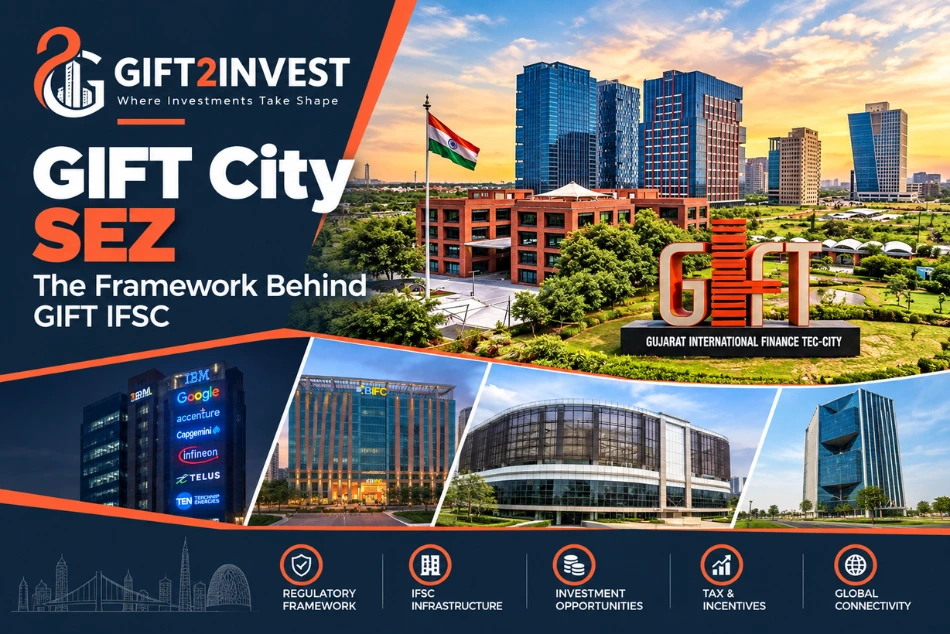
GIFT City SEZ: The Framework Behind GIFT IFSC
What Is GIFT City SEZ? Understanding the SEZ Framework for IFSC Units Most people run into…
-
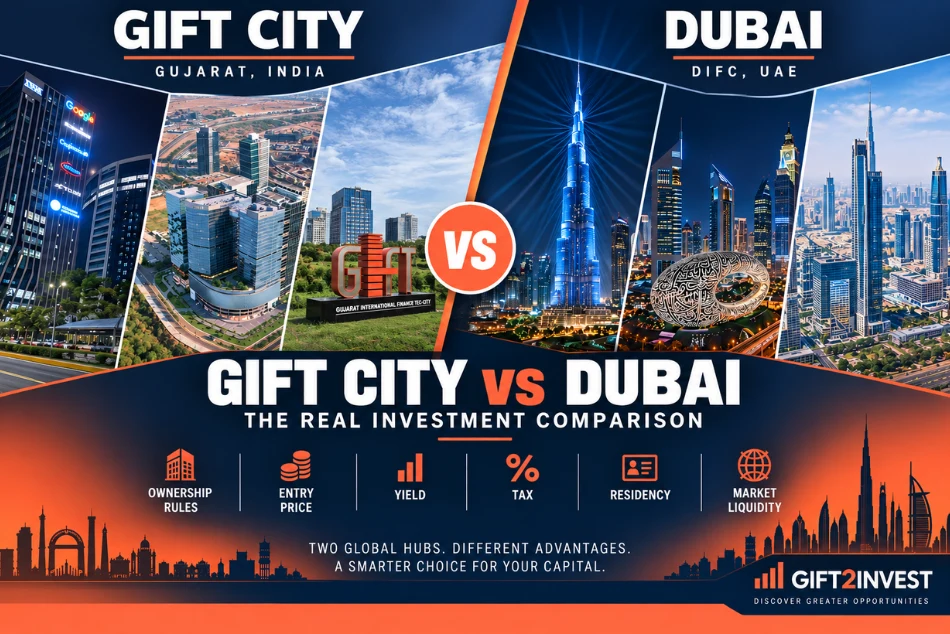
GIFT City vs Dubai: The Real Investment Comparison
GIFT City vs Dubai: Two Free Zones Built for the Same Global Capital The GIFT City…