
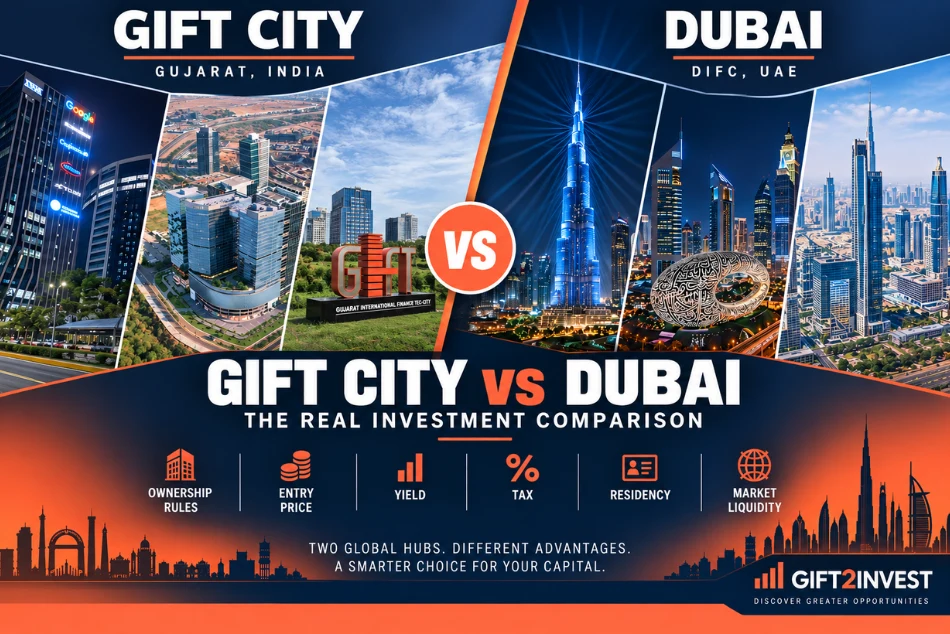
GIFT City vs Dubai: Two Free Zones Built for the Same Global Capital
The GIFT City vs Dubai question comes up constantly among NRIs, especially the large Gujarati and Indian diaspora based in the UAE. DIFC is a financial free zone with its own regulatory and court framework, while GIFT IFSC is India’s International Financial Services Centre within GIFT City, regulated by IFSCA under India’s legal framework.
One sits in Gujarat. The other sits on Sheikh Zayed Road. For an investor weighing where a serious chunk of capital should actually go, GIFT City vs Dubai is less about which city is “better” and more about which structure fits your money, your passport, and your timeline.
This article runs the comparison properly — regulation, ownership rules, entry pricing, yields, tax, and the residency angle that most comparisons skip entirely.
GIFT City vs Dubai: Side-by-Side Comparison
Before going section by section, here’s the full picture at a glance.
| Factor | GIFT City | Dubai (DIFC) |
|---|---|---|
| Established | Since 2015 (SEZ); IFSC operational from 2020 | Since 2004 |
| Regulator | IFSCA — single unified authority | DFSA, under English common law |
| Registered Entities | 1,147+ IFSCA registrations (March 2026) | 7,700+ active registered companies (H1 2025) |
| Banking Assets | USD 111 billion+ | N/A (broader UAE banking sector) |
| Office Ownership for Individuals | Eligible property: ownership may be available subject to title/project and buyer eligibility | Ownership varies by development and title; verify the specific property |
| Indicative Commercial Cost | Rs. 9,000 – 14,000 per sq ft | AED 250 – 350 per sq ft (annual lease) |
| Residential Entry Price | Approx. Rs. 10,500 per sq ft | Approx. AED 2,977 per sq ft |
| Commercial Gross Yield | 8% – 10+% | Leasehold model; not directly comparable |
| Residential Gross Yield | 8% – 9% | Approx. 6.8% (1BR apartments) |
| Personal Income Tax | Standard Indian tax rules apply to owner | 0% personal income tax |
| Residency Incentive | None (NRIs/OCIs already have entry rights) | Golden Visa: 5 years for qualifying real-estate investors from AED 2 million, subject to conditions |
| Currency of Property Transaction | INR, under FEMA | AED, freely convertible |
| Market Liquidity | Improving, still thinner | Deep, globally liquid |
What GIFT City and DIFC Actually Are
Dubai International Financial Centre, or DIFC, has been running since 2004. It’s a 110-hectare special economic zone on Sheikh Zayed Road, operating under its own English common law framework, separate from UAE civil law. Over 6,920 companies are now registered there.
GIFT City is younger. It’s India’s only International Financial Services Centre, spread across roughly 886 acres between Ahmedabad and Gandhinagar, regulated by the IFSCA. As of March 2026, GIFT IFSC has crossed 1,147 registrations and authorisations, with banking assets in the ecosystem past USD 111 billion.
Both were developed to attract international financial and business activity and provide dedicated regulatory and business environments.
Regulatory Framework: DFSA vs IFSCA
DIFC runs under the Dubai Financial Services Authority, or DFSA, with disputes settled in DIFC Courts under English common law principles. DIFC has operated under this framework for over two decades.
GIFT City runs under IFSCA — a single regulator covering banking, capital markets, insurance, and fund management, all under one roof since 2020. It’s newer, but it consolidates what used to be split across RBI, SEBI, IRDAI, and PFRDA.
Neither framework is stronger in the abstract. DIFC has the track record. GIFT City has the consolidation advantage and a government explicitly backing its expansion every year.
Real Estate Ownership: Who Can Actually Buy What
This is where GIFT City vs Dubai gets genuinely practical for a property buyer, and it’s the part most comparisons skip.
Ownership structures in DIFC vary by development and title arrangement. Some properties are freehold while others are leasehold, so an investor should verify the title and permitted ownership structure for the specific property.
GIFT City can offer direct ownership of eligible residential and commercial property, subject to applicable FEMA rules, the project’s title structure and the buyer’s eligibility. For NRIs and OCIs, RBI rules permit acquisition of immovable property other than agricultural land, farm house or plantation property, subject to the applicable conditions.
For someone considering direct ownership of a financial-district property, the relevant comparison is the specific property’s title, ownership eligibility, tenure and transaction structure in each market.
Price per Square Foot: GIFT City vs Dubai
Numbers make this comparison concrete faster than anything else.
DIFC Grade A office space leases in the AED 250 to 350 per square foot annual range, with some premium towers touching AED 500 to 1,200. Converted, that’s a genuinely expensive occupancy cost — well above what most Indian financial districts charge.
GIFT City commercial space is quoted in the article at Rs. 9,000 to Rs. 14,000 per square foot for ownership, with the cited gross-yield range applying to selected leased commercial stock. These figures should be treated as indicative market data, not a universal rate or yield.
On residential, DIFC apartments trade around AED 2,977 per square foot as of Q1 2026 — among Dubai’s most expensive addresses, behind only Palm Jumeirah and Jumeirah. GIFT City residential sits at roughly Rs. 10,500 per square foot city-wide. Even accounting for currency conversion, the entry price gap is substantial.
Rental Yields: A Genuinely Close Race
The article’s cited market source puts DIFC one-bedroom gross rental yield at around 6.8%; the figure is market-specific and should be checked against the latest project and transaction data.
The article’s cited figures place GIFT City residential gross yields at roughly 8% to 9% and selected commercial office yields at 10+%. These are not directly comparable across property types and should be treated as indicative ranges.
DIFC residential yield is influenced by Dubai’s rental market and tax environment. GIFT City commercial demand may benefit from the presence of IFSC businesses, but tenant demand, occupancy and lease duration still vary by building, tenant and market conditions.
Tax Treatment: Two Different Kinds of “Zero”
Dubai’s pitch is straightforward: no personal income tax, no capital gains tax on individual property sales, and Qualifying Free Zone Persons can benefit from a 0% UAE Corporate Tax rate on Qualifying Income, subject to the applicable conditions; this is not a blanket 0% rate for every DIFC company or every type of income.
Eligible GIFT IFSC units can access specific tax incentives subject to the applicable law and conditions, including the Section 80LA deduction framework for qualifying income. These incentives should not be presented as a blanket zero-tax regime for every GIFT City business or property owner.
Here’s the catch that applies to both cities equally, and gets misunderstood constantly: neither jurisdiction’s business tax advantages automatically extend to an individual buying property as a personal investment. A GIFT City apartment owner pays standard Indian income tax on rental income. A Dubai apartment owner pays no UAE income tax on rental income — a genuine, real difference in GIFT City vs Dubai that favours Dubai for a pure buy-and-rent residential investor who isn’t also running a business through the zone.
The Residency Angle Nobody Compares Properly
This is genuinely different between the two, and it matters more than most articles admit.
Dubai offers a Golden Visa route tied to qualifying real-estate investment. The UAE Government currently lists a 5-year Golden Visa for real-estate investors with a minimum capital requirement of AED 2 million, subject to the applicable conditions. That’s a real pull for Indian buyers who want a foothold, and eventually a base, outside India.
GIFT City does not have a separate property-linked residency visa. NRIs and OCIs have property-acquisition rights under applicable Indian rules, while their entry and stay in India are governed by the rules applicable to their status. The comparison isn’t really about which offers “better” residency. It’s about which one an investor is trying to solve for. Someone diversifying out of India wants Dubai’s visa. Someone consolidating capital back home doesn’t need one.
Currency, Repatriation, and What Moves Where
Property transactions in Dubai are denominated in AED, and the UAE generally does not impose India-style foreign-exchange repatriation controls. However, applicable banking, transaction and source-of-funds requirements still apply.
GIFT City real estate transactions happen in INR under standard FEMA rules, even though the IFSC’s financial products often run in foreign currency. Repatriation of sale proceeds by NRIs and OCIs is subject to FEMA and RBI rules, including the applicable funding source, authorised-dealer process and repatriation limits or conditions for the particular property and transaction.
Neither route is inherently more restrictive. Dubai gives cleaner offshore capital mobility. GIFT City gives NRIs a compliant, well-documented way to bring capital back into an Indian asset while keeping full FEMA transparency.
Liquidity and Risk: Dubai’s Depth vs GIFT City’s Runway
Dubai’s property market, including DIFC, is deep and liquid. There’s an active secondary market, established transaction data through the Dubai Land Department, and a buyer pool that spans the entire world, not just one country’s diaspora.
GIFT City’s secondary market is thinner. It’s improving as the entity count grows, but a forced exit on a tight timeline in GIFT City will generally take longer than the same exit in Dubai.
Dubai’s risk sits more in market cyclicality — Dubai real estate has been through sharp boom-bust cycles before, most visibly after 2008. GIFT City’s risk is different: concentration on IFSCA’s regulatory pace rather than a global property cycle. Both are real risks. They’re just not the same risk.
Why the Gujarati and NRI Diaspora in the UAE Should Read This Twice
A meaningful share of GIFT2Invest.com’s audience is exactly this buyer: someone who built wealth in Dubai, still holds property there, and is now looking at GIFT City as a way to bring a portion of that capital back to India without losing the international-standard infrastructure they’re used to.
GIFT City vs Dubai isn’t really an either-or question for this buyer. Many are already comfortable with Dubai’s ownership model and are now adding a GIFT City position specifically because it feels familiar — IFSC regulation, foreign-currency banking, English-language documentation — while sitting on Indian soil, closer to family, and priced at a fraction of DIFC’s entry cost.
Who Should Actually Choose Which
An investor prioritising a Golden Visa, tax-free personal income, and the deepest, most liquid property market in the region is generally better served by Dubai — DIFC specifically, if a financial-district address matters to them.
An NRI or OCI looking to consolidate a position back in India, buy outright freehold ownership of a financial-district office unit at a fraction of DIFC’s entry price, and benefit from a rapidly scaling regulatory ecosystem is better served by GIFT City.
Family offices and larger diaspora investors increasingly don’t pick one. A Dubai residential or DIFC commercial holding paired with a GIFT City position diversifies both jurisdiction risk and currency exposure — while giving the family a genuine reason to hold assets in both centres rather than choosing a side.
Wrapping Up: GIFT City vs Dubai Comes Down to What You’re Actually Solving for
GIFT City vs Dubai is not a contest with a single winner. Dubai offers depth, liquidity, tax-free personal income, and a residency route that GIFT City simply doesn’t try to compete with. GIFT City offers direct freehold ownership at a fraction of DIFC’s price, a regulatory ecosystem still early in its growth curve, and a natural fit for NRIs consolidating capital back into India.
The right answer depends entirely on what the investment is actually meant to do — diversify abroad, or come home with the same international standard you’re used to. For many serious diaspora investors, the smartest answer to GIFT City vs Dubai is not choosing one over the other, but holding a considered position in both.
GIFT2Invest.com carries current GIFT City residential and commercial listings with zone classification and project details specified upfront — a useful starting point once you know where your next allocation belongs.
FAQs: GIFT City vs Dubai
Q1) Is It Cheaper to Buy Property in GIFT City or Dubai?
GIFT City, by a wide margin on entry price. Commercial space runs Rs. 9,000 to Rs. 14,000 per square foot against DIFC’s AED 250 to 350 per square foot annual lease rate, and GIFT City residential sits well below DIFC’s roughly AED 2,977 per square foot.
Q2) Can I Get UAE Residency by Buying in DIFC, and Can I Get Something Similar With GIFT City?
Yes, subject to the applicable UAE conditions. The current UAE Government guidance lists a 5-year Golden Visa for real-estate investors with a minimum capital requirement of AED 2 million. GIFT City has no equivalent visa mechanism, since NRIs and OCIs already hold property and entry rights in India without needing one.
Q3) Which Gives Better Rental Yield, GIFT City or DIFC?
DIFC residential yields around 6.8% on one-bedroom apartments. GIFT City residential runs 8% to 9%, but GIFT City commercial office space, at 10+%, is competitive with or ahead of DIFC’s number.
Q4) Can an Individual Investor Actually Own Office Space in DIFC the Way They Can in GIFT City?
Not usually. Most DIFC office towers are leasehold, held institutionally or by developers, with individual freehold ownership concentrated in residential towers. GIFT City allows individual investors to directly buy freehold commercial units, including small office formats.
Q5) Is GIFT City Property Income Taxed the Same Way As Dubai Property Income?
No. Dubai has no personal income tax, so rental income from a Dubai property is not taxed in the UAE. A GIFT City property owner pays standard Indian income tax on rental income, regardless of the IFSC’s business-level tax benefits, which don’t extend to a personal property investor.
Q6) Should a Dubai-Based NRI Choose GIFT City or Continue Investing in Dubai?
A Dubai-based NRI may consider both markets depending on objectives such as jurisdiction, residency, liquidity, property type, tax treatment and currency exposure. The two markets have different regulatory and ownership structures, so the relevant comparison depends on the specific investment.
Sources & References
This article was checked against the following sources at the time of writing. Entity counts, banking assets, and pricing move regularly in both markets — always verify current figures before relying on them for a transaction.
GIFT City official portal — master plan, zone data, and ecosystem statistics: https://giftgujarat.in/ IFSCA — GIFT IFSC Key Highlights (1,147 registrations/authorisations; USD 111bn+ banking assets, as on March 2026)
https://www.ifsca.gov.in
ANI / Tribune — GIFT City IFSC banking assets cross USD 106.7 billion, February 2026
https://www.tribuneindia.com
PIB — GIFT City registered entities and foreign university framework, November 2025
https://www.pib.gov.in
DIFC — official district information and registered company data
https://www.difc.ae
Property Finder / Engel & Völkers — DIFC office rental rates, 2026
https://www.propertyfinder.ae/ and https://www.engelvoelkers.com/
D&B Dubai — DIFC residential price per sq ft and rental yield data, Q1 2026
https://dandbdubai.ae
UAE Government — Golden Visa eligibility for property investors
https://u.ae
Reserve Bank of India — Master Circular on Acquisition and Transfer of Immovable Property in India
https://www.rbi.org.in
IFSCA – current GIFT IFSC key highlights (June 2026)
https://ifsca.gov.in
DIFC – H1 2025 active registered companies
https://www.innovationhub.difc.ae/media-center/media-center-listing/difc-records-best-ever-performance-for-the-first-half-of-a-year
UAE Government – Golden Visa eligibility, updated February 2026
https://u.ae/en/information-and-services/visa-and-emirates-id/residence-visas/golden-visa
UAE Federal Tax Authority – Corporate Tax guide for Free Zone Persons
https://tax.gov.ae/en/media.centre/news/federal.tax.authority.issues.corporate.tax.guide.on.free.zone.persons.aspx
RBI – FEMA 21(R)/2018 immovable property regulations for NRI/OCI
https://m.rbi.org.in/scripts/BS_FemaNotifications.aspx?Id=11248
Dubai Land Department – investor rights and DIFC jointly-owned property reference
https://dubailand.gov.ae/media/wlzmuycr/know_your_rights.pdf?trk=public_post_comment-text
Source Note: Regulatory, pricing, and visa rules referenced in this article can change. Readers should confirm current figures with official sources and a qualified property or financial advisor before making an investment decision.