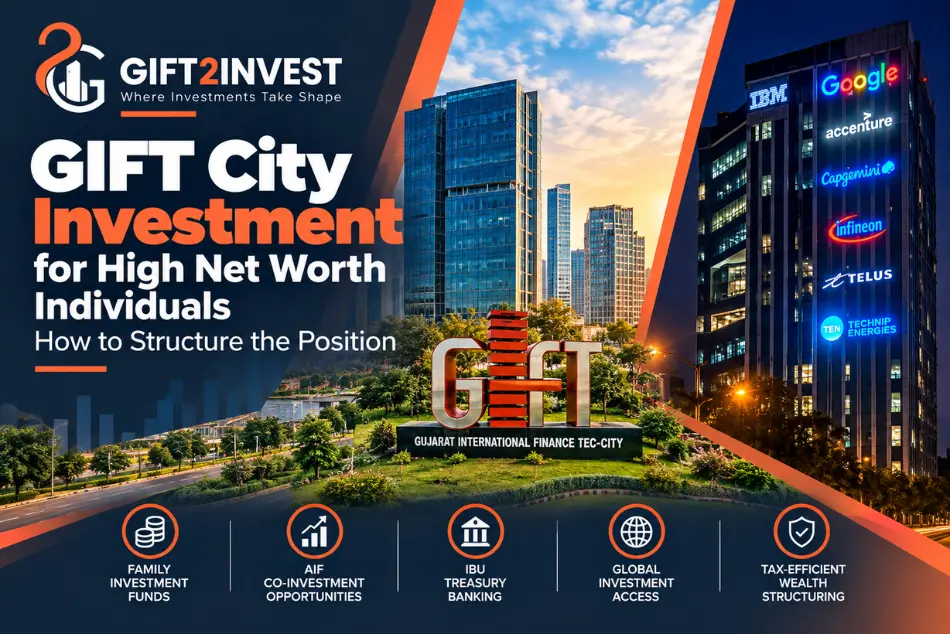
Gift City Investment for High Net Worth Individuals: The Question Is Not Whether, It’s How
For most investors, the GIFT City conversation is still about entry — whether to buy, which product to choose, what timeline to expect. Gift city investment for high net worth individuals operates at a different layer. The infrastructure is real, the regulatory framework is mature, and the binary buy-or-don’t-buy question has resolved itself for anyone who’s looked closely. The real question at HNI scale is structure. How do you deploy serious capital without concentration risk? Which legal entity gives you the most flexibility? And where does GIFT City sit in a larger wealth picture that includes international assets, private equity positions, and generational wealth goals?
This article skips the basics. It goes straight to the decisions that matter specifically when you’re deploying Rs. 10 crore or more across multiple GIFT City products.
The Family Investment Fund — What It Actually Enables
The Family Investment Fund (FIF) framework, introduced by IFSCA in 2022, is probably the most underused HNI structure in GIFT City. The minimum threshold is USD 10 million net worth for the family entity. That number exists because the FIF is built for single-family wealth management — not pooled retail products.
What an FIF actually does is give a large Indian family the ability to manage cross-border assets through an IFSC-regulated structure — with tax treatment comparable to what they’d get through a Singapore or Mauritius family office, but without routing capital offshore and without the compliance burden of maintaining a foreign entity.
The FIF can hold global equities, fixed income, real assets, private equity, and alternative investments. It can invest in IFSCA-registered AIFs and make direct investments. The investment universe is broad. The structure is flexible enough to handle the complexity that large family wealth actually involves.
What it is not is a property-holding vehicle — you wouldn’t use a FIF to hold residential apartments in GIFT City. But if a family already has real estate in the zone and wants to bring their investment portfolio and cross-border financial management under one regulatory roof, the FIF is how that happens. The property and the financial portfolio can coexist within a single GIFT City ecosystem without sitting in the same structure.
The comparison to Singapore is worth making explicitly. A Singapore Variable Capital Company (VCC) used for family office purposes carries annual compliance costs in the range of SGD 50,000 to SGD 150,000 before investment management fees. The IFSCA FIF framework creates a comparable regulatory wrapper at a fraction of that overhead, under a domestic regulator, with no requirement to relocate or maintain offshore substance. For Indian HNI families that previously saw Singapore as the only credible option, the FIF changes that calculation.
AIF Co-investment — The Tier Above Passive Fund Participation
Most investors who look at GIFT City AIFs think of them as passive vehicles: you commit capital, a fund manager deploys it, you receive distributions. For HNIs, that’s not the full picture.
Several IFSCA-registered fund managers in GIFT City offer co-investment rights to large limited partners. A co-investment means the fund manager brings a specific deal — an aircraft leasing transaction, a structured credit instrument, a private equity deal in financial services — to a limited number of large investors alongside the main fund. Same deal terms, lower or zero management fee on that capital, and direct exposure to a single asset rather than a diversified portfolio.
For an HNI with conviction on a specific sector, co-investing alongside a manager who has already completed the diligence gives targeted exposure without building proprietary deal sourcing infrastructure.
The threshold for co-investment access typically requires a Rs. 25 crore or above commitment to the main fund, though this varies by manager. Not every fund in GIFT City offers it. But for HNIs who qualify, it opens a category of deal access that doesn’t appear in standard fund listing data and isn’t available to smaller investors at any price.
IBU Relationship Banking at Scale — Beyond Fixed Deposits
Coverage of IBU (IFSC Banking Unit) products almost always focuses on fixed deposits. Tax-free interest, foreign currency denomination, no TDS. Those are useful products. They’re also entry-level compared to what IBU relationship banking offers large depositors.
For HNIs with significant business operations — particularly those with export revenue, import financing needs, or cross-border investment activity — an IBU relationship offers USD working capital facilities, commodity financing, trade finance structures, and foreign currency lending against global asset portfolios. These are treasury-level products, not savings products.
The economics are often better than domestic equivalents. USD borrowing rates at IBUs are tied to SOFR (Secured Overnight Financing Rate) rather than MCLR (Marginal Cost of Funds based Lending Rates), and the spread over benchmark for relationship clients with established deposits is typically tighter than what’s available through offshore syndicated lending for the same quantum of debt.
This is where gift city investment for high net worth individuals stops being about yield optimisation and becomes about how you run the entire financial operation.
IBUs operating in GIFT City — SBI, HDFC Bank, ICICI, Standard Chartered, Deutsche Bank, and others — have dedicated teams for HNI and corporate treasury relationships. If you have Rs. 500 crore or more in annual business turnover, the IBU conversation is about treasury management, currency hedging, and structured lending — not just parking capital in fixed deposits.
Commercial Property at HNI Scale — Corporate Treasury vs. Individual Investment
Most GIFT City commercial property articles frame the investment as: individual buys floor, individual earns rent. At larger scale, a different framing applies.
HNIs who operate business entities — family-owned companies, investment holding companies, operating businesses with treasury surplus — can buy commercial office space in GIFT City through a corporate entity. The property sits on the company’s balance sheet as a fixed asset. Depreciation is claimable. If the company has IFSC activities or plans to establish an IFSC presence, the property becomes an operational asset rather than a passive investment.
Several HNI families have established small IFSC offices for fund management, family office operations, or aircraft leasing SPV administration, and then purchased the office floor through their operating entity. The IFSC 100% income tax holiday on business profits runs for any 10 consecutive years within a 15-year window. That tax relief effectively reduces the carrying cost of the entire structure, including the property, across the holding period.
This is structuring-level thinking, not standard property investment. Whether it makes sense depends on the family’s existing business activities, tax position, and GIFT City operational plans. A chartered accountant who understands IFSC regulations and corporate real estate is the right person to model it — not a residential property consultant.
Premium Residential — The HNI Use Case Is Different
The residential story changes at HNI scale. For most investors, the question is whether a Rs. 1-3 crore apartment will appreciate and generate rental income. For an HNI, the residential decision is often about something else.
Senior executives placed on 2-3 year GIFT IFSC assignments by global banks carry employer housing allowances in the range of Rs. 80,000 to Rs. 1.5 lakh per month depending on seniority. An HNI who owns premium residential here — 3BHK, well-furnished, close to the IFSC towers — and can lease it to a global bank’s executive on a long corporate lease is accessing a tenant category that produces minimal management friction and consistent rent payment. The counterparty is a bank’s HR department, not an individual professional negotiating every renewal.
The second residential use case is the returning HNI NRI. Professionals who built careers in Singapore, Dubai, or London and are moving back to participate in India’s financial sector growth often see GIFT City premium residential as a functional end-use decision, not a yield calculation. The infrastructure quality, the walk-to-work model, the professional community are familiar from international financial centres they’re coming from. The premium pricing signals product quality rather than acting as a barrier.
Two universities are now active on campus in GIFT City — including Deakin University Australia. As university presence scales over the next two to three years, premium residential adjacent to both the IFSC core and the academic zone has two distinct demand pools feeding the same asset. That kind of structural demand overlap is uncommon in most Indian markets.
Structuring the Position — Individual, Trust, or Entity
How you hold GIFT City assets matters almost as much as what you buy. The decision has tax implications, succession implications, and operational implications that compound over the holding period.
Individual ownership works for residential property bought as a personal investment. Rental income flows through personal tax, capital gains follow standard Indian rules, and succession happens through standard estate mechanisms. Clean and simple.
An irrevocable discretionary trust is more complex to set up but creates clear succession pathways. For an HNI family with multiple GIFT City positions across residential and commercial, a trust structure prevents the fragmentation that individual ownership creates when assets pass to the next generation. Each property doesn’t need separate estate proceedings; the trust holds them as a portfolio.
For commercial IFSC property leased to IFSC-registered entities, holding through a closely held company can create depreciation advantages and can simplify exit — selling a company is sometimes structurally cleaner than transferring individual commercial assets, particularly when an institutional buyer wants a clean transaction. A listed REIT-compatible structure is also worth considering if the commercial portfolio reaches a scale that makes REIT inclusion viable.
The structural decision is harder to reverse than the property decision. Commit to a holding structure after professional advice, not as an afterthought after the purchase.
GIFT City vs. Singapore and Mauritius — The HNI Comparison That Matters
Indian HNIs with cross-border wealth have historically used Singapore and Mauritius as their preferred offshore structures. Both are under pressure. Mauritius has lost treaty benefits for capital gains tax on Indian equities since 2016. Singapore’s Economic Substance Requirements have made it more expensive to maintain genuine substance there. The days of a brass-plate Singapore company holding Indian assets at near-zero cost are substantially over.
GIFT City’s FIF and AIF structures compete directly with what Singapore and Mauritius offered — but they do it onshore, under a domestic regulator, without the substance requirements that have made offshore maintenance expensive. For capital that was already planning to repatriate, or for new wealth that was never going offshore in the first place, GIFT City is the cleaner structure.
The caveat: GIFT City doesn’t help with assets already held in mature offshore structures. If a family has a Cayman AIF or a Singapore trust holding significant assets, restructuring that into a GIFT City FIF is a complex exercise with tax and legal implications. The FIF is better positioned as a forward-looking structure for new capital than as a replacement for existing offshore setups.
Exit Options at HNI Scale
The exit picture for large GIFT City positions is different from what a retail investor faces. Small residential units are dependent on the individual secondary market. Large positions have additional options.
Institutional block sales of well-leased IFSC commercial space are the cleanest exit for commercial portfolios above Rs. 30-50 crore. REITs, PE funds, and family offices are all active in GIFT City quality commercial stock. A commercial floor with a 5-year institutional lease and IFSC zone classification has a realistic institutional buyer universe.
REIT-eligible structures are worth planning for at the time of acquisition if the commercial portfolio is likely to reach Rs. 100 crore or above. Listing a commercial portfolio via a REIT gives the broadest possible exit liquidity and tends to command a premium over direct sale because it opens the investor base to entities that can’t do direct property.
Family-to-family transfers are a third exit path that doesn’t get discussed enough. As the HNI community invested in GIFT City grows, secondary transactions between families — commercial floors, residential portfolios, even FIF stakes — will become more common. Having a clean holding structure from the outset makes these transactions faster and cheaper.
Wrapping Up: Gift City Investment for High Net Worth Individuals Is a System, Not a Single Bet
Gift city investment for high net worth individuals isn’t a single product decision. It’s a set of connected decisions across real estate, financial instruments, operating structures, and generational wealth goals within one of India’s most policy-backed financial ecosystems.
The FIF brings cross-border portfolio management onshore. AIF co-investment rights deliver deal-level access that passive fund allocation can’t match. IBU relationship banking manages treasury and USD exposure at business scale. Commercial property — through a corporate entity where appropriate — generates IFSC income that sits favourably within the tax holiday framework. Premium residential with institutional tenants provides a low-friction income stream anchored by employer housing allowances.
The pieces work better together than separately. An HNI who deploys across two or three of these structures in a connected way gets more from each than someone who treats them as standalone positions.
GIFT City’s fundamentals support the long-term case: 1,000+ operational entities, USD 100 billion in banking assets, two active university campuses as of 2025-26, ongoing IFSCA regulatory expansion, and infrastructure that runs at international standards. Gift city investment for high net worth individuals who understand the structural layer — not just the product layer — are the ones positioned to capture that case fully.
FAQs: GIFT City Investment for High Net Worth Individuals
Q1) What Is the Minimum to Set Up a Family Investment Fund in GIFT City?
USD 10 million net worth for the family entity, per IFSCA’s FIF framework introduced in 2022. The structure is designed for single-family wealth management only. It’s not a pooled vehicle and it’s not available to multi-family or unrelated investor groups.
Q2) Can HNIs Access Co-investment Rights Alongside GIFT City AIFs?
Some IFSCA-registered fund managers do offer co-investment rights to large LPs. This is typically available to investors who have committed at a significant anchor size to the main fund. It isn’t universal and it isn’t advertised widely. Ask fund managers specifically about co-investment terms before committing.
Q3) Is an IBU Fixed Deposit the Main Product for HNIs at GIFT City?
The fixed deposit is the entry-level IBU product. IBUs also offer USD lending facilities, trade finance, commodity financing, and treasury management products for business relationships. For HNIs with significant business operations, the treasury relationship is typically more valuable than the deposit.
Q4) Should GIFT City Commercial Property Be Held Personally or Through a Company?
Depends on whether the company has or plans IFSC business activity, the family’s existing holding structure, and the intended exit strategy. Corporate ownership can create depreciation advantages and simplify institutional sales. Individual ownership is simpler but less flexible at exit. Get specific advice from a CA familiar with IFSC regulations before deciding.
Q5) How Does GIFT City Compare to Singapore Structures for HNI Wealth Management?
GIFT City’s FIF and AIF frameworks offer comparable regulatory treatment to Singapore family office structures, but onshore, without the substance requirements that have made Singapore maintenance increasingly expensive. The FIF works best as a structure for new capital. Restructuring existing offshore holdings into a FIF involves its own tax and legal complexity and needs separate professional advice.
Q6) What Are the Best Exit Options for Large GIFT City Commercial Positions?
Institutional block sales are the cleanest exit for well-leased IFSC commercial stock above Rs. 30-50 crore. REIT-eligible structuring from the outset opens the broadest exit liquidity for larger portfolios. Family-to-family secondary transfers are a growing option as the HNI investor community in GIFT City deepens. Individual secondary market exit is slower and depends on retail buyer availability.