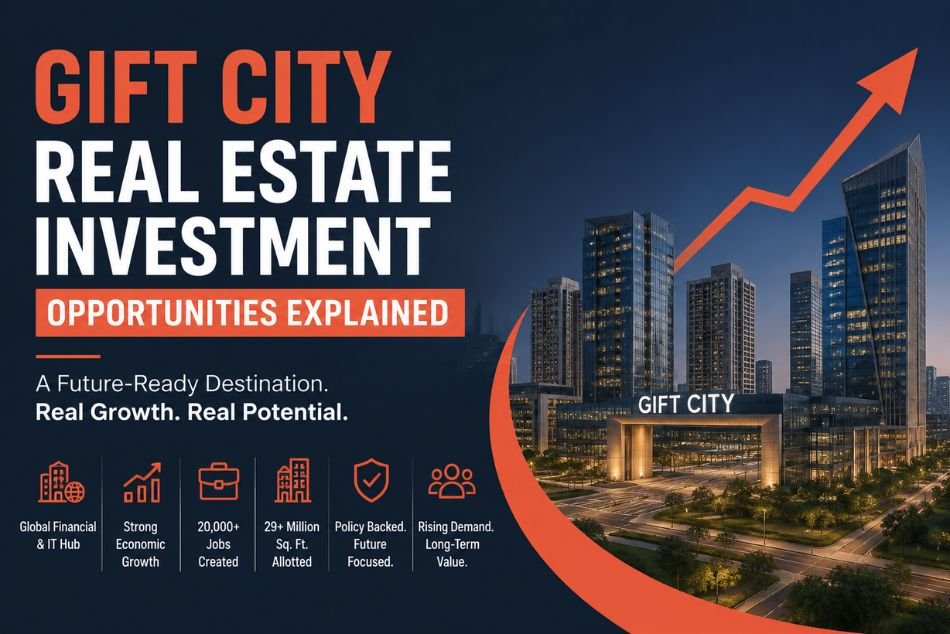
GIFT City Real Estate Investment Opportunities Are Reshaping Gujarat’s Property Market
GIFT City real estate investment opportunities are no longer limited to institutional investors or large corporate occupiers. They are now becoming a serious consideration for business owners, HNIs, NRIs, long-term investors, and even end users who want to invest in a location built around finance, technology, infrastructure, and smart urban planning.
Unlike many conventional micro-markets that expand first and get organized later, GIFT City is developed with a clear economic purpose from the beginning. It’s designed to become a world-class finance and IT destination with integrated commercial, residential, and social infrastructure, which makes it very different from a typical real estate growth corridor.
That difference matters because most real estate markets in India are shaped by city sprawl, traffic issues, uneven infrastructure, and unplanned commercial growth. GIFT City, on the other hand, has been envisioned as a modern business district with global ambitions. It brings together India’s first operational International Financial Services Centre (IFSC), a Special Economic Zone (SEZ), smart infrastructure, and a walk-to-work urban model.
As a result, the demand story here is not being driven only by marketing or speculation. It is being supported by employment growth, policy backing, financial activity, business expansion, and long-term ecosystem development. That is what makes GIFT City more than just another emerging location. It positions the city as a strategic investment destination with real estate potential attached to a much larger economic vision.
If you are evaluating GIFT City as an investment market, the right way to look at it is not as a standard township or isolated property zone. It should be seen as a future-focused financial and commercial ecosystem where real estate value is closely linked to infrastructure, business demand, and long-term urban relevance.
What Makes GIFT City Different From a Typical Real Estate Destination?
To understand the investment case, you first need to understand what GIFT City actually is.
GIFT City, or Gujarat International Finance Tec-City, is positioned as a global financial and technology hub. It is built to support sectors such as banking, capital markets, insurance, fund management, fintech, aircraft leasing, ship leasing, global in-house centres, and ancillary services. The official ecosystem is designed around both international financial services and domestic business activity, making it a rare hybrid destination in India. (Gift Gujarat)
This matters for property because demand in GIFT City is not dependent on one sector alone. It is tied to:
- Financial services expansion
- Corporate office demand
- Talent migration
- Residential absorption
- Retail and social infrastructure growth
- Institutional ecosystem development
In simpler terms, the real estate market here has an economic engine behind it.
The official GIFT platform highlights more than 29 million sq. ft. allotted, over 1,000 entities operational, and 20,000+ jobs generated, with banking asset size in the ecosystem exceeding USD 100 billion as of September 2025. These numbers show that GIFT City is no longer just a planned vision, but an actively growing financial and business ecosystem.
More recent official tender documents also indicate that around 29.45 million sq. ft. has been allotted, with 25 buildings operational, 38 under construction, and 8 under planning. They also suggest that employee numbers are expected to rise significantly by 2030, reinforcing the city’s long-term growth potential. (Gift Gujarat)
That is not early-stage speculation anymore. That is ecosystem formation.
Why GIFT City Real Estate Investment Opportunities Are Attracting Serious Investors
There are many emerging real estate stories in India, but only a few have a combination of policy backing, infrastructure readiness, employment generation, and global positioning. GIFT City checks all four.
1) It Is Demand-Led, Not Purely Marketing-Led
A lot of real estate in India is sold on future promises. GIFT City is different because office demand, institutional participation, and regulatory relevance are already present. When financial institutions, multinational firms, and service providers establish a presence, real estate demand follows naturally.
2) It Is a Limited Geography With Controlled Development
Scarcity matters in real estate, but it matters even more in a high-intent business district. GIFT City’s development is structured and finite, not endless. This naturally creates stronger long-term pricing power than oversupplied suburban corridors.
3) It Has Infrastructure That Actually Supports Premium Valuation
Premium pricing cannot survive on brochure language alone. It needs roads, power, water, cooling systems, utilities, security, and urban efficiency. GIFT City has been designed with integrated smart-city infrastructure including utility tunnels, district cooling, smart water systems, power infrastructure, command and control systems, and automated waste management. (Gift Gujarat)
4) It Aligns With Where India Wants to Grow
Macro themes matter. India is pushing formalization, financialization, global capital access, digital governance, and institutional expansion. GIFT City fits directly into that national growth story.
That is why GIFT City real estate investment opportunities appeal not just to local buyers from Ahmedabad and Gandhinagar, but also to investors from Mumbai, Delhi, Bengaluru, Dubai, Singapore, and the NRI community.
The Core Real Estate Segments in GIFT City
When people say “invest in GIFT City,” they often talk as if it is one single property market. It is not. There are multiple layers to the opportunity.
1) Commercial Office Real Estate
This is arguably the strongest foundational segment in GIFT City.
Commercial real estate in GIFT City benefits from:
- Corporate occupier demand
- Financial institutions
- Global capability centres
- Professional services firms
- Leasing-led absorption
- Long-term ecosystem stickiness
This is important because commercial demand is one of the strongest factors that gives credibility to a real estate market. As companies expand, office demand supports rental yields, footfall, employee movement, and eventually residential absorption.
For investors, this means commercial property in GIFT City is not just about “buy office, earn rent.” It also reflects participation in a district where business activity is expected to strengthen over time.
2) Residential Real Estate
Residential is where many retail investors get interested first, but it should be evaluated carefully.
GIFT City is not primarily a residential suburb. It is a business-led urban district. That is a positive.
Why?
Because residential demand here can be more quality-driven than speculative. The official planning mix cited in recent GIFT documents indicates a development potential of up to 62 million sq. ft., comprising roughly 67% commercial, 22% residential, and 11% social space. (api.giftgujarat.in)
That means residential supply is structurally limited compared to the commercial backbone. In many markets, too much residential supply kills pricing. In GIFT City, the relatively smaller residential share may actually support stronger long-term value if employment and occupancy continue to rise.
3) Mixed-Use and Support Assets
As office and residential density increase, support categories become more relevant:
- Retail
- Food and beverage
- Hospitality
- Serviced apartments
- Social infrastructure
- Convenience-led spaces
These are often overlooked by early investors, but they can become very valuable once a district matures.
The Real Driver: Employment, Occupancy, and Ecosystem Expansion
The biggest mistake investors make is focusing only on launch prices and resale premiums.
In a location like GIFT City, the real question is:
Will more people work, operate, lease, live, and transact here over the next 5 to 10 years?
If the answer is yes, the investment thesis becomes stronger.
Official GIFT materials and tender documents show a city that is already functioning and still expanding. The platform highlights more than 1,000 operational entities, while recent documents point to a growing number of operational and under-construction buildings. Projections in official documents also indicate that the employee base could rise significantly by 2030, alongside a growing residential population. (Gift Gujarat)
That combination is critical.
Because in real estate, jobs create occupancy, and occupancy creates durable demand.
This is what separates a true investment zone from a “story market.”
Infrastructure: The Part Most Buyers Underestimate
People often say infrastructure matters, but most do not fully appreciate how much it influences property value.
In GIFT City, infrastructure is not just a support layer. It is part of the investment thesis.
The official ecosystem emphasizes:
- Utility tunnel systems
- District cooling
- Smart water infrastructure
- Strong power infrastructure
- City command and control systems
- Automated waste management
- Walk-to-work planning
- 24/7 security environment (Gift Gujarat)
Why does this matter for real estate?
Because better infrastructure can improve:
- Tenant appeal
- Operational efficiency
- Corporate leasing confidence
- Resident quality of life
- Asset longevity
- Premium perception
This is especially important for commercial and premium residential properties, where occupiers are paying not just for square footage, but for convenience and reliability.
In many Indian cities, infrastructure is reactive. In GIFT City, it is part of the core design.
That is a major edge.
Is GIFT City Better for Capital Appreciation or Rental Income?
The honest answer is: it depends on what you buy and when you buy it.
If Your Goal Is Capital Appreciation:
You are betting on:
- Future ecosystem maturity
- Stronger occupier density
- Limited high-quality supply
- Brand-led project appreciation
- Rising investor confidence
This works best when you enter at the right stage, in the right project, with realistic holding expectations.
If Your Goal Is Rental Income:
You need to focus more on:
- Actual demand, not brochure assumptions
- Tenant profile
- Possession timeline
- Usable product, not just attractive layouts
- Whether the property fits the local occupier base
Commercial assets may offer stronger rental logic in some cases, while residential may appeal more to end users and selective investors depending on supply and project positioning.
The key point is this:
Do not buy in GIFT City assuming every property will perform equally.
That is not how high-potential markets work.
The location may be strong, but asset selection still matters.
Who Should Seriously Consider Investing in GIFT City?
GIFT City is not for every buyer. But for the right investor, it can be highly strategic.
Ideal Investor Profiles Include
- Long-Term Investors: People willing to hold for 5 to 10 years rather than expecting instant flips.
- Business Owners and Professionals: Especially those who understand the value of being close to a growing financial and commercial hub.
- HNIs and NRIs: Investors looking for premium, future-facing, institution-backed real estate exposure in Gujarat.
- Commercial Property Investors: Those who prefer leasing, rental yield, and business district-led demand.
- End Users With Future Lifestyle Intent: Buyers who want to live in a planned, modern, high-quality urban environment close to work and services.
Who Should Be Cautious?
- Buyers looking for ultra-cheap entry points
- Short-term speculative flippers
- People expecting overnight appreciation
- Investors who buy only based on launch hype
GIFT City has strong fundamentals, but it still rewards patient, informed capital more than impulsive buying.
Risks You Should Not Ignore
A good investment article should not only sell upside. It should also explain risk.
So let’s keep this grounded.
1) Pricing Can Already Feel Premium
Because of the location narrative and institutional relevance, some assets in GIFT City may already be priced aggressively. That does not automatically make them bad investments, but it means you need to assess value carefully.
2) Not Every Project Will Age Equally Well
In strong micro-markets, weaker projects can still sell. But over time, quality differences become obvious. Brand, construction quality, maintenance, tenant fit, and execution matter.
3) Residential Demand May Not Move Uniformly
Even if the ecosystem is growing, not every residential product type will absorb at the same pace. Configuration, ticket size, and livability matter.
4) Timelines Matter
A market can be promising and still move slower than expected in certain phases. Investors should avoid assuming linear growth every year.
5) Liquidity Varies by Asset Type
Some properties are easier to lease or resell than others. Commercial, residential, and mixed-use inventory do not behave the same way.
This is why serious investing in GIFT City should be driven by strategy, not excitement.
Why GIFT City Can Become One of Gujarat’s Most Important Real Estate Corridors
If you zoom out, the long-term case becomes clearer.
GIFT City is not trying to compete with every area in Ahmedabad or Gandhinagar on conventional housing volume. It is building a more specialized identity.
Its strength lies in becoming:
- A financial district
- A global business destination
- A premium commercial ecosystem
- A modern urban hub with structured live-work potential
That makes it less comparable to generic city expansion zones and more comparable to high-intent economic corridors.
The best real estate wealth in India has often been created where:
- Policy supports growth
- Jobs come first
- Infrastructure is ahead of demand
- Land and supply remain relatively controlled
GIFT City fits that framework better than most emerging micro-markets.
And that is exactly why GIFT City real estate investment opportunities continue to gain attention among serious investors rather than only retail speculators.
How to Evaluate a GIFT City Property Before You Invest
If you are planning to buy, do not stop at “location is good.”
Use a sharper checklist.
Look at These 10 Factors
- Project Type: Residential, commercial, mixed-use, office, or leasing-focused?
- Developer Credibility: Execution history matters more than brochures.
- Possession Timeline: Under-construction and near-ready investments behave very differently.
- End-User Fit: Who will actually live here or lease here?
- Yield Potential: Is the rental story backed by actual demand?
- Micro-location Within GIFT City: Even within a strong market, placement matters.
- Investment Horizon: A 2-year mindset and a 10-year mindset lead to very different buying decisions.
This is where many investors go wrong. They buy a “good location” but a weak asset.
In GIFT City, that mistake can be expensive because the market is more strategic and premium than average.
The Bigger Conclusion: GIFT City Is Not Just a Trend, It Is a Structural Story
A lot of real estate headlines fade after one cycle.
GIFT City looks different because it is tied to structural themes:
- India’s financial modernization
- Global capital connectivity
- Institutional growth
- Business-friendly planning
- Smart infrastructure
- Integrated urban development
That does not mean every launch is automatically a great deal. It does mean the location itself deserves serious attention.
The smartest way to approach this market is not to ask:
“Will GIFT City go up?”
A better question is:
“Which assets in GIFT City are positioned to benefit most from long-term ecosystem growth?”
That is where serious wealth is created.
Final Thoughts on GIFT City Real Estate Investment Opportunities
In the coming years, GIFT City real estate investment opportunities are likely to be judged not just by Gujarat standards, but by how well the city evolves into India’s most credible finance-led urban district. The foundation already exists: operational business activity, institutional relevance, integrated infrastructure, limited residential share, expanding commercial footprint, and a policy-backed growth framework. (Gift Gujarat)
For investors, that creates a rare situation. You are not only buying into a property market. You are buying into an economic ecosystem.
And when real estate is backed by jobs, infrastructure, regulation, and long-term intent, the upside tends to be much more durable.
That is what makes GIFT City real estate investment opportunities worth serious consideration today.
FAQs About GIFT City Real Estate Investment Opportunities
Q1) Is GIFT City a Good Place for Real Estate Investment?
Yes, GIFT City is considered one of Gujarat’s most promising real estate destinations because it combines strong infrastructure, policy support, commercial growth, and long-term development potential. It is not just a residential market, but a planned financial and business hub.
Q2) Why Are GIFT City Real Estate Investment Opportunities Gaining Attention?
GIFT City real estate investment opportunities are attracting attention because the area is backed by India’s financial ecosystem, smart city planning, office demand, and limited structured supply. Investors see it as a long-term growth corridor rather than a short-term speculative market.
Q3) Is GIFT City Better for Residential or Commercial Investment?
Both segments have potential, but they serve different investment goals. Commercial properties may suit investors looking for business-led demand and rental potential, while residential properties may appeal more to end users and long-term capital appreciation seekers.
Q4) Can Residential Property Prices in GIFT City Rise in the Future?
Yes, residential property prices in GIFT City have already shown a strong upward trend and may continue to rise as the area evolves further. According to Housing.com market trend data, the average residential property rate in GIFT City is around Rs. 11,964 per sq. ft., reflecting an overall 165% growth since 2020 in residential pricing alone. (Housing.com)
This indicates that GIFT City’s residential market has already experienced significant appreciation over the past few years. However, it is important to note that this trend currently reflects residential property prices only, not the entire GIFT City real estate market. With rising business activity, increasing employment, and relatively limited residential supply, quality residential projects may continue to see long-term demand.
Q5) Who Should Invest in GIFT City Real Estate?
GIFT City may be suitable for long-term investors, HNIs, NRIs, business owners, professionals, and buyers looking for premium, future-ready real estate. It may not be ideal for people expecting very fast short-term returns.
Q6) Is GIFT City Only for Commercial Investors?
No, GIFT City is not only for commercial investors. While its commercial identity is strong, residential and mixed-use developments are also becoming increasingly relevant as the area grows into a complete live-work ecosystem.
Q7) What Makes GIFT City Different From Other Real Estate Locations in Gujarat?
GIFT City stands out because it is a purpose-built financial and technology hub with planned infrastructure, global positioning, modern urban design, and institutional support. Most traditional locations grow organically, but GIFT City has been strategically developed from the ground up.
Q8) Are GIFT City Real Estate Investment Opportunities Suitable for Long-Term Wealth Creation?
Yes, they can be suitable for long-term wealth creation if the investment is made in the right project, at the right price, and with a realistic holding period. The strongest opportunities usually come from strategic asset selection rather than hype-driven buying.
Q9) What Should Buyers Check Before Investing in GIFT City?
Buyers should evaluate the developer, project type, location within GIFT City, demand potential, possession timeline, rental prospects, pricing, and future resale potential. A good location alone does not guarantee a good investment.
Q10) Is Now the Right Time to Invest in GIFT City?
That depends on your budget, investment horizon, and property type. For long-term investors, entering during the growth and expansion phase can be beneficial, provided the project is selected carefully and not bought only because of market buzz.