GIFT City Homes for Self Use Are a Different Decision Than GIFT City Investment
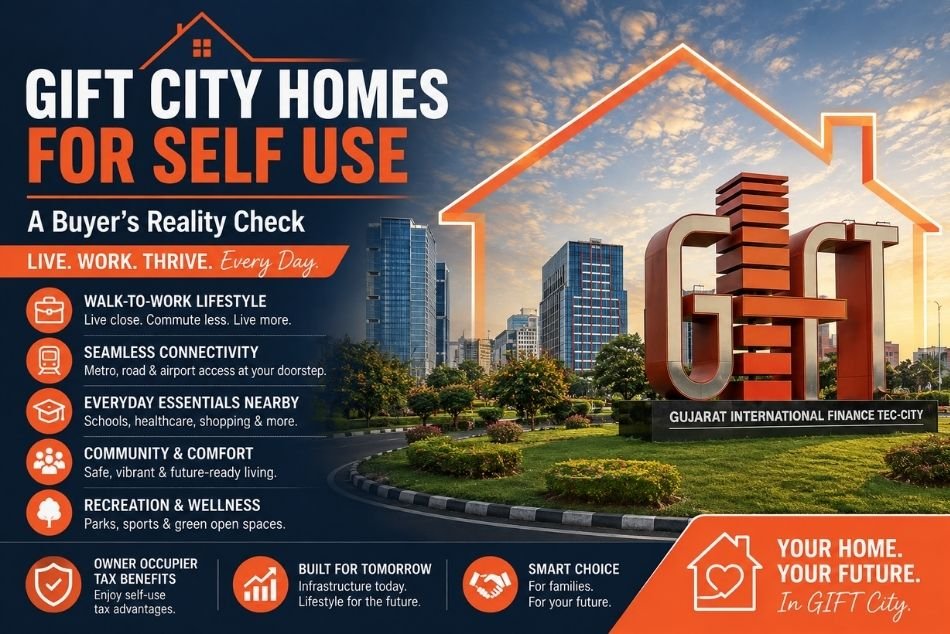
Most of what gets written about GIFT City property is written for investors. Yield tables, appreciation curves, exit timelines. None of that answers the question a self-use buyer is actually asking: will my family be comfortable living here, today, not in some projected version of the city five years out. Gift city homes for self use need to be judged on livability first and price second — the opposite order most listings push you toward.
This article is written for that buyer. Not the investor looking for a tenant, but the person who plans to wake up here, send their kids to school nearby, see a doctor when needed, and build an actual life within GIFT City’s boundary. The questions that matter are different, and so are the answers.
Who Actually Buys for Self Use in GIFT City
Three buyer types dominate the self-use segment: a working professional inside GIFT IFSC who wants to cut the daily commute from Ahmedabad or Gandhinagar entirely, a senior executive on a multi-year posting treating the purchase as a long-term home rather than a short lease, and a returning NRI who wants a base in India that feels familiar in standard and pace to the international financial centres they are coming from.
None of these three are thinking about rental yield. They are thinking about whether the daily mechanics of life — school runs, grocery shopping, a hospital visit, a weekend with the kids — actually work inside GIFT City right now, not on a master plan timeline.
The Walk-to-Work Promise, Tested Against Real Daily Life
GIFT City’s walk-to-work design is real, not marketing language. Residential towers sit within a genuine short distance of the commercial core. For a self-use buyer who actually works inside the IFSC zone, this removes the single biggest daily friction point that every other Indian city imposes on its workforce: the commute.
But walk-to-work only delivers its full benefit if your workplace is inside GIFT City. If you work in Ahmedabad and are buying a GIFT City home for self use purely for the lifestyle and infrastructure, you are trading a shorter in-city walk for a longer daily drive to your actual office. That trade-off needs to be honest in your own head before you sign anything — the city’s planning logic assumes your job is here too.
Walk-to-work is a real feature of the city. It is not a feature of your specific commute unless your office is actually inside the boundary.
Connectivity Just Changed — And It Matters More for Self Use Than for Investment
The Ahmedabad Metro’s Violet Line extension to GIFT City went operational in January 2026. For an investor, this is a future catalyst to model into appreciation assumptions. For a self-use buyer, it is something more immediate: a working transport link, today, connecting GIFT City to the wider Ahmedabad-Gandhinagar metropolitan area without depending on a car.
That matters for a family in ways an investor’s spreadsheet does not capture. A spouse who works in Ahmedabad now has a transit option that did not exist a year ago. Teenagers who want independent mobility have one too. Visiting family and friends from outside the city have an easier route in. This is one of the most concrete livability upgrades GIFT City has delivered recently, and it changes the self-use calculation more than most other recent developments.
Schools: What Is Actually Operating, Not What Is Planned
Jamnabai Narsee School is operational within GIFT City and remains the primary K-12 option physically inside the boundary. For families with younger children, this is the school most self-use buyers will evaluate first — and it is worth visiting in person rather than relying on a developer’s brochure description of it.
On the higher-education side, two Australian universities — Deakin University and the University of Wollongong — now run active campuses inside GIFT City. That is a genuine milestone, but it is not the same thing as a deep K-12 school ecosystem. Families with multiple children across different age groups, or families seeking a specific curriculum (IB, ICSE, a particular international board), should check current admission availability and curriculum fit directly with Jamnabai Narsee rather than assume GIFT City offers the same range of school choice as an established residential suburb in Ahmedabad.
The honest picture for gift city homes for self use right now: one well-regarded school is running, two universities are active, and the ecosystem is still thinner than what you would find in Bodakdev or Satellite. It is improving quickly, but “improving quickly” and “already there” are different claims, and a self-use buyer should not confuse the two.
Healthcare: A Hospital Has Opened, but Read the Fine Print
Lilavati Hospital has begun operations inside GIFT City — a meaningful and recent development. OPD services and free medical camps started first, and the facility is being built out in phases toward a planned 375-bed multi-specialty hospital, with roughly 120 beds expected in the first phase and full operational scale targeted by March 2027.
For a self-use buyer evaluating day-to-day healthcare access, this means outpatient consultations and basic medical camps are available within GIFT City today. It does not yet mean full emergency, surgical, and specialist capacity at the scale a family would eventually want for serious medical situations. Until the later phases complete, residents are still reasonably likely to head into Ahmedabad for anything beyond routine care.
This is not a reason to avoid buying. It is a reason to plan around the current phase honestly rather than assume the brochure description of the finished hospital applies to the city as it stands the day you move in.
Daily Errands: Retail, Groceries, and the Small Things That Add Up
Day-to-day convenience is improving but is still the area where GIFT City lags an established Ahmedabad neighbourhood the most. Land has been allotted for a D-Mart inside the city, which will materially help once it opens — grocery access is one of the most-cited daily friction points among current residents.
In the meantime, the GIFT City Club, F&B options within the commercial towers, and a gradually expanding retail layer cover the basics, but a household doing a full weekly grocery run or wanting a wider restaurant choice still benefits from proximity to Ahmedabad and Gandhinagar. Most current residents treat this as a short drive rather than a dealbreaker, but it is worth experiencing yourself before committing, not just reading about.
Choosing a Configuration for Living, Not for a Tenant Profile
Investor-focused content tells you to size your unit to match the renter pool — studios and 1BHKs for fast turnover, 2BHKs for the dominant corporate tenant. None of that logic applies when you are buying gift city homes for self use. The right configuration is the one that fits how your own household actually lives, not a hypothetical tenant’s preferences.
A few practical points specific to self-use buyers. If you have school-age children, proximity to Jamnabai Narsee School and to a residential cluster with other families matters more than proximity to the commercial towers. If you are a single professional or a couple without children, a smaller unit closer to the IFSC core genuinely does maximise the walk-to-work benefit. If you are a returning NRI planning a longer-term family base, factor in guest space and storage in a way a pure rental-yield calculation never would, since you are not optimising for turnover.
Furnishing decisions also look different for self use. Rental-focused buyers furnish to shorten vacancy periods and lift achievable rent. A self-use buyer furnishes for how they actually want to live — which may mean spending more on permanent fixtures and less on the kind of generic furnished look that appeals to a relocating tenant.
What Self-Use Buyers Should Actually Check Before Signing
The due-diligence checklist for a self-use purchase overlaps with an investor’s checklist in places, but the priorities shift.
- Visit the specific school and, if relevant, the university campuses in person, not just on the developer’s site map.
- Confirm the current phase of Lilavati Hospital’s rollout and what services are actually live versus still under construction.
- Check the Violet Line metro station location relative to the specific tower you are considering — walking distance to a station differs building by building.
- Ask current residents, not just the sales team, what their actual weekly routine for groceries, fuel, and errands looks like.
- Confirm RERA registration and the developer’s GIFT City-specific delivery history, since a stretched possession timeline affects a family’s moving plans far more directly than it affects a pure investor’s spreadsheet.
- Get the maintenance charge per square foot in writing — GIFT City’s infrastructure quality comes at a real, recurring cost to the household budget, not just to a rental yield calculation.
Community Life: What It Feels Like to Actually Live There
Investment articles rarely touch this, because community fabric does not show up in a yield table. For a self-use buyer, it is one of the most important factors. GIFT City is still a young residential community by the standards of an established Ahmedabad neighbourhood, and that has both an upside and a downside.
The upside is that the resident base skews toward people in a similar life stage — working professionals, many in financial services or fintech, several internationally mobile. Families with children attending Jamnabai Narsee School naturally cross paths at pickup and at the GIFT City Club, which functions as the de facto community centre right now. For a newcomer, that overlap makes it easier to build a social circle quickly compared with moving into an already-settled suburb where social groups are long established.
The downside is scale. The number of occupied residential towers is still limited, so the pool of neighbours and informal community events is smaller than a mature locality offers. Some early residents compare it to moving into a new, well-funded gated community — quiet on weekday evenings, livelier as more towers fill up, and dependent on a handful of common spaces for most community life. That is a fair trade for many buyers and a real adjustment for others, worth weighing honestly before treating gift city homes for self use as a full-time address rather than a part-time one.
Parks, Security, and Recreation: What’s Landing Over the Next Year
Security infrastructure is one area where GIFT City clearly outperforms a typical Indian residential locality. The city runs 24/7 surveillance through its City Command and Control Centre, and the underground utility design means residents are not dealing with the open cabling, water tankers, or street-level maintenance disruptions that are routine in most Indian cities. For a family prioritising safety and predictable infrastructure, this is a genuine, daily, lived benefit — not a brochure claim.
Recreation has been the thinnest part of daily life in GIFT City, and that is changing on a defined timeline rather than a vague promise. A multi-sport arena being built by the Savvy Group is scheduled for completion by September 2026, with eight pickleball courts, two padel courts, two box-cricket pitches, a box-football court, a volleyball court, a jogging track, an outdoor gym, a café, and an event space for post-work gatherings.
A second project, developed with The Sports Gurukul and OneGolf, is bringing a technology-enabled golf facility to the city across roughly 84,700 square feet — a 350-foot driving range, 20 golf bays, coaching programmes, and simulator-based play — expected to open in 2027. Separately, GIFT City has floated a Request for Proposal for a Destination Mall spanning at least 7.5 lakh square feet, planned as a retail, dining, entertainment, and cinema hub for the wider region.
None of these three are open yet, so a self-use buyer moving in this year should not factor them into day-one expectations. For anyone weighing a multi-year hold, though, this is the clearest sign yet that the recreational gap most early residents flagged is being closed on a real construction schedule, not just a master plan promise.
The Tax Picture, Briefly, for Owner-Occupiers
It is worth being direct about one point that confuses many buyers. The IFSC’s well-known tax holidays — the profit exemptions, the GST relief, the exemptions on STT and CTT — apply to businesses registered and operating inside the IFSC. They do not extend to an individual buying a residential apartment for their own family to live in. Your home loan, your property tax, and any future resale gains follow standard Indian income tax rules, the same as a flat anywhere else in Gujarat.
This does not weaken the case for gift city homes for self use. It simply means the decision should rest on livability and fit for your household, not on an assumed tax advantage that was never designed for residential owner-occupiers in the first place. A chartered accountant can confirm your specific position, but do not let a sales pitch imply your own flat carries the IFSC’s corporate tax benefits.
What’s Genuinely Better Than It Was a Year Ago
It is worth being equally direct about the positive side of this honest assessment. The Violet Line metro connection is live, not just planned. Lilavati Hospital has moved from announcement to actual OPD operations. Two universities are running real academic terms, not just signing ceremonies. Jamnabai Narsee School has an established track record rather than being a future promise. And a multi-sport arena, a golf facility, and a Destination Mall are all now on dated construction timelines rather than sitting as line items in a long-range master plan.
A self-use buyer evaluating GIFT City eighteen months ago was looking at a city built mostly on commitments. A self-use buyer today is looking at a city with several of those commitments now functioning, even if not yet at full scale. That distinction is the most accurate way to frame where GIFT City genuinely stands for someone planning to live there, rather than simply invest in it.
Wrapping Up: Gift City Homes for Self Use Need an Honest Lens
Buying gift city homes for self use is not the same exercise as buying a GIFT City investment property, and treating it like one leads to disappointment on both sides — over-optimistic buyers who expected a finished city, and overly cautious buyers who underestimate how much has genuinely come online in the last year.
The honest picture: walk-to-work works if your job is actually here, the metro connection now genuinely reduces dependence on a car, one solid school and two universities are operating, a hospital has opened in its first phase, and daily retail is still catching up. None of that requires a sales pitch to make it compelling — it is simply where the city stands today for a family actually planning to live in it.
FAQs: Gift City Homes for Self Use
Q1) Is Gift City Actually Livable Full-Time Right Now, or Is It Still Mostly a Commuter Workplace?
It is genuinely livable, with real caveats. Professionals working inside the IFSC and commuting on foot already do this daily. Families with school-age children have one solid school option and improving but still developing daily-errand infrastructure. Full-time living works well for some household profiles today and asks for more patience from others.
Q2) What School Options Exist Inside Gift City for Families Considering a Move?
Jamnabai Narsee School is the operational K-12 option within the city boundary. Two universities — Deakin University and the University of Wollongong — run active campuses for higher education. Families needing a specific curriculum or multiple school choices should confirm current availability directly with the school rather than assume broader choice than currently exists.
Q3) Is Healthcare Access Good Enough for a Family to Rely on Day to Day?
For routine and outpatient care, yes — Lilavati Hospital’s GIFT City facility has launched OPD services. For serious or specialist medical situations, the hospital is still in its phased build-out toward full operational scale, targeted for March 2027. Most residents currently still go into Ahmedabad for anything beyond routine care.
Q4) Does the New Metro Connection Actually Change Daily Life for Residents?
Yes, meaningfully. The Violet Line extension to GIFT City went live in January 2026, giving residents a working transit link to the wider Ahmedabad-Gandhinagar region without relying solely on a car. This is one of the most concrete livability improvements the city has delivered recently.
Q5) Should I Buy a Smaller or Larger Configuration if I’m Buying Purely for My Own Family to Live in?
Size it to your household, not to a hypothetical tenant. A smaller unit close to the IFSC core suits a professional or couple maximising the walk-to-work benefit. A family with children should weight proximity to the school and to other resident families more heavily than proximity to the commercial towers.
Q6) What Recreational Facilities Are Actually Coming, and When?
Three concrete projects are underway. A multi-sport arena with pickleball, padel, box-cricket, and football facilities is scheduled for completion by September 2026. A technology-enabled golf driving range and coaching facility is expected to open in 2027. A Destination Mall covering at least 7.5 lakh square feet is at the Request for Proposal stage. None are open yet, so treat them as a medium-term upgrade rather than a day-one amenity.
Q7) Do I Get Any Tax Benefit on My Home Purchase Because It’s Inside the Ifsc Zone?
No. The IFSC’s tax holidays apply to registered businesses operating within the zone, not to individuals buying residential property for personal use. Your home loan, property tax, and resale treatment follow standard Indian income tax rules. Confirm your specific position with a chartered accountant.