
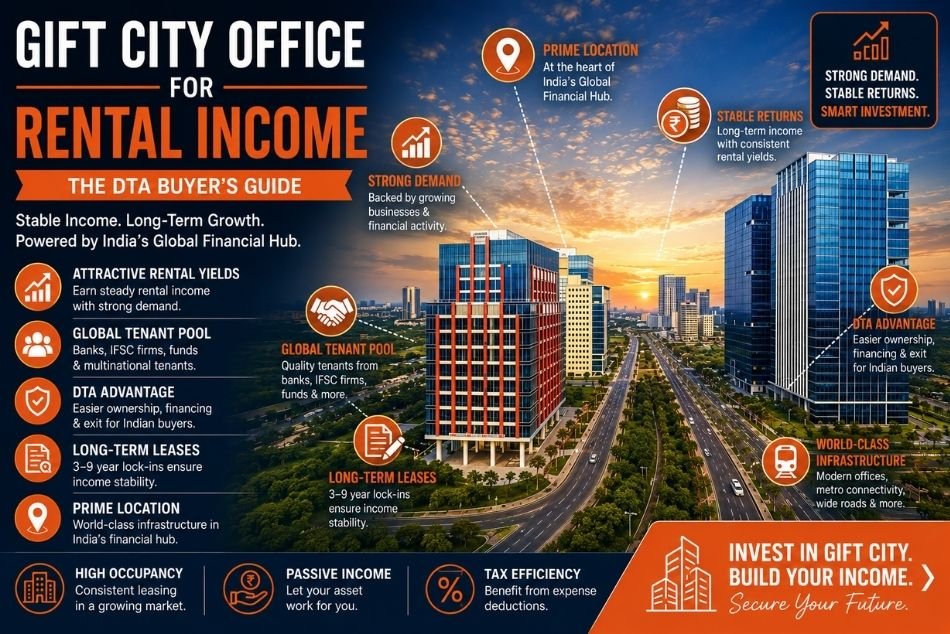
GIFT City Office for Rental Income Starts With a Rule Most Listings Don’t Mention
Every broker in Ahmedabad will tell you GIFT City office space is a good investment. Almost none of them will tell you where, exactly, you’re allowed to buy it if your goal is rental income and not running your own business out of it.
That distinction matters more than price, more than developer, more than floor. GIFT City office for rental income is only available to you in one of the city’s two commercial zones. Buy in the wrong one, and you won’t have an income asset — you’ll have a unit you cannot legally lease to the tenant you were counting on.
This guide walks through that rule first, then the numbers, then what to actually check before you sign.
The Zone Rule Nobody Explains Upfront
GIFT City has two commercial zones, and they are not interchangeable.
The SEZ, which houses the IFSC, covers roughly 261 acres of the city. It’s built exclusively for international financial services — banking units, fund managers, insurance offices, aircraft leasing SPVs, fintech entities registered under IFSCA. Every one of these tenants needs a physical address inside the SEZ boundary to hold their regulatory license and access the tax benefits that come with it.
That’s the part most articles cover. Here’s the part they leave out.
Space inside the SEZ can only be leased to SEZ-registered entities. If you buy a unit in the SEZ purely as an investor — with no IFSCA-registered business of your own operating out of it — you don’t have a rentable asset. You have a unit that, under the SEZ framework, is meant for occupation by a company that has itself been approved to operate within the zone. The tenant pool you’re legally allowed to lease to is restricted to SEZ-registered businesses, and getting a unit occupied by one typically runs through the developer or GIFT City’s own allotment process, not a straightforward open-market lease the way a landlord would rent out a normal office.
In practice, this means SEZ office space suits two kinds of buyers: a company that wants to set up its own IFSC-registered operation and needs the address, or an investor buying specifically to lease to an SEZ-registered tenant through the appropriate structure — not a retail investor looking for a passive, open-market rental income stream.
If your plan is to buy an office, hand it to a property manager, and collect rent from whichever tenant walks in, the SEZ is not where that plan works.
The SEZ was built to house regulated financial institutions. It was never designed as a rental product for a retail investor — and no amount of broker enthusiasm changes that.
SEZ vs DTA – What It Means for a Rental Investor
| Factor | SEZ / IFSC | DTA |
|---|---|---|
| Who can occupy | SEZ-registered entities only | Any domestic company |
| Open-market leasing | Not available to retail investors | Standard landlord model |
| Typical tenant | Banks, funds, insurers, fintech | GCCs, professional services, IT/ITES |
| Currency | Foreign currency | Indian rupees |
| Gross yield range | 6% to 9% (institutional) | 5% to 7% (retail-accessible) |
| Best suited to | Companies setting up their own IFSC operation | Individual investors seeking rental income |
That table is the entire decision in one place. If your row is the last one, keep reading — the rest of this article is written for you.
Where the Rental Income Model Actually Works: The DTA
The Domestic Tariff Area — the DTA — is the other 625 acres of GIFT City, and it’s built for exactly this purpose. Businesses here operate under standard Indian rules, transact in rupees, and don’t need IFSCA registration to occupy space.
That single difference changes everything about who you can rent to. A DTA office unit isn’t restricted to a narrow, regulator-approved tenant class. You can lease it to an IT services firm, a GCC support function, an accounting or legal practice serving the IFSC ecosystem, a consulting outfit, or any domestic company that wants a GIFT City address without needing SEZ registration.
For anyone looking at a straightforward, landlord-style investment — buy the unit, find a tenant, collect rent, renew the lease — the DTA is the zone built for that model. The SEZ is built for regulatory occupation, not retail rental yield.
This is the first thing to confirm on any listing, before price, before floor plan, before anything else. Ask for the zone classification in writing, from the GIFT City Development Corporation’s allotment documentation — not the developer’s brochure. A salesperson who can’t produce that document clearly is a reason to pause.
Who Actually Rents DTA Office Space
DTA office demand in GIFT City doesn’t come from the same tenant universe as SEZ commercial space, and understanding who you’re actually renting to shapes what kind of unit makes sense.
Global Capability Centres and their support functions are one of the largest sources of DTA demand right now. As more GCCs set up in and around GIFT City under Gujarat’s GCC policy push, a meaningful share of their back-office, HR, and administrative functions don’t need to sit inside the SEZ boundary — they operate as standard domestic entities and lease DTA space accordingly.
Professional services firms are the second major tenant category. Law firms, chartered accountancy practices, compliance consultancies, and recruitment firms that serve the IFSC ecosystem from the outside — advising SEZ tenants without being SEZ tenants themselves — are a steady and growing DTA occupier base. They want proximity to the IFSC cluster without the registration overhead of operating inside it.
IT and ITES companies round out the tenant mix. GIFT City’s DTA has increasingly attracted domestic technology firms and smaller fintech companies that haven’t gone through IFSCA registration but still want the address, the infrastructure, and the proximity to a fast-growing business district.
None of these tenants are as prestige-driven as an international bank branch. But they’re a broader, less regulator-dependent demand base — which actually reduces one specific risk for a DTA landlord: your leasing pool isn’t limited to a policy-sensitive category of entity.
The Yield Picture for DTA Office Rental Income
DTA commercial yields run lower than SEZ/IFSC commercial, and it’s worth being upfront about why before quoting numbers. IFSC space carries a structural demand floor because tenants are there by regulatory necessity. DTA space competes more like a well-run business park — good infrastructure, but demand that tracks the general economy rather than IFSCA’s policy expansion.
Gross rental yields on DTA office space in GIFT City currently run in the 5 to 7 percent range for well-located, well-specified units. That’s noticeably below the 6 to 9 percent some SEZ-zone commercial listings advertise — but remember, most retail investors were never eligible to capture that SEZ number as a passive landlord in the first place.
Net yield, after maintenance and a fair vacancy allowance, typically comes in one to one-and-a-half points below the gross figure. A DTA unit advertised at 6.5 percent gross is a realistic 5 to 5.5 percent net proposition once GIFT City’s above-average maintenance charges are factored in — a direct consequence of the city’s district cooling and underground utility infrastructure, which applies across both zones.
Compare that against a fixed deposit paying 6.5 to 7.5 percent pre-tax with none of the illiquidity, and the honest picture is this: gift city office for rental income alone doesn’t dramatically outrun safer alternatives on yield. Where the case strengthens is when you add capital appreciation — GIFT City DTA commercial values have moved up alongside the broader city’s growth, and a five to seven year hold captures both the income and the value gain.
Lease Structures and What They Mean for You as a Landlord
DTA office leases in GIFT City follow standard Indian commercial leasing conventions — Leave and License agreements, registration, security deposits typically running six to ten months of rent. Nothing exotic here, which is itself an advantage over SEZ leasing structures.
Lock-in periods for DTA tenants tend to run three to five years, shorter than the five-plus year terms common with SEZ institutional tenants, but still meaningfully longer than a typical residential lease. Escalation clauses of 5 percent annually, or a larger step-up every three years, are standard.
Fit-out periods matter here too, though less dramatically than in SEZ space. A DTA tenant — say, a mid-sized professional services firm — typically needs one to three months to fit out a unit before occupancy, compared to the six to nine months an institutional SEZ tenant might need for a trading floor build-out. That shorter runway to income is one practical advantage of buying in the DTA rather than chasing SEZ exposure you may not actually be eligible to lease out freely.
What to Verify Before You Buy
Zone classification comes first, and it’s worth repeating: confirm DTA status from the GIFT City Development Corporation’s allotment document, not a brochure or a verbal assurance. This single check decides whether you actually have a gift city office for rental income, or just an office you happen to own.
Floor specification is next. Even within the DTA, tenant quality varies by building. Power backup, cooling, connectivity, and lift capacity all affect what kind of tenant your unit can realistically attract. A DTA unit with weak infrastructure competes with ordinary Ahmedabad IT park space — and loses the GIFT City address premium that made the purchase interesting in the first place.
Developer track record inside GIFT City specifically is worth checking independently of their record elsewhere in Gujarat. Delivering inside GIFT City’s Special Investment Region involves allotment processes, utility connections, and construction protocols that don’t exist in a standard development. A developer who has handed over DTA buildings on schedule before is a materially lower risk than one attempting their first GIFT City project.
Existing occupancy matters enormously if you’re buying a completed building rather than a pre-launch unit. A DTA tower running at 70 to 80 percent occupancy with established tenants gives you far more confidence in achievable rent than a mostly vacant building where you’d be the one testing demand.
Maintenance charges should be confirmed in writing and built into your net yield calculation from day one — not discovered after possession. GIFT City’s infrastructure quality is genuinely higher than a typical Indian commercial building, and that comes at a real, recurring cost that the DTA shares with the SEZ.
Risks Worth Pricing in Honestly
DTA office demand tracks the general economy rather than IFSCA’s policy calendar. That’s the trade-off for having a broader, less regulator-dependent tenant pool. If GCC hiring slows or the domestic services sector cools, DTA absorption slows with it. There’s no equivalent to the SEZ’s structural demand floor cushioning you here.
Vacancy between tenants is a real cost most first-time buyers underestimate. A DTA unit that sits empty for four to six months between leases can erase most of a year’s yield advantage over a fixed deposit. Budget for that gap rather than assuming back-to-back tenancy.
Liquidity on resale is thinner than a comparable office in an established Ahmedabad business district. GIFT City’s secondary commercial market, including the DTA, is still forming. A forced exit on a tight timeline may mean accepting a lower price than you’d get with more patience.
Building quality varies more than buyers expect. Two DTA units can sit in adjacent towers and attract completely different tenant profiles depending on power backup, connectivity, and finish quality. Don’t assume every DTA listing carries the same rental prospects just because it shares a zone classification.
None of these risks are reasons to avoid the DTA. They’re reasons to underwrite the purchase with realistic assumptions rather than the yield figure printed in the listing.
A Quick Word on Tax Treatment
The IFSC’s well-publicised tax holidays — the profit exemptions, GST relief, exemptions on STT and CTT — apply to businesses registered and operating inside the SEZ/IFSC. They have never applied, and don’t apply, to a DTA property owner collecting rental income.
Rental income and any eventual capital gains on a DTA office unit are taxed under standard Indian income tax rules, the same as commercial property anywhere else in the country. Several buyers assume proximity to the IFSC means their own return automatically inherits some of its tax advantage. It doesn’t. Run your net numbers on standard tax treatment, and confirm your specific position with a chartered accountant before you commit.
Where This Genuinely Makes Sense
None of this is an argument against GIFT City commercial property. It’s an argument for buying the right product for what you’re actually trying to do.
If your goal is a passive, landlord-style rental income asset — buy a unit, lease it to a tenant, collect rent, renew every few years — the DTA is where that model is legally and practically available to you as an individual investor. A well-located, well-specified DTA office near the IFSC core, in a building with existing occupancy and a credible developer behind it, is a genuinely reasonable income asset with appreciation upside layered on top.
If instead you’re set on SEZ exposure specifically for the higher advertised yields, understand exactly what you’re buying into first: either your own IFSC-registered business occupying the space, or a structured arrangement to lease to an SEZ-registered tenant — not a simple buy-and-rent transaction available to any investor off the street.
For most people, that clarity alone — DTA for rental, SEZ for your own regulated operation — saves months of confusion and, often, a costly mistake.
Wrapping Up
GIFT City office for rental income is a real opportunity, but it comes with a rule that most sales conversations skip past. The SEZ is built for companies operating their own IFSC-registered business, not for investors looking to lease out to the open market. The DTA is where that open, landlord-style rental model is actually available to you.
Get the zone right first. Then check the building’s specification, the developer’s GIFT City track record, and the existing occupancy before you look at yield numbers at all. Do that, and this becomes a straightforward, well-understood asset class rather than a pitch you’re taking on faith.
FAQs: Gift City Office for Rental Income
Q1) Can I Buy Office Space Anywhere in Gift City and Rent It out Freely?
Not anywhere. SEZ/IFSC office space can only be leased to SEZ-registered entities, which means it isn’t a straightforward rental-income product for a typical investor. DTA office space carries no such restriction and is the zone built for open-market rental income.
Q2) Why Do SEZ Commercial Listings Advertise Higher Yields if I Can’t Buy Them as an Investor?
Those yield figures usually apply to institutional or structured transactions — an SEZ-registered company buying its own space, or an investor working through a specific arrangement to lease to an SEZ tenant. They aren’t the yield a retail buyer earns from a simple, open-market lease, which is the model DTA space supports.
Q3) What Rental Yield Can I Realistically Expect From a DTA Office in GIFT City?
Gross yields currently run 5 to 7 percent for well-located, well-specified DTA units. Net yield, after maintenance and a fair vacancy allowance, typically lands one to one-and-a-half points lower.
Q4) Who Are the Typical Tenants for DTA Office Space?
Global Capability Centre support functions, professional services firms serving the IFSC ecosystem, and domestic IT and fintech companies that haven’t gone through IFSCA registration. This tenant base is broader and less policy-dependent than SEZ demand.
Q5) Do DTA Office Owners Get Any of the IFSC’s Tax Benefits?
No. The IFSC tax holidays, GST relief, and transaction tax exemptions apply to businesses registered inside the SEZ. A DTA property owner’s rental income and capital gains are taxed under standard Indian income tax rules.
Q6) How Do I Confirm Whether a Listing Is in the Sez or the DTA Before I Buy?
Ask for the GIFT City Development Corporation’s allotment documentation, which states zone classification clearly. Don’t rely on a developer’s brochure or a verbal confirmation from a sales team — get it in writing before you proceed.