
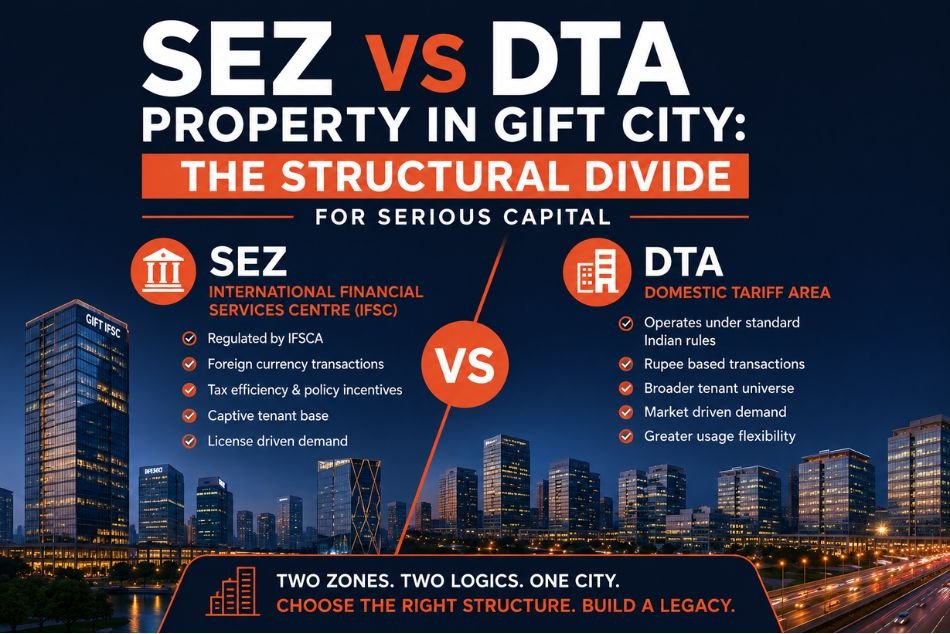
The Difference Between SEZ and DTA Property in Gift City Is Not a Detail — It’s the Whole Decision
Ask most brokers about the difference between SEZ and DTA property in GIFT City and you will get a one-line answer. One is tax-linked, the other is not. That answer is true and almost useless once the capital on the table is large enough to anchor a family’s entire India strategy.
At that scale, the SEZ and the DTA are not two shelves in the same shop. They are two different infrastructure classes inside the same 886-acre boundary — different ownership logic, different succession pathways, different tenant universes, and different roles to play inside a portfolio built to outlast the person building it.
This is not a retail buyer’s checklist. It is a structural brief for the kind of capital that does not buy a unit — it builds a position. If you are deploying at a scale where the question is no longer whether to enter GIFT City but how to architect the entry, the difference between SEZ and DTA property in GIFT City is the first decision everything else sits on.
Why This Decision Looks Different at Scale
A buyer acquiring a single office or a single apartment treats zone classification as a checkbox — confirm it, note the yield difference, move on. That is the right amount of effort for that size of decision.
A family office, a consolidated diaspora capital pool, or an individual deploying a capital block large enough to reshape a regional allocation strategy cannot treat it that way. At that scale, you are not choosing a listing. You are choosing an operating model — whether your GIFT City position behaves like a regulated financial-sector holding with a captive tenant base, or like a diversified commercial income engine with broader optionality.
Both are legitimate. Both belong in a serious portfolio. But conflating them — buying SEZ space expecting DTA-style open-market flexibility, or buying DTA space expecting SEZ-style policy-anchored demand — is the single most expensive misunderstanding a large buyer can make here.
What the SEZ Actually Is — And Why It Behaves Differently
The SEZ inside GIFT City is the International Financial Services Centre — roughly 261 acres carved out specifically for regulated, cross-border financial activity. This is the part of the skyline every photograph of GIFT City shows: the towers where banking units, fund managers, insurers, exchange operations, aircraft and ship leasing structures, and increasingly family investment vehicles actually sit.
Entities inside the SEZ operate under IFSCA — the International Financial Services Centres Authority — a single regulator built specifically to compete with Singapore’s MAS and Dubai’s DIFC framework. Transactions within the IFSC can be conducted in foreign currency, and certain IFSC units are treated as persons resident outside India for specified FEMA purposes; the SEZ itself remains within India.
The part that matters most for a serious buyer: an entity cannot simply choose a cheaper address outside the SEZ and keep its IFSCA license. Physical presence inside the boundary is part of the operating license itself. That is not sentiment-driven demand. It is demand created by regulatory design — and it does not evaporate the way ordinary commercial demand can in a downturn.
An IFSC/SEZ unit must operate from SEZ premises approved for its authorized activities, creating a tenant universe tied to the zone’s regulatory framework. That is a different demand floor than any conventional Indian commercial asset offers.
What the DTA Actually Is — and Where It Fits
The Domestic Tariff Area is the remaining roughly 625 acres of the master plan — the part of GIFT City that operates under standard Indian rules, in rupees, without IFSCA registration as a requirement to occupy space.
This is where Global Capability Centre support functions sit. Where professional services firms serving the IFSC ecosystem from the outside — law firms, accountancy practices, consultancies — choose to locate. Where domestic technology and fintech companies that have not gone through IFSCA registration still want the GIFT City address and infrastructure standard.
The DTA shares GIFT City’s core infrastructure framework, including district cooling, underground utility infrastructure and city-level monitoring systems, subject to the applicable zone and development. What differs is the demand engine underneath it. DTA absorption tracks the general economy and GIFT City’s own ecosystem growth, rather than IFSCA’s regulatory calendar specifically.
Difference Between SEZ and DTA Property in Gift City — Side by Side
The table below is the structural summary. It is worth reading in full before any conversation with a developer, because every subsequent decision in this article builds on it.
| Dimension | SEZ / IFSC Zone | DTA (Domestic Tariff Area) |
|---|---|---|
| Land footprint within GIFT City | Roughly 261 acres, the notified IFSC boundary | Roughly 625 acres, the remainder of the master plan |
| Who can occupy the space | Entities registered with IFSCA — banks, fund managers, insurers, aircraft and ship leasing SPVs, family investment structures | Any domestic company — GCC support functions, professional services, IT, fintech not seeking IFSCA registration |
| Currency of operation | Foreign currency transactions as the norm, under FEMA’s non-resident treatment of the zone | Indian rupees, under standard domestic rules |
| Regulatory anchor | IFSCA — a single unified authority built for international-standard finance | Standard Indian regulatory framework |
| Tax posture for operating businesses | Profit-linked tax holiday, GST relief on specified services, no STT/CTT/stamp duty on IFSC exchange trades | Standard Indian corporate and business tax treatment |
| Tax posture for a property owner as investor | Does not automatically extend to the property owner — the holiday belongs to the operating business, not the landlord | Standard Indian property tax treatment, identical in principle to the SEZ side for a passive owner |
| Demand driver | Policy-mandated occupancy — tenants must be physically present in the zone to keep their license | General economic activity and the broader GIFT City ecosystem |
| Tenant covenant quality | Extremely high — a regulated entity effectively cannot walk away without losing its license | Strong but conventional — comparable to a well-run business park |
| Best strategic role | A permanent, policy-anchored core holding — control, prestige address, generational asset | A liquid, diversified income layer that behaves more like conventional commercial real estate |
Why Whales Don’t Choose One — They Architect Both
This is the part most GIFT City coverage skips, because it only makes sense once your capital block is large enough to hold more than one position at a time.
A retail buyer has to choose. A single acquisition, a single zone, a single bet. Serious capital does not have to choose — and the sophisticated move is not picking a side of the difference between SEZ and DTA property in GIFT City, but deliberately holding both, each doing a different job.
The SEZ position becomes the anchor. A whole floor, a standalone building, or a land parcel allotted directly by the GIFT City Development Corporation for build-to-suit development. This is the piece that carries the prestige address, the policy-backed tenant covenant, and — if the family also runs its own IFSC-registered entity, whether a family investment structure, a fund management arm, or an aircraft leasing vehicle — a genuine operational base rather than a passive holding.
The DTA position becomes the ballast. Broader tenant universe, more conventional leasing dynamics, and a resale pool that is not limited to regulated financial entities alone. It diversifies the family’s exposure away from a single sector’s regulatory pace, while still sitting inside the same integrated ecosystem and benefiting from the same institutional momentum.
One zone gives you the address that opens doors. The other gives you the tenant depth that keeps the position liquid. A family that owns both isn’t hedging its GIFT City bet — it’s running the full playbook.
This dual-zone architecture is exactly the pattern serious capital has followed in every comparable global financial district — Canary Wharf, Marina Bay, DIFC. The families and funds that did best did not pick a lane early and stay in it. They built a core position in the regulated financial core, then layered a broader commercial position around it as the surrounding district matured.
Currency, Repatriation, and the Architecture Around Both Zones
For NRI, OCI, and foreign family capital, the currency and repatriation mechanics around SEZ and DTA holdings deserve their own attention — because they are not identical, and getting this wrong at scale is expensive.
Property acquisition itself, in either zone, follows FEMA and RBI’s general permission route for NRIs and OCIs — no cap on the number of properties or total value. Payment must move through banking channels using permissible NRE, NRO, or FCNR routes, and the exact mechanics depend on funding source.
Repatriation is where the zones start to diverge in practice, though the underlying rule set is the same. For property acquired with eligible foreign exchange through banking channels or funds from NRE/FCNR(B) accounts, repatriation of sale proceeds is permitted subject to the applicable FEMA conditions and, for residential property, a restriction to not more than two such properties. Property acquired out of rupee funds, inheritance or legacy is governed by separate remittance rules, including the USD 1 million facility where applicable.
Where the SEZ genuinely changes the picture is for the operating businesses inside it. Rent negotiated with a foreign bank branch or an international fund manager is frequently denominated in USD or escalated against a USD benchmark. For a landlord holding SEZ-adjacent or SEZ commercial space through an appropriate structure, that is either a natural currency hedge or an added exposure, depending on the rest of the family’s balance sheet. It should be modelled explicitly, not assumed to net out favourably.
Who Can Actually Hold SEZ Space — And Why the DTA Is the More Straightforward Route for Passive Rental Income
This is the single most consequential structural fact in the entire difference between SEZ and DTA property in GIFT City, and it is the one most sales conversations gloss over.
Space inside the SEZ is intended for SEZ/IFSC units authorised to operate there. A passive buyer therefore needs to understand the permitted occupier and leasing structure before treating SEZ space as a conventional rental asset. The tenant universe is tied to the applicable SEZ/IFSC approvals and authorised activities.
In practice, SEZ space suits two kinds of large buyers cleanly. A family that wants to establish and operate its own IFSC-registered entity — a family investment structure, a fund management company, an aircraft leasing SPV — and needs the address as part of that entity’s own operating footprint. Or a buyer working through a properly structured arrangement specifically built to lease to SEZ-registered tenants, rather than a simple buy-and-rent transaction available to anyone.
The DTA does not carry the same SEZ/IFSC occupancy restriction, giving owners access to a broader range of domestic occupiers and making a conventional landlord model more straightforward for many investors without their own IFSC operating entity. For a large buyer whose objective is a diversified, professionally managed rental income layer rather than an operational base, the DTA is very often the structurally cleaner starting point, even though it sits alongside — not instead of — an SEZ position for the reasons already covered above.
The Foreign Family Investment Fund — Where the Two Zones Now Connect
A development from earlier this year changes how large foreign capital should think about this entire question, and it is recent enough that most advisors have not fully priced it into their standard pitch yet.
In April 2026, IFSCA approved the first Foreign Family Investment Fund under its 2025 regulations — a structure purpose-built for foreign family offices and NRI-controlled family wealth, distinct from the domestic Family Investment Fund framework that has existed since 2022. A family office based in Dubai, London, New York, or anywhere in the diaspora corridor can now set up an IFSCA-regulated structure inside the SEZ that consolidates cross-border financial assets under Indian regulatory oversight.
This matters for the SEZ versus DTA question specifically because it gives large foreign capital a genuine reason to hold operational presence inside the SEZ — not as a real estate bet alone, but as the seat of the family’s actual financial architecture. A family running its FFIF, its AIF allocations, and its treasury relationships from a GIFT City SEZ address, while holding a separate DTA commercial and residential portfolio around it, is no longer running two disconnected investments. It is running one platform, with each zone doing distinct, complementary work.
A family office that consolidates its financial structure and its real estate under one regulatory roof is not diversifying for diversification’s sake. It is building a single platform that happens to have two different rooms.
Succession and Structuring — Why the Zone Decision and the Holding Decision Are Linked
How a large position is held matters almost as much as which zone it sits in, and the two decisions are more connected than most families initially assume.
A Foreign Family Investment Fund or another suitable holding structure may be considered for a family consolidating financial activity and related real-estate exposure under a common governance framework, subject to the fund’s permitted activities and applicable property, FEMA and tax rules.
For DTA commercial and residential holdings — the broader, more conventional layer of the portfolio — an irrevocable discretionary trust prevents the fragmentation that individual inheritance creates across multiple properties. One trust, one succession process, regardless of how many separate GIFT City assets sit inside it.
A closely held corporate entity may be considered for commercial property intended for lease to SEZ-registered or DTA tenants, depending on the family’s tax, governance and exit objectives. The specific tax treatment, including depreciation and any future share or asset sale, should be confirmed for the chosen structure.
None of these structural decisions are reversible without real cost once capital has moved. Committing to the right wrapper before the first acquisition — not after — is the difference between a portfolio that compounds cleanly across generations and one that spends its first decade untangling avoidable complexity.
Why the Window on This Decision Is Narrower Than It Looks
None of this is a story about potential. GIFT IFSC had 1,147 IFSCA registrations/authorisations, with banking assets exceeding USD 111 billion as of March 2026. That is the current operating figure, not a target.
The master plan covers 886 acres and roughly 62 million square feet of planned development, split across the SEZ and DTA. A majority of approved buildings are already operational, with the balance under active construction. That means the pool of large, block-purchasable inventory across both zones is finite and shrinking as a share of total supply, relative to the entity count arriving to occupy it.
Every fresh IFSCA-permitted activity category — aircraft leasing, ship leasing, family investment structures, the fintech sandbox graduating new entities on a rolling basis — creates a new wave of SEZ tenant demand before the broader market has finished pricing in the last wave. Every one of those new entities also generates DTA demand indirectly, through the professional services, GCC support functions, and ancillary businesses that grow up around them.
Layer on the physical milestones that have landed only in the past year and a half. The Ahmedabad Metro’s Violet Line extension into GIFT City is live, not pending. Multiple foreign university campuses are operating, not merely announced. Lilavati Hospital has moved from press release to actual outpatient operations, building toward full multi-specialty scale. Each of these closes a specific liveability gap — and in every comparable financial district globally, each such milestone has historically produced a step-change in surrounding property values once it lands, not a gradual drift.
The capital that moved into Canary Wharf, Marina Bay, and BKC while those districts still felt unfinished captured the steepest returns. The capital that waited for full maturity bought in after the re-rating had already happened. GIFT City is still writing that first chapter.
Residential per-square-foot pricing in GIFT City has already risen substantially from roughly Rs. 4,500 in 2020 to around Rs. 10,000+ per square foot in recent market reports. Commercial pricing has tracked leasing momentum closely, firming after every major IFSCA announcement. The entry pricing available to a large buyer today already reflects a fraction of what the fully built-out master plan will eventually command, and that gap narrows with every quarter, not widens.
A Practical Deployment Sequence for Large Capital
For a buyer operating at this scale, the process differs from a standard property purchase in sequence, not just in size.
- Define the role each zone will play in the family’s broader strategy before evaluating a single asset — operational base, income anchor, appreciation play, or a blended position across both.
- Engage GIFT City-specific legal counsel and a chartered accountant with genuine IFSCA and SEZ experience, not a generalist India advisory team.
- Decide on the holding structure — Foreign Family Investment Fund, trust, or corporate entity — before the first acquisition, since reversing this decision later carries real cost.
- Confirm zone classification for every asset under consideration directly from the GIFT City Development Corporation’s allotment documentation, never from a developer brochure alone.
- Shortlist developers on GIFT City-specific delivery history — completed buildings, on-schedule possession, no post-handover disputes — rather than a general pan-India track record.
- Model currency exposure, carry costs, and construction timelines conservatively for any forward-purchase or land-parcel commitment.
- Set up NRE, NRO, and where relevant FCNR banking relationships with an institution experienced in large-value GIFT City transactions before initiating any purchase agreement.
Factors to Verify Before You Commit — Not Reasons to Wait
A serious capital decision deserves an honest accounting of what needs checking, framed as diligence rather than hesitation.
Zone classification determines your entire tenant universe and cannot be assumed from a listing headline — get it in writing from the Development Corporation’s allotment document every time.
SEZ occupancy eligibility needs to be confirmed against your family’s actual plans. If there is no intent to operate an IFSCA-registered entity, or to structure through a properly built leasing arrangement, SEZ acquisition should be approached with that constraint explicitly understood upfront, not discovered afterward.
Developer track record specifically inside GIFT City’s Special Investment Region carries more weight than a general Gujarat or pan-India record, given the additional layers of SEZ construction protocol and Development Corporation approval involved.
Currency denomination on any existing or proposed lease — particularly on SEZ-adjacent commercial space with foreign bank or fund manager tenants — should be modelled explicitly against the rest of the family’s balance sheet.
Remittance and repatriation documentation, particularly the CA-certification requirements that apply to outward remittances, should be mapped out with a specialist chartered accountant before capital moves, not after a future sale is already underway.
None of these are reasons to delay. They are the checklist that separates a well-structured, multi-generational GIFT City position from one that spends years untangling a decision that should have taken one careful conversation.
Wrapping Up: The Difference Between SEZ and DTA Property in GIFT City Is the First Decision, Not the Last
The difference between SEZ and DTA property in GIFT City is not a footnote to research after you have picked a building. It is the decision that determines what kind of asset you actually end up holding — a policy-anchored operational core, a diversified income layer, or, for the capital that can support it, both working together as a single platform.
GIFT City has already answered the question of whether this ecosystem is real. Over 1,147 IFSCA registrations/authorisations, banking assets past USD 111 billion, a live metro connection, operating university campuses, a functioning hospital, and — as of this year — a regulatory structure built specifically for foreign family wealth. What remains open is entry pricing, and entry pricing moves in one direction as each of these milestones compounds into the next.
For a family or an individual deploying capital at a scale that can genuinely shape a position rather than fill one listing, the sequence is straightforward. Understand the difference between SEZ and DTA property in GIFT City properly. Decide what role each zone plays in the strategy. Structure the holding correctly from day one. Then move — because the buyers who have done well here did not wait for the city to feel finished. They understood the structure early, and gave the position the time it needed to compound.
FAQs: SEZ vs DTA Property in Gift City
Q1) What Is the Single Biggest Difference Between SEZ and DTA Property in Gift City for a Large Investor?
Occupancy eligibility. SEZ space can only be leased to SEZ-registered, IFSCA-regulated entities, which restricts who can hold it as a passive rental asset. DTA space can be leased to any domestic company, making it the more straightforward route for a conventional, landlord-style income position. This single distinction shapes almost every other decision that follows.
Q2) Can a Large NRI or OCI Buyer Hold Both SEZ and DTA Property at the Same Time?
Yes, and for capital at this scale it is often the more sophisticated approach. A well-structured position typically anchors around an SEZ holding — particularly where the family also operates or plans an IFSCA-registered entity — while building a broader, more liquid DTA portfolio around it for diversification and conventional leasing depth.
Q3) Does the Foreign Family Investment Fund Change How a Family Should Approach the SEZ Versus DTA Decision?
It adds a genuine reason to hold SEZ presence beyond real estate alone. A family operating its FFIF from an SEZ address consolidates its financial architecture and its regulatory standing in one place, while its broader real estate diversification can sit comfortably across DTA holdings around that core.
Q4) Do SEZ Tax Benefits Extend to a Family That Owns the Property but Does Not Operate the Business Inside It?
Not automatically. IFSC tax and transaction incentives generally attach to eligible IFSC units and specified activities, not simply to passive ownership of property. The treatment applicable to a property owner depends on the holding structure and the specific incentive. A chartered accountant with IFSC-specific experience should confirm the treatment applicable to your exact structure before you finalize anything.
Q5) Is DTA Property in Gift City a Lower-Quality Asset Than SEZ Property?
No — it is a different asset, not a lesser one. GIFT City’s core infrastructure framework serves both zones, while specific uses and requirements can differ by zone and development. DTA property trades policy-mandated tenant demand for a broader tenant universe, more conventional leasing dynamics, and typically deeper resale liquidity. For a diversified, multi-generational portfolio, that is a genuine strength rather than a compromise.
Q6) What Should a Family Office Confirm Before Committing Capital to Either Zone?
Zone classification from the Development Corporation’s allotment documentation, the developer’s GIFT City-specific delivery history, the intended holding structure, and the currency denomination of any existing or proposed lease. Each of these should be resolved with specialist counsel before the first rupee moves, not after.
Reference & Sources
GIFT City official portal — master plan, zone data, infrastructure and entity statistics
https://giftgujarat.in
IFSCA — GIFT IFSC key highlights and regulatory updates
https://www.ifsca.gov.in
IFSCA — Foreign Family Investment Fund, first registration press release (April 20, 2026)
https://www.ifsca.gov.in/CommonDirect/ViewFile?fileName=Press_Release_FIF_1_20260420_0105.pdf&id=d575554ec59b09e7fde503d3a8d33f60
IFSCA — Fund Management Regulations, 2025
https://ifsca.gov.in/Legal/Index/ogGPf3wx5GE=
Reserve Bank of India — Master Circular on Acquisition and Transfer of Immovable Property in India (FEMA/NRI-OCI rules)
https://www.rbi.org.in/commonperson/English/scripts/Notification.aspx?Id=845
Income Tax Department — Forms 145 and 146, remittance reporting and CA-certification requirements
https://www.incometax.gov.in/iec/foportal/newformpage/forms/form145
Gujarat Metro Rail Corporation — Ahmedabad Metro Phase-II / Violet Line project overview
https://www.gujaratmetrorail.com/project-overview2
Lilavati Hospital — GIFT City facility and phased rollout
https://www.lilavati-hospital.com/facilities.php
Press Information Bureau, Government of India — foreign university campuses in GIFT City
https://www.pib.gov.in/PressReleasePage.aspx?PRID=2270836&lang=2®=48
IFSCA — GIFT IFSC Key Highlights (1,147 registrations/authorisations; USD 111bn+ banking assets, March 2026)
https://www.ifsca.gov.in
IFSCA — First Foreign Family Investment Fund Registration, 20 April 2026
https://www.ifsca.gov.in/CommonDirect/ViewFile?fileName=Press_Release_FIF_1_20260420_0105.pdf&id=d575554ec59b09e7fde503d3a8d33f60
IFSCA — SEZ Compliance FAQ Booklet
https://www.ifsca.gov.in/Document/Developments/SEZ_Compliance_FAQs_Booklet.pdf
GIFT City — Official SEZ/DTA and master-plan information
https://api.giftgujarat.in/public/tool-guiedes-for-setting/DoingBusinessInGIFTCity.pdf
RBI — NRI/OCI immovable-property and repatriation framework
https://www.rbi.org.in/Commonperson/english/Scripts/Notification.aspx?Id=730
RBI — Master Direction / immovable-property repatriation conditions
https://systemhealth.rbi.org.in/Scripts/BS_ViewMasDirections.aspx_id%3D10196.html
Income Tax Department — Current income-tax forms and remittance guidance
https://www.incometax.gov.in/iec/foportal/help/all-topics/e-filing-services/income-tax-forms