
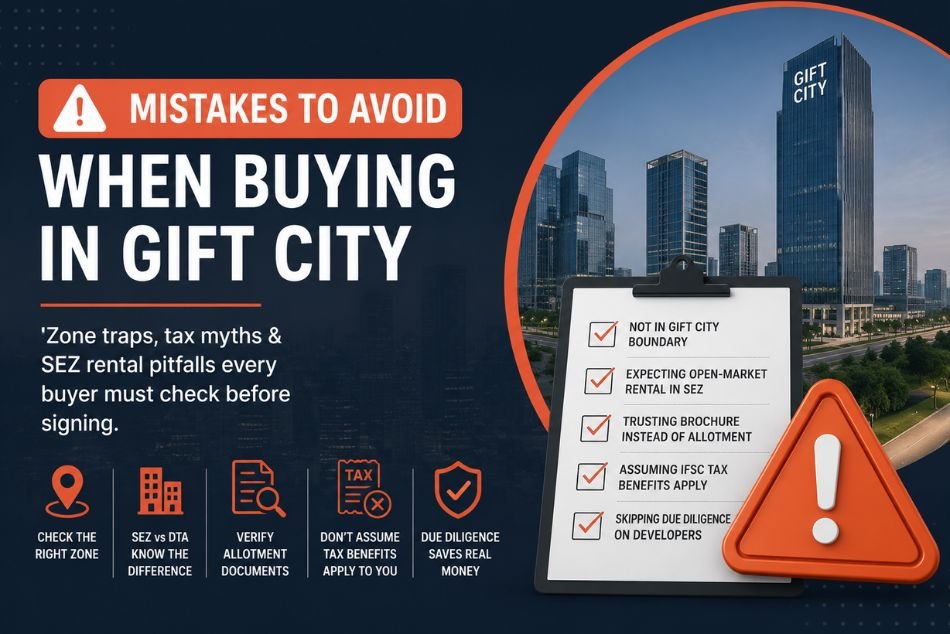
Mistakes to Avoid When Buying in GIFT City Start Before You See a Single Listing
GIFT City has crossed 1,147 IFSCA registrations and banking assets past USD 111 billion. The metro is live. Three foreign universities are running classes. A hospital has opened. On paper, this looks like a market where it is hard to go wrong. In practice, the mistakes to avoid when buying in GIFT City are not about the city’s fundamentals at all. They are about buyers applying a standard Ahmedabad or Gandhinagar property checklist to a market that runs on entirely different rules.
Most of these mistakes are not dramatic. Nobody loses everything overnight. What actually happens is quieter and more common: a buyer ends up with a unit that cannot be rented the way they assumed, a yield that never matches the brochure number, or a tax benefit they thought applied to them and never did. This article works through the mistakes that show up again and again, so you can avoid making them with your own capital.
Mistake One: Assuming “Near GIFT City” Means “In GIFT City”
This is the single most common and most avoidable mistake in this list.
Several residential and commercial projects in the surrounding corridor use “GIFT City” in their marketing without actually sitting inside the Special Investment Region or the IFSC boundary. They may be a short drive away. They are not the same product, and they do not carry the same demand drivers, tenant pool, or resale profile.
Confirm the exact boundary of GIFT City’s Special Investment Region against the GIFT City Development Corporation’s own allotment documentation before you get emotionally attached to a listing. A brochure that says “GIFT City” is not proof. An allotment letter is.
Mistake Two: Buying SEZ Commercial Space Expecting Open-Market Rental Income
This is where many first-time commercial buyers lose real money, and it deserves its own section because the mistake is structural, not cosmetic.
GIFT City’s SEZ, which houses the IFSC, is built for entities that hold IFSCA registration. Space inside the SEZ boundary is meant for occupation by SEZ-registered businesses. A retail investor who buys a SEZ unit expecting to hand it to a property manager and collect open-market rent, the way a landlord would rent out any ordinary office, runs into a wall almost immediately. The tenant pool is restricted to SEZ-registered entities, and placing one typically runs through the developer or the allotment process, not a straightforward lease.
The Domestic Tariff Area is where the conventional landlord model actually works. If passive rental income is your goal, DTA office space is very often the more straightforward starting point. SEZ exposure makes sense if you plan to operate your own IFSC-registered business from the unit, or if you are working through a structured arrangement built specifically to lease to SEZ tenants.
Among the mistakes to avoid when buying in GIFT City, this one is the most expensive to discover after you have already signed.
Mistake Three: Trusting the Brochure Instead of the Allotment Document
Zone classification decides everything downstream — your tenant universe, your pricing power, your legal ability to lease the way you intend. Yet a surprising number of buyers still take a salesperson’s verbal confirmation as sufficient.
Ask for the GIFT City Development Corporation’s allotment documentation in writing before you commit. It states zone classification, permitted use, and land parcel details clearly. If a sales team cannot produce it on request, treat that as a signal to slow down, not a formality to skip.
Mistake Four: Assuming IFSC Tax Benefits Apply to You as a Property Owner
This misunderstanding shows up constantly, and it is genuinely understandable given how much marketing material leans on GIFT City’s tax framework.
The 100% tax holiday, the GST relief, the exemption from STT and CTT — these apply to businesses registered and operating inside the IFSC. They do not automatically extend to an individual who buys a residential apartment or a DTA commercial unit as a personal investment. Your rental income and any eventual capital gains follow standard Indian income tax rules, the same as a property anywhere else in Gujarat.
This does not weaken the case for buying here. It simply means you should never let a sales pitch imply your own flat inherits a corporate tax holiday it was never designed to carry. Confirm your specific position with a chartered accountant who understands both real estate taxation and IFSC regulations before you structure anything.
Mistake Five: Skipping the Developer’s Gift City–Specific Track Record
A developer with a strong reputation in Ahmedabad or Vadodara is not automatically reliable inside a Special Investment Region. Delivering here involves GIFT City Development Corporation approvals, SEZ-specific construction protocols, and utility connections that simply do not exist in a standard residential project elsewhere in Gujarat.
Ask for the developer’s GIFT City-specific delivery history — projects completed, possession dates hit, any post-handover disputes. A developer’s broader Gujarat record is a reasonable secondary indicator if they are building in GIFT City for the first time, but it should never substitute for zone-specific evidence when one exists.
Mistake Six: Not Modelling Carry Costs Honestly
If you are financing an under-construction unit, you carry EMI or opportunity cost through the entire construction period without any rental income to offset it. Buyers who skip this step tend to discover the real cost of holding the asset only after possession, when it is far too late to adjust the purchase decision.
On a residential property yielding 3 to 6 percent gross, financed at a market interest rate, the honest monthly outlay is rarely zero. Run the numbers at a realistic loan-to-value ratio before you sign, not after. A higher equity contribution reduces this carry meaningfully and makes the entire hold more comfortable.
For commercial buyers, the equivalent trap is underestimating fit-out periods. An institutional IFSC tenant may need six to nine months to build out a floor before the first rupee of rent arrives. Budget for that gap explicitly.
Mistake Seven: Mismatching Your Holding Horizon to the Product You Bought
Residential property in GIFT City is primarily a capital appreciation play, with yields sitting in the 4.5 to 6 percent range and the real return coming from price growth over a multi-year hold. Commercial IFSC space behaves more like an income asset, with gross yields of 6 to 10 percent on leased, well-specified units.
Buyers who confuse the two — expecting residential to deliver commercial-style yield from day one, or buying commercial hoping for a quick appreciation flip — usually end up disappointed with an asset that was never designed for the outcome they wanted. Decide which bet you are actually making before you shortlist properties, not after you own one.
Under five years is a genuinely difficult horizon for GIFT City residential. Seven to ten years is where the appreciation thesis has room to actually play out, particularly with the metro connection now live and further ecosystem milestones still ahead.
Mistake Eight: Ignoring Maintenance Charges Until After Possession
GIFT City’s infrastructure — district cooling, underground utility tunnels, round-the-clock surveillance — is genuinely superior to a typical Indian residential society. It also comes at a real, recurring cost that is higher than what most buyers are used to budgeting for.
Get the exact maintenance charge per square foot in writing before you buy, and run your net yield calculation against that figure rather than the headline gross number a broker quotes you. A unit advertised at a strong gross yield can look considerably less attractive once maintenance and a fair vacancy allowance are subtracted.
Mistake Nine: Skipping Floor Specification Checks on Commercial Purchases
Not every commercial building in GIFT City delivers the same infrastructure standard, even within the same zone. Institutional IFSC tenants — banks, fund managers, insurance offices — have baseline requirements: power redundancy at minimum N+1, raised flooring, financial-grade broadband, and dedicated cooling.
A commercial unit without these specifications will not attract the premium tenant category regardless of how the zone is classified. Ask for the building’s mechanical and electrical specification sheet before assuming your unit will command institutional-grade rent.
Mistake Ten: Buying Vacant Commercial Space and Assuming Instant Income
A vacant commercial unit and a leased one are different investments, not different flavours of the same one. Buying vacant space means you are underwriting the leasing process yourself, and IFSC tenants can take months to identify, negotiate with, and onboard.
Where possible, buy commercial property with an existing tenant or a credible letter of intent already in place. The premium over a vacant equivalent is almost always worth paying for the income visibility and reduced leasing risk it delivers.
Mistake Eleven: Overlooking Currency Denomination on Commercial Leases
Some IFSC tenants — particularly foreign bank branches and international fund managers — negotiate rent in USD or with escalation benchmarked to a USD rate. For a landlord, that is either a useful currency hedge or an added exposure, depending on the rest of your financial position.
Know which currency your lease is denominated in before you model your expected returns. This is a detail that rarely comes up until after the lease is signed, and by then it is simply something you are living with rather than something you chose.
Mistake Twelve: Assuming Furnishing Is Optional
GIFT City’s residential tenant base is overwhelmingly relocating — from another Indian city, from abroad, from a previous IFSC posting elsewhere. An unfurnished unit takes noticeably longer to lease and typically achieves lower rent than a comparable furnished one in the same building.
Budget furnishing into your total investment figure from the outset rather than treating it as an afterthought once possession arrives. This single decision has a measurable effect on both lease-up speed and achievable rent.
Mistake Thirteen: NRI and OCI Buyers Skipping the Repatriation Rules Until Sale
NRIs and OCIs can buy GIFT City property under standard RBI guidelines with no cap on the number of properties or total value. Where buyers stumble is repatriation. Property funded through NRE or FCNR channels qualifies for a simplified repatriation route, but generally only for up to two residential properties in a lifetime. Beyond that, and for NRO-funded or inherited property, the standard annual remittance cap applies.
Map out your funding channel and expected repatriation route with a specialist before you wire the first rupee, not when you are trying to sell years later and discover the documentation trail does not support the exit you assumed you had.
Mistake Fourteen: Treating a Self-Use Purchase Like an Investment Decision
Buyers planning to actually live in GIFT City sometimes shop the way an investor would — sizing the unit to a hypothetical tenant profile, prioritising proximity to the IFSC core above everything else, ignoring furnishing preferences that matter for daily life but not for rental yield.
If you are buying GIFT City property for your own family, livability comes first. Check the school and healthcare options in person. Confirm the metro station’s actual walking distance from your specific tower, not just “GIFT City” as a general address. A good investment decision and a good self-use decision are evaluated differently, and conflating them leads to regret on both sides.
Mistake Fifteen: Not Verifying RERA Registration and Possession History
This is basic hygiene that gets skipped surprisingly often simply because GIFT City feels like a premium, institutional market. It is still subject to Gujarat RERA like any other project in the state.
Pull the RERA registration certificate for any project you are considering. Check the stated possession date, then cross-reference it against the same developer’s actual delivery history on other GIFT City projects. A clean RERA record elsewhere in Gujarat is reassuring, but it is not a substitute for zone-specific delivery evidence.
Bringing These Mistakes to Avoid When Buying in Gift City Together
None of the fifteen items above are reasons to avoid GIFT City. The city’s fundamentals — the entity growth, the banking assets, the live metro connection, the operating universities and hospital — are real and well documented. What separates a buyer who does well here from one who ends up disappointed is rarely the market itself. It is almost always whether they did the specific, GIFT City-shaped diligence this article walks through, rather than the generic checklist that works fine in an established Ahmedabad neighbourhood but leaves real gaps here.
Confirm the zone in writing. Understand exactly what SEZ space is built for before you buy it as a rental play. Don’t assume a corporate tax holiday belongs to you as an individual owner. Check the developer’s GIFT City-specific record, not just their name recognition. Model your carry costs and your holding horizon honestly, before you sign rather than after.
The mistakes to avoid when buying in GIFT City are, in the end, mostly about slowing down at the exact points where the market behaves differently from everywhere else in Gujarat — and treating those points with the specific attention they actually require.
FAQs: Mistakes to Avoid When Buying in Gift City
Q1) What Is the Single Costliest Mistake Buyers Make in Gift City?
Buying SEZ commercial space expecting to lease it out on the open market like a normal office. SEZ space is restricted to SEZ-registered tenants, which means a retail investor without an IFSC-registered business, or a structured leasing arrangement, does not have the passive rental asset they assumed they were buying.
Q2) Do IFSC Tax Benefits Apply to Me if I Buy a Flat or a DTA Office Unit?
No. The IFSC’s tax holidays, GST relief, and transaction tax exemptions apply to businesses registered and operating inside the zone, not to individual property owners. Rental income and capital gains on your purchase follow standard Indian income tax rules.
Q3) How Do I Confirm a Property Is Actually Inside Gift City’s Boundary?
Ask for the GIFT City Development Corporation’s allotment documentation, which states zone classification and land parcel details clearly. Some nearby projects use the GIFT City name in marketing without sitting inside the Special Investment Region itself.
Q4) What Should NRI and OCI Buyers Check Before Wiring Funds?
Confirm your funding channel — NRE, NRO, or FCNR — and understand how it affects your eventual repatriation route before you buy, not at the point of sale. The simplified repatriation route generally applies to a limited number of residential properties funded through NRE or FCNR channels.
References & Sources
GIFT City official portal — master plan, zone data, infrastructure and entity statistics
https://giftgujarat.in
IFSCA — GIFT IFSC Key Highlights (1,147 registrations/authorisations; USD 111bn+ banking assets, as on March 2026)
https://www.ifsca.gov.in
GIFT City — Foreign universities at GIFT IFSC, official update
https://giftgujarat.in/updates/foreign_universities_at_GIFT_city_a_new_era_of_global_education_in_india
IFSCA (Setting up and Operation of International Branch Campuses) Regulations — regulatory framework for foreign university campuses
https://www.ifsca.gov.in/Legal
Gujarat Real Estate Regulatory Authority (RERA) — project registration verification
https://gujrera.gujarat.gov.in
Gujarat Metro Rail Corporation — Ahmedabad Metro Phase-II / Violet Line project overview (GIFT City connectivity)
https://www.gujaratmetrorail.com/project-overview2