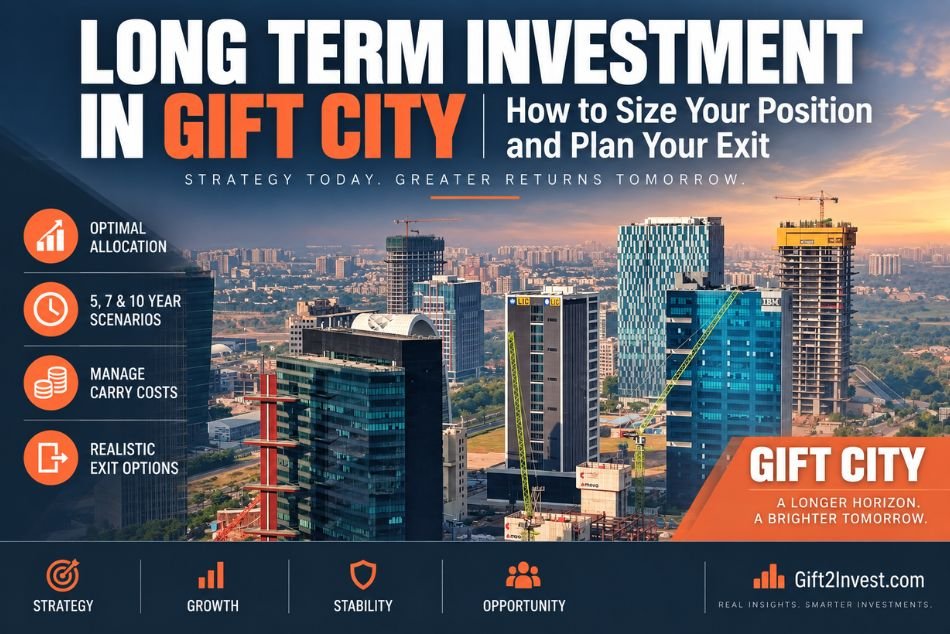
Long Term Investment in GIFT City Is an Allocation Question, Not Just a Buy Decision
Everyone asks whether to invest in GIFT City. Fewer people ask how much to put in, in what form, and how to eventually get out.
Those are the questions that actually determine whether a long term investment in GIFT City works for you. The city’s fundamentals are strong enough that the buy-or-don’t-buy question has a fairly clear answer for most serious investors. The allocation, timing, and exit questions are where the real work is.
This article addresses the portfolio strategy side — how GIFT City fits into a broader real estate portfolio, what a sensible allocation looks like, what the 5, 7, and 10-year scenarios look like in numbers, and what your realistic exit options are.
How GIFT City Fits Into a Real Estate Portfolio
GIFT City is not a substitute for core real estate positions. It’s an addition to them — and that distinction matters for sizing.
Core real estate positions are your primary residence, maybe a second property in an established city like Bengaluru, Ahmedabad, or Pune. Liquid, mature markets. High-confidence rental demand. Relatively easy resale.
GIFT City sits in a different category — call it growth-oriented real estate. It has strong structural tailwinds and genuine appreciation potential, but it has less liquidity than a mature city market and it requires a longer holding period to deliver its thesis.
A reasonable framework: no more than 20 to 30 percent of your real estate portfolio in emerging or specialised markets like GIFT City. Within that allocation, GIFT City is one of the more defensible bets — it has policy backing and institutional tenants that most emerging micro-markets don’t. But the concentration risk argument still applies. Spreading across two or three emerging market positions is better than going all-in on one.
Commercial vs Residential — Different Allocation Logic
Commercial and residential in GIFT City serve different portfolio functions. Understanding that difference helps size each correctly.
Commercial IFSC space is closer to an income asset — if you buy a leased Grade-A office with an institutional tenant in place, you have a fairly predictable cash flow stream backed by a 5-year lease. The appreciation upside is real but secondary to the income yield. Treat it more like a bond with equity upside.
Residential in GIFT City is closer to a pure appreciation play. Rental yields are 7 to 9 percent — they exist, but they’re not the reason to buy. The reason to buy is the gap between current pricing and where prices will be when the city reaches operational maturity. That’s a capital appreciation thesis, not an income thesis.
For investors who need current income, commercial is the better fit. For investors who can afford to wait, residential offers more upside — but it requires patience that a lot of investors say they have and then don’t.
Commercial gives you income while you wait. Residential rewards you for waiting. Know which one you’re actually buying.
The 5, 7, and 10-Year Holding Scenarios
GIFT City property has appreciated roughly 20 to 30 percent in per-sqft residential terms over the past three years. That’s a strong base rate. But past performance in an emerging market doesn’t roll forward automatically — the next phase of appreciation depends on specific catalysts landing on schedule.
A 5-year hold is workable but requires catalyst awareness. Metro connectivity landing within that window is the key variable. If it arrives in year 3 or 4, your exit timing benefits from the re-rating. If it stretches to year 6, you’ll want to extend. A 5-year hold should be modelled with an extension option, not a hard exit deadline.
A 7-year hold is more comfortable. By year 7, the metro connection is very likely operational, the first foreign university campus should be fully running, and the retail/hospitality layer will have thickened considerably. The city will look and feel materially different from today. That change in character is what drives price step-changes in developing districts — and 7 years is long enough to capture it.
A 10-year hold is the highest-conviction thesis. You’re buying into the full buildout story — the gap between 35-40 percent development today and 70+ percent development by the mid-2030s. If you can genuinely hold 10 years without being forced to sell, GIFT City residential is one of the cleaner long-duration bets in Indian real estate. The downside case over 10 years, given the institutional anchors and government backing, is modest underperformance. The upside case is substantial.
Carry Costs: The Maths Most Investors Skip
Any honest analysis of long term investment in GIFT City has to account for carry costs — the total cost of holding the asset before you sell or earn enough income to cover it.
For a residential property generating 3.5 percent rental yield: if your borrowing cost is 9 percent, you’re carrying 5.5 percent of the asset value every year in net cost. On a 1 crore property, that’s Rs. 55,000 per month coming out of your pocket.
Over a 7-year hold, the cumulative carry is approximately Rs. 46 lakhs. The appreciation needs to comfortably exceed that number to justify the position. At 20 percent total appreciation over 7 years — a conservative case given the catalysts in the pipeline — the maths is tight. At 50 to 60 percent appreciation, it’s strong.
The carry maths is why loan-to-value matters in GIFT City specifically. Buyers who can put in 50 to 60 percent equity rather than 80 percent debt have a much more manageable carry position. The trade-off between leverage and carry is worth modelling explicitly before committing.
For commercial IFSC property with an 8 to 9 percent yield, the carry equation is different — income roughly covers or exceeds borrowing costs, so you’re not paying to hold. That’s why commercial makes more sense for leveraged investors and residential makes more sense for those with stronger equity positions.
Exit Options: What’s Actually Available
Liquidity in GIFT City is improving but still narrower than established city markets. Here’s an honest look at your exit options.
Secondary sale to another investor is the most common exit path. The buyer pool for GIFT City property is growing — NRIs, financial services professionals familiar with the zone, institutional investors increasingly active in the market. But it’s not the Ahmedabad SG Highway secondary market. Expect to spend more time finding the right buyer, and price your listing accordingly.
Lease-and-hold for commercial is a valid long-term strategy — collect income through the holding period and sell into a more liquid market in year 7 to 10 when occupancy and valuations are higher. This requires a quality tenant in place. A vacant commercial unit is significantly harder to sell than one with a 3-year lease in place.
Developer buyback schemes exist in some GIFT City projects but are not universal. Read these clauses very carefully — the buyback price, timeline, and conditions are usually conservative. Don’t buy a project primarily because of the buyback clause unless you’ve modelled the scenario where the developer doesn’t honour it.
Distressed exit — if you need to sell quickly — should be modelled as a 10 to 15 percent discount to market price, given the thin liquidity. If there’s any chance you need capital back within 3 years, GIFT City property is not the right vehicle for that capital.
Concentration Risk and Portfolio Diversification
GIFT City is a single geographic location tied to a single economic theme — financial services. That’s concentration risk even within a diversified real estate portfolio.
If you own both residential and commercial in GIFT City, both positions are affected by the same risk — an IFSCA policy slowdown, a broader financial sector downturn, or a development delay. You’ve diversified by asset class but not by risk factor.
The better diversification approach: pair a GIFT City position with exposure to a different economic theme. A GIFT City commercial position plus a residential position in a high-growth corridor driven by manufacturing or IT is a more genuinely diversified portfolio than two GIFT City positions.
None of this is an argument against GIFT City. It’s an argument for sizing the position within a portfolio context rather than treating it as a standalone investment.
When to Add to Your Position vs When to Wait
The most common mistake in emerging market real estate is trying to time the market precisely. You don’t need to buy at the bottom. You need to buy before the catalysts land.
The current window — before metro connectivity, before the first foreign university is operational, before the retail layer matures — is one of the better entry periods available. These catalysts are confirmed and funded. They’re not speculative.
If you’re waiting for the city to ‘feel ready,’ you’re waiting for a signal that will arrive after the pricing has already moved. That’s consistently how emerging district real estate works across every market globally.
Add to your position on dips in sentiment rather than on positive headlines. GIFT City commercial values dipped during quieter IFSCA periods. Those dips were entry windows for investors with conviction in the longer story. They will likely recur.
FAQs: Long Term Investment in GIFT City
Q1) How Much of My Real Estate Portfolio Should I Allocate to GIFT City?
A reasonable range is 15 to 25 percent of your total real estate portfolio, depending on your liquidity needs and risk appetite. Below 15 percent, the position is too small to move your portfolio meaningfully. Above 30 percent, you’re taking significant concentration risk in a single geography and economic theme.
Q2) Is Residential or Commercial the Better Long-Term Investment in GIFT City?
Different portfolio functions. Commercial IFSC property is better for investors who need yield now. Residential is better for investors playing capital appreciation with a 7 to 10-year horizon. Both have a place in a portfolio — they just serve different roles.
Q3) What’s the Minimum Realistic Holding Period for GIFT City Residential?
5 years minimum. 7 years is more comfortable. Below 5 years, you’re racing against the carry cost and the liquidity constraint simultaneously. That’s a tough position to win from unless you’ve bought into a project at exceptional entry pricing.
Q4) Can I Exit a GIFT City Position Through a REIT or Institutional Sale?
Institutional buyers — REITs, PE funds, family offices — are increasingly active in quality GIFT City commercial assets. For well-leased institutional-grade commercial property, this is a realistic exit path. Residential and smaller commercial units are more dependent on the individual buyer market.
Q5) What’s the Biggest Risk to the Long Term Investment in GIFT City Thesis?
A sustained deceleration in IFSCA’s regulatory expansion pace. Everything else — construction delays, short-term sentiment — is recoverable over a 7 to 10-year hold. But if the pace of new permitted activities, new entity registrations, and new institutional entrants slows materially for 3 to 4 consecutive years, the commercial demand story weakens and takes residential with it. Track IFSCA’s annual activity reports as your leading indicator.