The Real Benefits of Investing in GIFT City
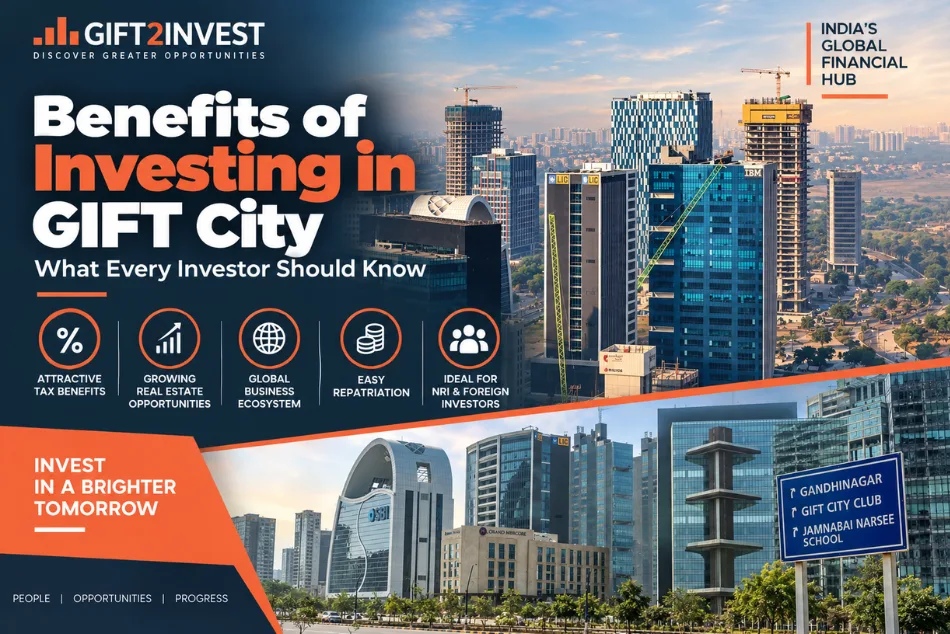
The benefits of investing in GIFT City go well beyond what most people expect when they first hear about it. Yes, there are tax breaks. Yes, the infrastructure is impressive. But what makes Gujarat International Finance Tec-City genuinely interesting is how it has quietly repositioned itself from a government ambition into something that serious investors — domestic, NRI, and foreign — are actually paying attention to. If you have been on the fence, this is a breakdown of what is actually on offer.
Situated between Ahmedabad and Gandhinagar, GIFT City is India’s first operational greenfield smart city and its only International Financial Services Centre (IFSC). That last bit matters a lot. The IFSC designation gives it a regulatory identity that is separate from the rest of India — and the practical implications of that are significant.
It Operates Like a Jurisdiction of Its Own
For regulatory purposes, GIFT City IFSC is treated as a foreign jurisdiction under FEMA — India’s Foreign Exchange Management Act. That means transactions happen in foreign currencies (USD, EUR, AED, SGD), and entities based here are not subject to the usual constraints that apply on the Indian mainland.
Foreign exchange moves freely. Companies can transact, retain, and repatriate foreign currencies without the caps that apply elsewhere in India. For international investors and NRIs, this is a big deal — it removes a layer of friction that normally makes India-based investments complicated.
The regulator here is IFSCA — the International Financial Services Centres Authority — not SEBI or RBI. That is not just an administrative detail. It means the regulatory framework is specifically built for international-standard financial activity, with a unified approach that covers banking, insurance, capital markets, and fund management under one roof.
Tax Advantages That Are Actually Meaningful
Let’s be direct about the tax picture because it is genuinely one of the strongest cases for GIFT City.
Companies set up in the IFSC can choose a 100% tax holiday on profits for 10 consecutive years out of a 15-year block. There is no GST on services received by IFSC units or on services provided to IFSC units, SEZ units, and offshore clients. Minimum Alternate Tax (MAT) is significantly reduced. Duty-free imports and exports apply within the SEZ.
For investors (not just companies), the picture is similarly attractive. Interest income earned from money lent to IFSC units is fully tax-exempt. Dividends and long-term capital gains from GIFT City investments carry concessional tax rates. Gains from transferring specified securities listed on IFSC exchanges are not treated as a taxable transfer for non-residents. Income from certain derivatives — including non-deliverable forward contracts with IFSC banking units — is exempt from tax.
There is also no Securities Transaction Tax (STT), no Commodity Transaction Tax (CTT), and no stamp duty on trades executed on IFSC exchanges. For active traders, that is a material saving.
NRIs and OCIs get an additional angle: GIFT City funds are exempt from TDS, operate in tax-friendly jurisdictions, and can leverage bilateral tax treaties between India and other countries depending on where the investor resides.
Real Estate: Steady Growth, Not Speculation
Property investment at GIFT City is different from what you see in most Indian real estate markets. The city is still in its growth phase, which means current buyers are not paying peak prices. More companies are setting up here each year — as of mid-2025, there were 939 registered entities, including over 100 foreign companies.
That growing corporate presence pulls in professionals and expats who need housing. Rental demand for both residential and commercial property is rising. Average residential rents run around Rs. 30,000 per square foot, and the upward trend is likely to continue as the ecosystem matures.
For long-term investors, the buy-and-hold play is particularly interesting. Early entry now, before the city reaches full occupancy and recognition, is the kind of positioning that looks obvious in hindsight. You are still early enough to benefit from appreciation without overpaying.
The city itself covers 886 acres and is designed as an integrated urban environment — commercial, residential, schools, healthcare, parks, and retail all in one compact layout. The walk-to-work concept means residents and employees are not commuting across a sprawling city. That translates to higher quality of life and, practically, makes the location more attractive to employers recruiting talent.
Infrastructure That Actually Works
One reason the benefits of investing in GIFT City hold up under scrutiny is that the infrastructure is not aspirational — it is operational. Uninterrupted power, centralized cooling, high-speed data connectivity, and 24/7 security surveillance are already in place.
The city uses a district cooling system, an automated waste collection system, and a utility tunnel that runs underground — all implemented in India for the first time here. For businesses that need reliable infrastructure, particularly in financial services and technology, this matters more than it sounds.
The plug-and-play setup also means companies do not need to spend months sorting out utilities and basic services before they can operate. That reduces setup time and cost considerably.
Who Is Already Here
Standard Chartered was the first foreign bank to commence operations at GIFT IFSC and has since extended its full range of services to both international and domestic clients. SGX (Singapore Exchange) operates through a subsidiary here. Barclays has established a branch. Hundreds of funds — 272 at last count — are registered in the city, along with 47 insurance firms.
This is not a city that is waiting for credibility. Global names chose to be here because the framework works. That validation matters when you are deciding where to place capital.
The 2025 Gujarat GCC Policy targets Rs. 10,000 crore in Global Capability Centre investment and 250 new centres across the state, with GIFT City at the center of that push. Companies in semiconductors, pharmaceuticals, fintech, and auto-tech are all being courted — with real incentives on CAPEX, OPEX, skill development, and R&D.
Fintech and the Regulatory Sandbox
GIFT City runs a dedicated FinTech sandbox — a controlled environment where startups and established firms can test new products under regulatory supervision before full-scale launch. For anyone building in payments, insurtech, or financial analytics, this is genuinely useful infrastructure.
The broader fintech ecosystem here includes a growing talent pool — professionals with backgrounds in financial analytics, risk management, and digital payments. Ahmedabad-Gandhinagar was ranked the top emerging Tier-II city in India by Zinnov, which means the talent available to companies setting up in GIFT City is not a compromise.
What NRIs and Foreign Investors Get Specifically
For NRIs and foreign investors, GIFT City funds are probably the cleanest access point. These are mutual funds launched by asset management companies operating in GIFT City, denominated in major global currencies, and structured for ease of cross-border investment.
Full repatriation of proceeds is allowed — you can move money out when you need to. Securities traded on GIFT City exchanges are generally liquid. The funds invest across global securities in multiple currencies, which gives a diversification benefit that purely domestic Indian investments cannot offer.
Bonds listed on IFSC exchanges also carry concessional tax rates, and income from AIF Category III funds is taxed at the fund level — meaning investors in such funds generally do not face an additional personal tax hit.
The combination of FEMA relaxation, tax treaty benefits, and the ability to transact in foreign currencies makes GIFT City a genuinely practical option — not just a theoretical one — for NRIs who want exposure to Indian growth without the usual regulatory friction.
State-Level Support on Top of Central Policy
The Government of Gujarat layers on additional incentives beyond what the central government provides. These include grants, subsidies, OPEX and CAPEX support, and employment generation incentives. IT and ITeS companies get state-level benefits on top of the central IFSC framework.
Compliance is also lighter than on the mainland — there are relaxations on appointments of internal auditors and on certain loan and investment restrictions that apply to companies set up in GIFT IFSC. For companies, that lowers operational overhead.
Wrapping Up: Why the Benefits of Investing in GIFT City Add Up
The benefits of investing in GIFT City are not built on a single compelling feature. They stack. A unique regulatory framework. Serious tax advantages for both companies and investors. Infrastructure that functions at international standards. A city designed around the people who live and work in it. Full currency freedom for cross-border activity. A growing ecosystem of global institutions that have already committed capital here.
It is also still early. With 939 registered entities and more joining each year, the city has reached a threshold where momentum is real — but it has not yet reached the stage where property prices and commercial rents reflect its full potential.
Whether you are looking at commercial property, residential investment, financial instruments, or setting up a business, the benefits of investing in GIFT City become clearer the closer you look. The framework is solid. The direction is clear. The question is really just timing.
For detailed listings, updated property data, and GIFT City-specific investment guides, check Gift2Invest.com — a resource built specifically around GIFT City, covering everything from listings to in-depth blogs on how the zone works.
Frequently Asked Questions: Investing in GIFT City
Q1) What Exactly Is GIFT City and Why Is Everyone Talking About It?
GIFT City — Gujarat International Finance Tec-City — is India’s first International Financial Services Centre (IFSC), located between Ahmedabad and Gandhinagar. It is a special zone that operates under its own regulatory authority (IFSCA) and is treated as a foreign jurisdiction under FEMA for practical purposes.
The reason it gets attention is simple: it offers a business and investment environment that does not exist anywhere else in India. Transactions happen in foreign currencies, compliance is lighter, and the tax framework is built to compete with global hubs like Singapore and Dubai.
Q2) Who Can Invest in GIFT City?
A fairly wide range of people. Resident Indians, NRIs, Overseas Citizens of India (OCIs), Foreign Portfolio Investors, Foreign Institutional Investors, and global financial institutions can all participate.
The entry point depends on what you are investing in. Financial instruments, GIFT City mutual funds, and real estate each have their own process and eligibility criteria. NRIs often find the funds route the most straightforward.
Q3) What Are the Main Tax Benefits for Individual Investors?
Interest income from money lent to IFSC units is fully tax-exempt. Dividends and long-term capital gains from GIFT City investments are taxed at concessional rates. For non-residents, gains from transferring specified listed securities are not treated as a taxable event at all.
There is also no Securities Transaction Tax (STT), no Commodity Transaction Tax (CTT), and no stamp duty on trades executed on IFSC exchanges. For anyone trading actively, those savings add up fast.
Q4) How Is GIFT City Different From Investing Anywhere Else in India?
The clearest difference is the regulatory layer. Everywhere else in India, you deal with SEBI, RBI, and domestic tax rules as one package. At GIFT City, IFSCA is the single unified regulator, foreign currency transactions are unrestricted, and a separate tax framework applies.
The benefits of investing in GIFT City are partly about what you gain — tax holidays, concessional rates, duty-free activity — and partly about what you avoid: STT, CTT, stamp duty, GST on specified services, and several layers of compliance that apply on the mainland.
Q5) Is It Safe to Invest in GIFT City? What Protections Exist?
The regulatory framework under IFSCA includes mandatory entity registration, strict reporting requirements, and a structured investor complaint system. It is benchmarked against international financial standards, not domestic ones.
Major global institutions — Standard Chartered, Barclays, SGX — have set up here, which is a reasonable indicator that the framework holds up to scrutiny. That said, as with any investment, the specific risk profile depends on what you are investing in.
Q6) Can NRIs Move Money out Freely After Investing?
Yes, and this is one of the more practical benefits of investing in GIFT City for NRIs. Full repatriation of proceeds is permitted — funds generated from transfer, redemption, or liquidation of IFSC securities can be freely remitted abroad, unless there are investment-specific restrictions on a particular instrument.
GIFT City funds are also denominated in major global currencies (USD, EUR, AED, SGD), so currency conversion is not a constant headache.
Q7) What Is the Real Estate Opportunity Like?
GIFT City real estate is still in a growth phase. The city currently has 939 registered entities and is adding more foreign companies each year. That growing corporate base creates genuine rental demand from professionals and expats.
For long-term buyers, the opportunity is early-stage appreciation. Property prices have not yet caught up with the city’s trajectory. Residential and commercial properties are both seeing rising demand. For updated listings specific to GIFT City, Gift2Invest.com is a good place to research what is currently available.
Q8) What Is a GIFT City Fund and How Does It Work?
GIFT City funds are mutual funds launched by asset management companies operating within the IFSC. They are denominated in foreign currencies, regulated by IFSCA, and exempt from TDS.
They invest across global securities in multiple currencies, which gives investors a diversification angle that domestic Indian funds cannot offer. AIF Category III funds are taxed at the fund level, meaning investors typically do not face a separate personal tax on income distributed from such funds.
Q9) Is It a Good Time to Invest in GIFT City Right Now?
The benefits of investing in GIFT City are arguably strongest right now precisely because the city is not yet fully built out. Early investors get lower entry prices, higher appreciation potential, and all the tax advantages — without waiting for the ecosystem to mature.
The risk of waiting is that prices adjust once the city hits full recognition. Several global institutions have already made that calculation and committed capital. Retail and individual investors are still relatively early to the party.
Q10) Where Do I Go to Research GIFT City Investment Opportunities Further?
Gift2Invest.com is a specialized platform built around GIFT City — it covers listings for both residential and commercial properties, as well as blog content explaining how different aspects of the GIFT City framework work.
For official regulatory and policy information, IFSCA’s website and GIFT City’s official portal both maintain updated documentation on frameworks, incentives, and registered entities.