
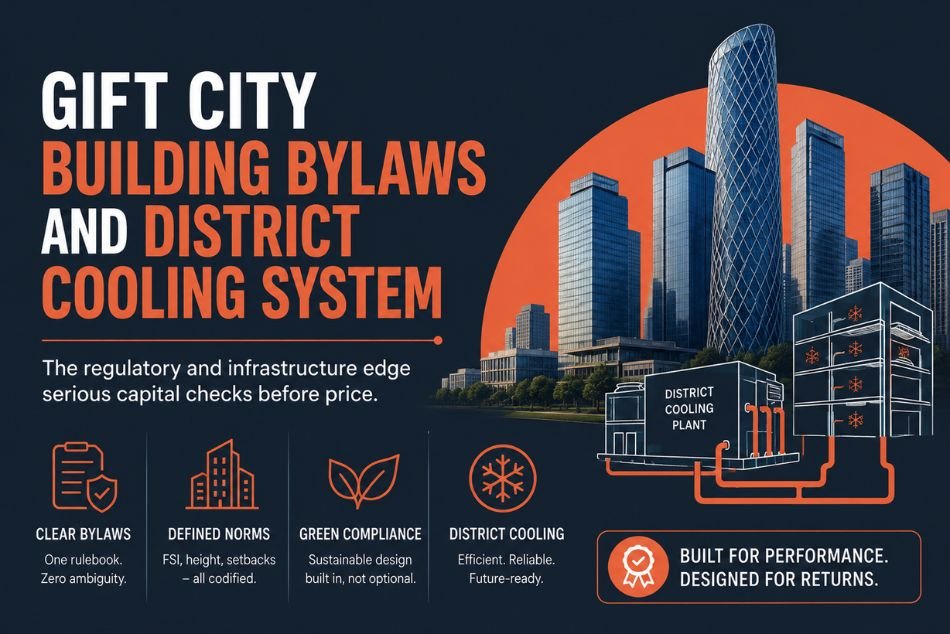
Gift City Building Bylaws and District Cooling System: Why This Layer Decides Real Returns
Most people researching GIFT City start with tax breaks. Serious capital starts somewhere else. Before a family office or an institutional buyer commits to a whole floor, or a whole building, inside GIFT City, the first documents their advisors actually read are the building bylaws and the specifications of the district cooling system.
That is not a technicality. GIFT City building bylaws and district cooling system requirements together decide what you are legally allowed to build, how efficiently that building runs once it is occupied, and how much of your rental income actually survives after operating costs. For a buyer thinking in whole floors rather than single units, this is the layer where real returns are made or eroded.
This article is written for that buyer. Not the first-time residential purchaser. The family office, the treasury desk, the private investment vehicle looking at GIFT City as a genuine multi-decade allocation. Everything here is checked against the framework published by the GIFT City Development Corporation and IFSCA.
Why Bylaws Are the First Filter for Whale-Scale Capital
A retail buyer looks at a floor plan and a price. An allocator moving eight or nine figures into a single asset looks at the regulatory framework the building was constructed under, because that framework outlives the current owner, the current tenant, and the current market cycle.
GIFT City’s advantage is not that it has bylaws — every Indian city does. The advantage is that GIFT City has a defined development-control framework, with applicable regulations and approval processes varying by the relevant zone and development. A buyer evaluating a whole building here is not reverse-engineering which ward officer approved what exception. There is one rulebook, and it is public.
For capital that plans to hold an asset for a decade or more, that consistency is worth more than a headline yield number. It is the difference between underwriting a building and underwriting a jurisdiction.
What Gift City’s Building Bylaws Actually Govern
GIFT City sits inside a notified Special Investment Region under Gujarat’s SIR Act. That single fact changes how construction works here compared to a standard Indian city.
In most Indian cities, building bylaws are set by a municipal corporation, and enforcement varies by ward, by inspector, by year. GIFT City operates under a Development Control Regulations framework administered through its development-approval system, with zone-specific and infrastructure requirements applying where relevant.
Floor Space Index, height permissions, setback requirements, parking norms, and fire and life-safety codes are fixed and published, not negotiated project by project. A whole-floor or whole-building acquisition depends on knowing exactly what the developer was permitted to build, and confirming the building was actually delivered against that permission — not an approximate version of it.
The bylaws also fix zone-specific rules. What is permitted inside the IFSC notification boundary differs from what is permitted in the Domestic Tariff Area. Both fall under the same Development Corporation, but end use, tenant eligibility, and in some cases construction specification differ by zone. Confirming zone-specific bylaw compliance is step one in any serious due diligence process here, well before price is even discussed.
FSI, Height, and Setback Norms — The Numbers Behind the Skyline
Floor Space Index determines how much built-up area a given land parcel can carry. In GIFT City, FSI norms are set centrally by the Development Corporation and applied consistently across comparable zones, rather than varying building to building based on local negotiation.
That matters directly for a whole-building buyer. It means the building next door, on a similarly zoned parcel, was built under the same ceiling your asset was built under. There is no risk of a competitor tower quietly securing a more generous FSI approval that undercuts your asset’s relative scarcity.
Setback and height norms follow the same logic — codified, published, and applied uniformly within each zone. For an institutional buyer, this predictability is what makes long-range planning around views, light, and future redevelopment potential possible in the first place. You are underwriting known rules, not hoping the rules stay the same.
Green Building Compliance Is Not Optional Here
Most Indian developers treat green building certification as an optional upgrade, priced at a premium. GIFT City’s bylaws treat it as baseline.
GIFT City has adopted stringent green-building and environmental sustainability requirements within its development framework, with green-building standards and sustainability guidelines applying to relevant developments.
For an institutional buyer, this removes a variable that complicates due diligence almost everywhere else in Indian commercial real estate. You are not evaluating whether a specific developer chose to build efficiently. Relevant developments are required to comply with the applicable sustainability and development requirements.
That baseline matters for exit too. Institutional buyers — REITs, pension-linked funds, sovereign-adjacent capital — increasingly screen for ESG compliance before they will even look at an asset. A GIFT City commercial floor arrives with that box checked by regulation, not by developer discretion. It widens your eventual buyer pool without you having to do anything extra.
Power Redundancy and Data Infrastructure Bylaws
The tenant profile GIFT City is built for — banks, fund managers, insurers, exchanges — cannot tolerate an unplanned power interruption. A trading desk that loses power mid-session is not a minor operational hiccup. It is an event that gets reported to a global head office within the hour.
That is why resilient power infrastructure and building-services specifications are important considerations for Grade-A buildings serving IFSC tenants, alongside raised flooring, dedicated cooling paths, and financial-grade broadband infrastructure. A building without these specifications will not attract institutional financial tenants, regardless of its address or its zone classification.
Before committing capital to a whole floor intended for an IFSC-registered tenant, ask for the building’s mechanical and electrical specification sheet directly. A rendering will not tell you the redundancy level. The specification sheet will.
The District Cooling System: What It Actually Is
Air conditioning is usually the single largest recurring operating cost for a commercial office floor in India. GIFT City removed that cost structure at the city level, not the building level.
The district cooling system is a centralised network that produces chilled water at dedicated plants and distributes it through underground pipelines to every connected building in the city. Individual buildings draw chilled water from the network instead of running their own compressors, chillers, and cooling towers.
This is the first system of its kind implemented at city scale in India. It was built into GIFT City’s master infrastructure from the ground up, alongside the utility tunnel and the automated waste collection network, rather than retrofitted after the towers went up.
For a tenant or an owner-occupier, the daily experience is simple: consistent, reliable cooling, with no rooftop plant, no compressor noise, and no separate maintenance contract for a building-level chiller. For an investor, the number that matters is what disappears from the operating expense line entirely.
Why District Cooling Sits in the Bylaws, Not the Amenities Brochure
Here is the detail most listings skip. District cooling is a core GIFT City utility, and applicable buildings in the connected zones are subject to the relevant DCS requirements and connection processes.
That distinction is the whole point. An amenity is something a developer can quietly remove under cost pressure. A bylaw requirement cannot be removed without losing occupancy approval. When you are evaluating a whole floor or whole building purchase, confirming district cooling connectivity through the allotment and completion documentation — not the sales brochure — is a short check that protects a very large commitment.
Because DCS is integrated into GIFT City’s core infrastructure, applicable buildings in connected zones start from a common infrastructure framework, subject to the specific requirements for the parcel and development. You are not comparing a district-cooled tower against a conventionally air-conditioned one and trying to price the difference yourself. The comparison set is already normalised, which makes your due diligence faster and your yield assumptions more reliable.
An amenity is a marketing choice. A bylaw is a legal condition of occupancy. GIFT City built district cooling into the second category — and that is exactly why it has stayed universal instead of getting value-engineered out.
The Operational Expenditure Case for Large Offices
Run the arithmetic that actually matters to a treasury desk evaluating a whole-floor acquisition.
A conventional Grade-A office building carries its own chiller plant, its own maintenance contracts, its own peak-demand electricity draw, and its own equipment replacement cycle roughly every ten to fifteen years. Every one of these is a fixed cost line sitting on the landlord’s or the occupier’s books, regardless of occupancy.
GIFT City’s district cooling infrastructure can remove much of the need for building-level cooling plant capital expenditure and maintenance, while the owner or occupier still pays for chilled-water consumption and applicable network charges. You pay for chilled water consumption through the network operator instead of running and maintaining your own plant. No capital expenditure on chiller replacement. No standalone maintenance crew. No compressor failure risk during a critical trading week.
For a tenant that is a regulated financial entity, uptime is not a convenience, it is a regulatory and operational necessity. District cooling’s redundancy at the network level, rather than the single-building level, is a real underwriting consideration for exactly this tenant category — and it can be a relevant consideration when institutional tenants assess building performance, operating continuity, and long-term occupancy.
None of this shows up as a headline number in a listing. It shows up in your net yield calculation, quarter after quarter, for as long as you hold the asset.
The Utility Tunnel and What It Means for Large Buildings
The district cooling network does not run through open trenches or overhead cabling. It runs through GIFT City’s underground utility tunnel, alongside power lines, data cabling, and the automated waste collection system.
The utility tunnel is a core part of GIFT City’s infrastructure. Applicable buildings connect to the relevant utility systems through the planned underground infrastructure, subject to the specific development and service requirements.
For an owner of a whole floor or whole building, this has a practical consequence. Utility maintenance, repairs, and upgrades happen inside the tunnel, without digging up roads or disrupting building access. Downtime windows are shorter and more predictable than in a conventional Indian commercial district, where a single cable fault can mean days of disruption.
At scale, that predictability is worth more than it sounds. A tenant signing a long institutional lease is underwriting years of uninterrupted operation. Infrastructure that fails less often, and recovers faster when it does fail, is a real input into the rent that tenant is willing to commit to — and the covenant strength behind that lease.
How Gift City’s Framework Compares to DIFC, Marina Bay, and Canary Wharf
Investors evaluating GIFT City at this capital scale are typically also holding, or have held, positions in Dubai’s DIFC, Singapore’s Marina Bay, or London’s Canary Wharf. The comparison they make is not about tax rates alone. It is about infrastructure discipline.
DIFC and Marina Bay both benefited from a single master developer and a single planning authority in their formative years, which is precisely why their infrastructure feels coherent decades later. GIFT City was built on the same logic — one Development Corporation, one bylaw framework, one infrastructure backbone — rather than the fragmented, multi-agency approvals typical of most Indian commercial districts.
One of GIFT City’s notable infrastructure features at this stage is its centralised district cooling network, built into the city’s master infrastructure rather than relying solely on building-level cooling systems. That is a genuine structural advantage for a buyer thinking about operating costs over a multi-decade hold, not just entry pricing.
What This Means When You Are Buying a Whole Floor or Whole Building
Retail buyers evaluate a single unit against a brochure. At whale scale, the evaluation looks completely different.
A whole-floor or whole-building acquisition means you are effectively underwriting the building’s entire operating cost structure for the life of your hold. GIFT City’s building bylaws and district cooling system are the two variables that determine whether that structure is genuinely efficient or merely marketed as such.
Before committing capital at this scale, three documents matter more than the developer’s pitch deck. The Development Corporation’s allotment letter, confirming zone classification and permitted construction. The occupancy certificate, confirming the building actually met the green building and infrastructure bylaws it was approved under. And the district cooling connection agreement, confirming the building is genuinely tied into the network rather than running a parallel standalone system.
Buyers who skip this and rely on a rendering or a sales presentation are underwriting a promise. Buyers who verify against these three documents are underwriting a fact. At the capital scale this article is written for, that distinction is not optional diligence — it is the difference between a defensible institutional position and an expensive assumption.
A Due-Diligence Checklist for Whole-Floor and Whole-Building Buyers
Run any large-ticket GIFT City acquisition through this sequence before capital moves.
- Confirm zone classification — IFSC or DTA — from the Development Corporation’s allotment document, not the developer’s brochure.
- Request the building’s occupancy certificate and cross-check it against the green building compliance requirement for that zone.
- Verify the district cooling connection agreement directly with the network operator, not just the developer’s sales team.
- Ask for the mechanical and electrical specification sheet — power redundancy level, raised flooring, dedicated cooling capacity — for any floor intended for an institutional financial tenant.
- Confirm the utility tunnel connection status for power, data, and waste systems.
- Check the developer’s specific delivery history inside GIFT City, not their broader Gujarat or pan-India record.
- Model carry costs and fit-out timelines conservatively, particularly for any forward-purchase or under-construction acquisition.
The FOMO Nobody Talks About: Regulatory Certainty Has a Shelf Life
Here is the part most GIFT City content misses entirely. The regulatory and infrastructure advantage described above is not permanent by default. It is a function of GIFT City still being early enough in its build-out that the Development Corporation operates within a defined development-control framework, with applicable requirements depending on the relevant zone and development.
As GIFT City fills out its remaining land parcels — and a meaningful share of the master plan is still under construction — every new building added to the network strengthens the case for district cooling and unified bylaws economically. But it also means the buildings closest to the operational core, already connected, already certified, already delivering the full infrastructure advantage today, are a finite and shrinking share of total city inventory.
Whole-floor and whole-building inventory of this quality does not come back onto the market in volume. Institutional-grade assets inside a bylaw-governed, district-cooled zone tend to get acquired and held by exactly the kind of capital this article is written for — family offices, treasury desks, sovereign-adjacent funds — and they do not typically resell in the short term once acquired.
The buyers moving on this now are not chasing a story. They are locking in verified infrastructure economics before the remaining core inventory is absorbed by other capital exactly like theirs.
The Honest Risk Register
No serious allocation decision skips risk, and this one shouldn’t either.
Construction timelines inside GIFT City, like anywhere in India, have stretched before. A building under construction today, promised with full district cooling and bylaw compliance, should still be verified at occupancy — not assumed from the brochure at booking stage.
Liquidity for whole-floor and whole-building assets is thinner than for smaller units. An institutional-scale exit typically means finding another institutional buyer, which takes longer to arrange than a retail resale, even when the underlying asset is exactly as strong as described here.
Network dependency is worth naming honestly. Being tied into the district cooling system means your building’s cooling reliability is partly a function of the network operator’s maintenance standards, not solely your own building management. In practice this has run reliably since the system’s inception, but it is a dependency worth discussing directly with the operator, not assuming away.
None of these change the underlying case. They are the parameters a serious allocator prices in before committing, not reasons to wait indefinitely.
Wrapping Up: Gift City Building Bylaws and District Cooling System As the Real Underwriting Layer
Most investment content about GIFT City talks about tax holidays and entity counts, and those matter. But for capital operating at whole-floor and whole-building scale, GIFT City building bylaws and district cooling system requirements are the layer that actually determines whether an asset performs the way the pitch says it will.
The development framework provides a high degree of regulatory consistency, with applicable development-control and sustainability requirements that must be satisfied through the approval process. The district cooling system removes one of the largest recurring cost lines a commercial building carries anywhere else in India, and does it at the infrastructure level rather than leaving it to individual developer discretion.
For a family office or an institutional buyer evaluating GIFT City as a genuine multi-decade position, checking GIFT City’s building bylaws and district cooling system credentials before price, before floor plan, before anything else, is exactly the discipline that separates a defensible allocation from an expensive assumption.
FAQs: Gift City Building Bylaws and District Cooling System
Q1) Who Actually Enforces Gift City’s Building Bylaws?
The GIFT City Development Corporation administers the Development Control Regulations for the Special Investment Region, working alongside IFSCA for IFSC-zone specific requirements. This is a single, consistent framework rather than the fragmented municipal enforcement typical of most Indian cities.
Q2) Is District Cooling Mandatory for Every Building in Gift City?
District cooling connectivity is built into the bylaws for the city’s core zones, meaning buildings in these areas are required to connect to the network rather than run standalone cooling plants. Always confirm the specific connection status for any building you are evaluating through the Development Corporation’s documentation, since exact requirements can vary by zone and by parcel.
Q3) How Does District Cooling Actually Lower Operating Costs for a Large Office?
It removes the need for a building-level chiller plant, its maintenance contracts, and its capital replacement cycle. Occupants pay for chilled water consumption through the network instead, which is typically more efficient than running fragmented, building-by-building cooling infrastructure.
Q4) What Should a Whole-Floor Buyer Verify Before Committing Capital?
Three documents matter most: the Development Corporation’s allotment letter confirming zone and permitted construction, the occupancy certificate confirming the building met its bylaw obligations, and the district cooling connection agreement confirming genuine network integration rather than a standalone system.
Q5) Does Green Building Certification Affect Resale Value?
It should, and increasingly does. Institutional buyers — REITs, pension-linked funds, larger family offices — are screening harder for ESG compliance before acquisition. A GIFT City building meeting IGBC Platinum-benchmarked norms by regulation, rather than developer choice, is better positioned for that buyer pool at exit.
Q6) Is This Infrastructure Advantage Unique to Gift City Within India?
Yes, at the scale it operates here. GIFT City’s district cooling system was developed as part of the city’s master infrastructure rather than being added as a building-by-building retrofit. No other Indian financial district currently offers this combination of unified bylaws and centralised cooling infrastructure.
Q7) What Happens to Cooling Reliability if the Network Has an Issue?
District cooling networks are built with redundancy at the plant level, which has historically meant more consistent uptime than a single building’s standalone chiller would deliver on its own. It is still worth discussing the network operator’s maintenance and redundancy protocols directly as part of due diligence for any large acquisition.
Q8) Does the Utility Tunnel Affect Anything Beyond Cooling?
Yes. The same underground tunnel network carries power lines, data cabling, and the automated waste collection system. For a large building owner, this means most utility maintenance and upgrades happen without surface disruption, which shortens downtime windows compared to conventional Indian commercial districts.
Q9) Are These Bylaw and Infrastructure Standards the Same Across the IFSC zone and the DTA?
The underlying Development Corporation framework applies across GIFT City, but specific permitted uses and some construction specifications differ between the IFSC boundary and the Domestic Tariff Area. Confirm zone-specific bylaw requirements for any specific parcel before assuming DTA and IFSC standards are identical.
Q10) Why Does This Matter More for Large-Ticket Buyers Than for a Single-Unit Purchase?
At whole-floor or whole-building scale, you are underwriting a building’s entire operating cost structure for the length of your hold, not just a single unit’s monthly maintenance bill. Bylaw compliance and district cooling connectivity are the two biggest levers determining whether that operating structure is genuinely efficient — which is exactly the diligence layer that protects a large capital commitment.
Source & Reference
GIFT City Developers & Services: DCR, Building Permission, Developer Guidelines and DCS application
https://giftgujarat.in/developers-services
GIFT City Official Website: Infrastructure
https://giftgujarat.in
GIFT City Official: District Cooling System
https://www.giftgujarat.in/infrastructure/dcs