
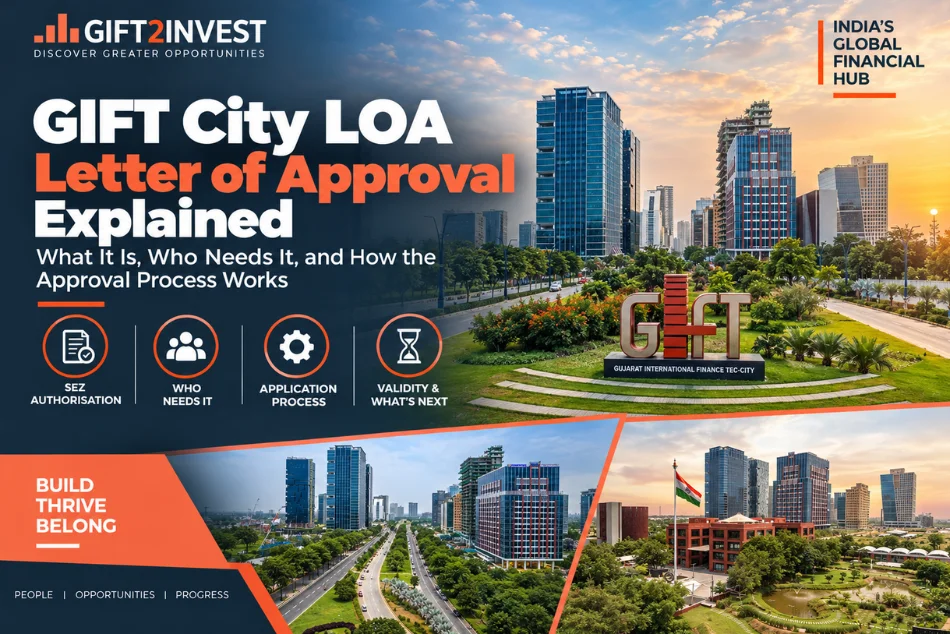
GIFT City LOA: What It Is, Who Needs It, and How the Approval Process Works
Anyone planning to set up a business inside GIFT IFSC runs into this term early. GIFT City LOA — the Letter of Approval — is the SEZ authorisation that lets an entity actually operate as an approved unit inside the zone. It is issued after the business has identified its premises, applied through the correct channel, and cleared review by the Unit Approval Committee.
A common misunderstanding trips up first-time applicants here. Signing a lease or reserving office space in GIFT City does not, on its own, make a business an IFSC unit. The LOA is the SEZ approval required for unit status; sector-specific IFSCA approval is separate. Understanding what GIFT City LOA actually covers, where it sits in the setup sequence, and what happens once it is issued is the difference between a setup that moves smoothly and one that stalls halfway through.
This guide walks through that sequence in practical terms — what the LOA is, who needs it, how the application works, what it authorises, how long it stays valid, and what comes next. It does not repeat the PLOA, Lease Deed, BLUT, or Commencement processes in depth. Each of those has its own dedicated guide on GIFT2Invest.com.
What Is a GIFT City LOA?
In formal terms, the Letter of Approval is the SEZ document issued under Rule 19 of the SEZ Rules, 2006 (in Form GA for IFSC units), authorising an entity to set up and operate as an SEZ unit within GIFT IFSC. It is issued by the Administrator (IFSCA), who exercises the powers of the Development Commissioner for units operating inside GIFT City’s SEZ.
The LOA is activity-specific. It does not grant a blanket permission to do anything inside GIFT City. It authorises the specific operations the applicant applied for and that the Unit Approval Committee reviewed and cleared — banking, fund management, insurance, aircraft leasing, fintech, or whichever category the entity falls under.
This matters because a GIFT City LOA is the SEZ-side approval, not a substitute for the sector-specific IFSCA approval required for the activity. A fund manager still needs IFSCA’s Fund Management Entity registration. A bank still needs its own IFSCA banking approval. The LOA clears the SEZ side of the equation; the regulatory authorisation for the actual financial activity is a separate step layered on top of it.
GIFT City SEZ, GIFT IFSC and the LOA: How They Connect
GIFT City is the broader 886-acre master-planned development. Inside it sits GIFT SEZ, the notified Multi-Services Special Economic Zone under the SEZ Act, 2005. GIFT IFSC — India’s only International Financial Services Centre — operates inside that SEZ, regulated by IFSCA.
Because an IFSC can only be established within an SEZ, every IFSCA-approved unit at GIFT City is automatically an SEZ unit too, and is bound by both frameworks at once. The GIFT City LOA is the SEZ-side approval for the unit; the IFSCA-side regulatory authorisation is a separate approval with its own requirements.
A fuller explanation of how these layers fit together sits in our dedicated article on GIFT City SEZ. This piece stays focused on the LOA itself.
Who Needs a GIFT City LOA?
Any entity planning to operate as an approved SEZ unit inside GIFT IFSC needs an LOA. That covers banking units, fund management entities, insurance offices and intermediaries, capital markets participants, aircraft and ship leasing SPVs, fintech firms graduating from the regulatory sandbox, and family investment structures.
This requirement is specific to businesses seeking IFSC unit status inside the SEZ boundary. A company operating in GIFT City’s Domestic Tariff Area, under standard Indian rules and without IFSCA registration, does not go through this SEZ approval route at all. And an individual buying commercial or residential property in GIFT City as a personal investment has no LOA requirement whatsoever — that obligation belongs to the operating business, not the property owner.
GIFT City LOA Process: Step by Step
The sequence starts well before any application is filed. A business first identifies its proposed activity and finalises premises within GIFT SEZ, typically confirmed through a Provisional Letter of Allotment from the developer. That PLOA becomes a supporting document once the formal SEZ application is filed.
For most business categories, the application route runs through IFSCA’s Single Window IT System, or SWIT. The applicant submits a Common Application Form through SWIT, which covers both the SEZ approval request and the sector-specific IFSCA regulatory application in one filing. For activities that are not yet SWIT-enabled — Foreign Universities and Bullion Trading are two current examples — the SEZ LOA application has to be filed directly on the SEZ Online portal, alongside a separate IFSCA regulatory filing.
Once submitted, the SEZ portion of the application flows automatically from SWIT into the SEZ Online portal for processing. All further steps — deficiency checks, clarifications, and the actual approval — happen on SEZ Online, not on SWIT. It helps to know this in advance, since applicants sometimes keep checking the wrong portal for updates.
Applications that are complete in all respects are placed before the Unit Approval Committee, or UAC, for review. If the UAC finds gaps or needs clarification, it raises deficiencies that the applicant has to address before the file moves forward. Once the UAC is satisfied and the meeting minutes are finalised, the Administrator (IFSCA) issues the GIFT City LOA through the SEZ Online portal, and the applicant downloads it directly from their application record.
A practical point worth flagging here: the documentation, fees, and exact timelines involved in this process are set by IFSCA and the SEZ authority, and they do get updated. Confirm the current checklist and processing expectations directly with IFSCA, the SEZ Online portal, or a qualified compliance advisor before filing, rather than relying on a fixed list from any single source.
What Does the GIFT City LOA Allow an IFSC Unit to Do?
Once issued, the LOA authorises the unit to set up and carry out the specific operations named in the approval — nothing broader than that. If a fintech firm’s LOA covers payments processing, it cannot start offering a different regulated activity without going back through an amendment process, known as broadbanding, before that new activity is added to its authorised operations in the LOA.
The LOA is the SEZ-side clearance. It is not, by itself, the same thing as IFSCA’s sector-specific regulatory registration or authorisation. A banking unit still needs its banking authorisation from IFSCA. A fund manager still needs Fund Management Entity registration. The two run in parallel through the SWIT process for most categories, but they remain legally distinct approvals with distinct conditions attached.
Staying inside the scope of an approved LOA matters operationally too. Units that expand into a new authorised activity without first securing the amendment risk a compliance gap that surfaces later during a review — an avoidable problem with a known, documented fix.
GIFT City LOA Validity and Commencement of Operations
Under the current SEZ Compliance FAQ framework — Version 2.0, issued by the Office of the Administrator (IFSCA) in August 2026 — a GIFT City LOA is issued for project implementation and is valid for one year from its date of issuance.
Within that one-year window, the unit is expected to commence its approved operations and formally intimate the date of commencement to the Administrator (IFSCA). Once that intimation is recorded, the LOA’s validity automatically extends to five years from the date operations actually began.
If a unit needs more time before commencing, an extension can be applied for through the SEZ Online portal, with supporting justification and evidence of progress. Current guidance allows extensions to be sought beyond the standard window, but a unit that lets its LOA lapse without applying for an extension may face consequences under applicable SEZ provisions and require an LOA extension or further UAC consideration.
After the initial five-year period following commencement, the LOA comes up for renewal, and that renewal repeats on a five-year cycle going forward. The specifics of extensions and renewals — timelines, documentation, and what counts as sufficient progress evidence — are covered in more depth in our dedicated GIFT City LOA Extension guide.
What Happens After the LOA Is Issued?
The LOA is a milestone, not the finish line. A handful of further steps still stand between an issued LOA and a fully operational unit.
- Bond-cum-Legal Undertaking (BLUT): executed under Rule 22 of the SEZ Rules and jointly approved by the Specified Officer of Customs and the Administrator (IFSCA). Since Instruction No. 123 of February 2026, this can now be executed electronically as an e-BLUT, without the earlier physical stamp-paper and notarisation steps.
- Registered Lease Deed: the unit has to execute and register a formal lease deed for its approved premises within six months of the LOA date, under Rule 18(2) of the SEZ Rules. This is separate from the PLOA and has its own compliance deadline.
- Eligibility Certificate: issued alongside the approved BLUT, this is what allows the unit to access applicable Gujarat state-level tax exemptions, including stamp duty relief on eligible transactions.
- Import Export Code and other approvals: GIFT-IFSC units are required to obtain an Importer-Exporter Code (IEC), with additional registrations or approvals depending on the specific business category.
- Commencement intimation and ongoing reporting: once operational, the unit moves into periodic compliance reporting, tracked against its LOA and its approved authorised operations.
Each of these steps has its own procedural detail, documentation requirements, and timeline. GIFT2Invest.com covers the BLUT, the Lease Deed, and Commencement of Operations in dedicated guides — this article deliberately keeps each at a summary level so the GIFT City LOA process itself stays the focus.
GIFT City LOA vs PLOA vs Lease Deed
These three terms get used loosely in casual conversation, but each belongs to a distinct stage of the same journey. The table below lays out where each one sits.
| Stage / Document | Main Purpose | Where It Fits | Key Point |
|---|---|---|---|
| PLOA | Provisional allotment of premises | Premises / setup stage, before the SEZ application | Not the same as the final SEZ LOA |
| GIFT City LOA | SEZ approval for the unit and its authorised operations | SEZ setup and approval stage | Issued under Rule 19; for IFSC units, the LOA is issued in Form GA |
| Lease Deed | Formal, registered lease or premises documentation | Premises documentation stage, after the LOA | Separate requirement, due within six months of the LOA date |
| Commencement | Start of approved operations | Post-LOA stage | Has its own intimation and evidence requirements |
A simple way to hold these apart: the PLOA is about where a business will sit. The GIFT City LOA is about the business’s SEZ approval and authorised operations. The Lease Deed is the formal, registered document that confirms the premises once the LOA is already in hand.
Common Mistakes to Avoid
- Assuming a PLOA is the same as the final LOA. It confirms premises, not SEZ approval.
- Treating a signed lease as proof of IFSC unit status. The LOA confers SEZ unit approval; sector-specific IFSCA approval is separately required.
- Assuming the LOA alone permits every financial activity. Sector-specific IFSCA registration or authorisation is a separate, additional requirement.
- Operating beyond the activities named in the approved LOA without first going through broadbanding.
- Letting the one-year commencement window pass without applying for an extension, or without intimating commencement once operations actually begin.
- Assuming property ownership in GIFT City automatically brings the tax benefits and incentives attached to an operating IFSC unit. Those incentives belong to the eligible unit’s business income, not to a landlord or a residential buyer.
Wrapping Up: GIFT City LOA in the Bigger Picture
A GIFT City LOA is the SEZ approval that establishes the business as an authorised SEZ unit. It sits after premises selection and the PLOA, and before the Lease Deed, BLUT, and eventual commencement of operations — each a distinct step with its own timeline and its own compliance file.
Getting the sequence right matters more here than in a standard business setup, because every later filing references back to what the LOA confirms. Understanding what the GIFT City LOA actually authorises, how long it stays valid, and what still has to follow it keeps a setup moving instead of stalling at the exact point most first-time applicants get stuck.
For the stages that sit on either side of the LOA, see our dedicated guides on GIFT City PLOA, GIFT City Lease Deed, GIFT City BLUT, and GIFT City Commencement of Operations.
Planning to set up your business in GIFT City SEZ? Share your business type, preferred area, approximate space requirement and budget. GIFT2Invest.com can help you explore relevant GIFT City commercial properties and identify suitable projects or developers.
GIFT City LOA FAQs
Q1) What Is a GIFT City LOA?
It is the Letter of Approval issued under Rule 19 of the SEZ Rules, 2006 (in Form GA for IFSC units), authorising an entity to set up and operate as an SEZ unit inside GIFT IFSC, for the specific activities the Unit Approval Committee has reviewed and cleared.
Q2) Who Needs to Apply for a GIFT City LOA?
Any business seeking IFSC unit status inside GIFT SEZ — banking units, fund managers, insurance offices, fintech firms, aircraft and ship leasing SPVs, and similar entities. Domestic Tariff Area businesses and individual property owners do not need one.
Q3) What Is the Difference Between PLOA and LOA?
The PLOA is a provisional allotment of premises issued by the developer, confirming a specific unit has been reserved. The LOA is the SEZ approval, issued by the Administrator (IFSCA), authorising the business for its approved SEZ operations.
Q4) How Is the GIFT City LOA Application Process Structured?
Most activities apply through IFSCA’s SWIT portal using a Common Application Form, which flows into SEZ Online for processing. A small number of activities not yet SWIT-enabled file directly on SEZ Online. The Unit Approval Committee reviews complete applications before the LOA is issued.
Q5) How Long Is a GIFT City LOA Valid?
One year from issuance for project implementation. Once the unit intimates commencement of operations within that window, validity extends automatically to five years from the commencement date, after which renewal is required every five years.
Q6) Does the LOA Itself Permit Financial Activity?
It authorises SEZ unit status and the operations named in the approval, but it does not replace sector-specific IFSCA regulatory registration. A bank, fund manager, or insurer still needs its own separate IFSCA authorisation.
Q7) What Happens Right After the LOA Is Issued?
The unit typically moves through BLUT execution, Eligibility Certificate issuance, registration of a formal Lease Deed within six months, and any activity-specific registrations, before commencing operations and intimating that date to the Administrator (IFSCA).
Q8) Can a GIFT City LOA Be Extended if Commencement Takes Longer?
Yes. Units can apply for an extension through the SEZ Online portal with supporting justification. Letting the LOA lapse without applying can lead to penalties, so this is worth acting on ahead of the deadline rather than after it.
Q9) Does Buying Property in GIFT City Require an LOA?
No. The LOA requirement applies to businesses seeking to operate as SEZ/IFSC units. A residential or commercial property purchase, by an individual or a passive investor, does not trigger this requirement and does not, by itself, carry the tax benefits attached to an approved unit.
References & Sources
This article was checked against the following official sources at the time of writing. IFSCA’s SEZ compliance framework, forms, and timelines are updated periodically — always verify the current position before relying on any figure or process step described here.
IFSCA — SEZ Compliance FAQs Booklet, Version 2.0 (Office of the Administrator, IFSCA), 20 August 2026
https://www.ifsca.gov.in/SezMeeting/SezComplianceFAQ
IFSCA — official website and regulatory updates
https://www.ifsca.gov.in
GIFT City official portal — master plan, zones, and setup process
https://giftgujarat.in
Ministry of Commerce and Industry — Special Economic Zones Act, 2005 and SEZ Rules, 2006 (including the 2026 amendment introducing Form GA for IFSC units):
https://www.sezindia.gov.in
Instruction No. 123 dated 23.02.2026, Ministry of Commerce — e-BLUT framework
Gujarat Real Estate Regulatory Authority (RERA) — project registration verification
https://gujrera.gujarat.gov.in
Ministry of Commerce & Industry — Instruction No. 123 dated 23 February 2026, Execution of Bond-cum-Legal Undertaking by SEZ Developers/Units
https://www.sezindia.gov.in/instructions
Ministry of Commerce & Industry — Notification dated 03 February 2026 inserting Form GA in Rule 19 for IFSC Letters of Approval:
https://sezindia.gov.in/sites/default/files/sez_rules_amendments/IFSC%20rule%20change%20from%20GA.pdf
IFSCA — Public Notice No. 04/2025-26: Process of Broadbanding of Services by the Units in the IFSC under SEZ Provisions (29 October 2025):
https://ifsca.gov.in/CommonDirect/ViewFile?fileName=Public_Notice_No__042025_26_%E2%80%93_Process_of_Broadbanding_of_Services_by_the_Units_in_the_IFSC_under_SEZ_Provisions_20251029_0606.pdf&id=47a297ad49aaae8fa365313a913228a4
This article is general information for awareness purposes only and is not legal, tax, or regulatory advice. Businesses should confirm current LOA, SEZ, and IFSCA registration requirements with qualified legal and compliance professionals before proceeding.