
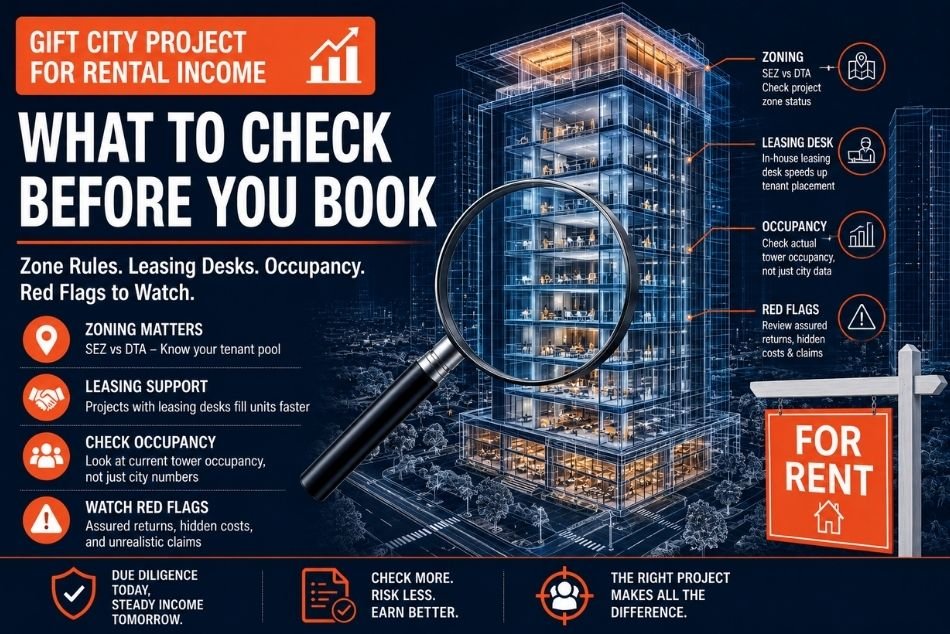
Gift City Project for Rental Income: Why the Specific Project Matters More Than the City
Most people researching a gift city project for rental income start with the wrong question. They ask whether GIFT City itself is a good rental market. That question has been answered many times over — the entity count, the banking assets, the metro connection, the operating universities. All of that is real.
The harder question, and the one that actually decides your return, is which specific project inside GIFT City is built to perform as a rental asset. Two towers can sit a five-minute walk apart, carry similar price tags, and still deliver completely different rental outcomes. The difference is almost never the city. It is the project.
This article is a project-level diligence guide. It does not repeat the case for why GIFT City works as a rental market — that ground has been covered elsewhere. Instead, it walks through what to check inside a specific project before you book, so the unit you buy actually behaves like the income asset you are expecting.
Start With What the Project Is Zoned for
Before comparing amenities or floor plans, confirm what the project is actually allowed to be rented out to. GIFT City has two commercial frameworks — the SEZ, which houses the IFSC, and the Domestic Tariff Area. Residential projects sit outside this distinction, but any gift city project for rental income involving commercial or office space needs this checked first.
SEZ-zoned units can only be occupied by SEZ-registered entities. That restricts your tenant pool sharply if your plan is a simple, open-market lease. DTA-zoned commercial space carries no such restriction, which makes it the more straightforward choice for an investor who wants a conventional landlord arrangement.
Get this in writing from the GIFT City Development Corporation’s allotment documentation, not from a brochure. A project’s zone status is the first filter, and it eliminates options faster than any other single check.
Ask Whether the Project Has a Leasing Desk or Rental Support Program
This is where project selection starts to diverge sharply, and it rarely gets covered in general GIFT City investment content.
A growing number of developers now run in-house leasing desks for their own residential and commercial towers. These desks maintain relationships with HR teams at IFSC banks, fund managers, and GCCs, and actively place tenants into units within the same project. Buying into a project with an active leasing desk changes your entire rental timeline — you are not searching for a tenant on your own, you are plugging into a channel that already exists.
Ask the developer directly: does this project have a dedicated leasing or tenant-placement service, and how many units in this specific tower are currently tenanted through it. A developer who can answer that question with real numbers is offering something meaningfully different from one who simply hands you the keys at possession.
This single factor is one of the most overlooked variables in choosing a gift city project for rental income, because it depends entirely on the individual project, not on the city’s fundamentals.
Be Skeptical of Assured Rental Return Schemes
Some projects, particularly newer or smaller developer launches, advertise an assured monthly rental return for a fixed period — commonly 12 to 36 months — regardless of whether the unit is actually tenanted.
These schemes can be legitimate marketing tools, and some developers honour them fully. But they deserve real scrutiny before you factor the promised number into your decision.
Ask what happens after the assured period ends, and whether the achievable market rent at that point actually supports the number you were promised during the guarantee window. In several cases, the assured rent during the scheme period is set higher than the unit’s realistic market rent, effectively front-loading part of your own purchase price back to you disguised as rental income. Once the scheme ends, rent resets to what the unit can genuinely command — which can be a real drop.
Check the Project’s Current Occupancy, Not Just the City’s
City-level occupancy figures — entity counts, banking assets, jobs created — tell you GIFT City is filling up. They tell you almost nothing about a specific building.
A tower that is already 70 to 80 percent occupied, with a visible mix of working professionals and expat tenants in the lobby and parking area, gives you real evidence that the building itself attracts tenants. A tower that has just received its occupancy certificate and sits mostly empty is a different proposition entirely, even if it is priced identically and sits in the same zone.
Ask the developer or their sales team for the building’s current occupancy percentage, and ask to see it, not just hear it quoted. A short site visit on a weekday evening tells you more about a project’s actual rental pull than any brochure statistic.
Look at the Unit Mix Within the Same Building
This is a detail almost every buyer skips, and it directly affects how quickly your specific unit will lease once you own it.
If a tower is heavily weighted toward 2BHK units and you are buying a 2BHK, you are entering a building where your unit competes against many similar units for the same tenant pool. If the same tower has very few studios or 1BHKs and you are buying one, you may face less internal competition but also a smaller pool of tenants actively seeking that configuration in that specific building.
Ask the developer for the building’s configuration breakdown — how many studios, 1BHKs, 2BHKs, and 3BHKs the tower actually contains. Compare that against what you know about the typical tenant profile in GIFT City, and think about where your specific unit sits within that internal competition, not just within the city-wide market.
Amenities That Actually Move Rent, and Ones That Don’t
Every project brochure lists a clubhouse, a gym, and a swimming pool. Not every amenity carries the same weight with the tenant profile that GIFT City actually attracts.
Reliable high-speed internet infrastructure inside the unit and building matters enormously to this tenant base — financial services professionals and fintech employees who sometimes work from home outside office hours. A building with genuinely strong, tested connectivity has a real edge over one that simply advertises it.
Covered, secure parking matters more here than in many Indian residential markets, because a meaningful share of GIFT City’s tenant pool commutes by car from Ahmedabad or Gandhinagar even while living inside the city, or keeps a vehicle for weekend use. A project with limited or uncovered parking will lose out to a comparable unit in a building that handles this properly.
Generic amenities — a rooftop lounge, a jogging track — are pleasant but rarely decide a leasing outcome on their own. Weigh a project’s amenity list against what this specific tenant actually prioritises, rather than against how long the list is.
The Developer’s Gift City-Specific Delivery Record
A developer’s reputation elsewhere in India tells you relatively little about how a specific gift city project for rental income will perform on delivery. Building inside GIFT City’s Special Investment Region involves Development Corporation approvals, SEZ-adjacent construction protocols, and utility connections that a standard residential project elsewhere never encounters.
Ask for the developer’s list of previously completed GIFT City buildings, their possession-date accuracy on those projects specifically, and whether any of those buildings had post-handover disputes over infrastructure, common area maintenance, or utility connections. A developer who has delivered cleanly inside GIFT City before is a materially lower risk than one attempting their first project here, even if their pan-India reputation is strong.
Read the RERA Registration for This Specific Project
Every GIFT City residential and commercial project falls under Gujarat RERA, and the registration certificate is public information worth pulling directly rather than relying on a sales team’s summary.
Check the stated possession date against where construction actually stands today. Then check the same developer’s history of hitting or missing possession dates on their other GIFT City projects. A project that is already delayed relative to its own RERA timeline, with a developer that has a pattern of delays on prior projects, pushes your first rental income further out than your financial model may currently assume.
Maintenance Charges Are a Project-Specific Number, Not a City Average
GIFT City’s infrastructure — district cooling, underground utilities, round-the-clock monitoring — comes at a real, recurring cost. But that cost varies meaningfully from project to project, depending on the building’s specific systems and the scale of common infrastructure it maintains.
Get the exact maintenance charge per square foot for the specific project you are considering, before you finalise your yield calculation. Two buildings with identical rent potential can produce noticeably different net yields once their actual maintenance charges are compared side by side.
Furnishing Support Offered by the Project
Some developers now offer optional furnishing packages at the point of sale, built specifically for the rental-income buyer rather than the self-use buyer. These packages are priced to match what the target tenant profile expects and are sometimes bundled with the developer’s own leasing desk, creating a single, coordinated path from possession to tenanted income.
If a project offers this, compare the package cost against furnishing the unit independently, and check whether using the developer’s package affects how quickly their leasing desk prioritises your unit. This is a project-specific detail with a direct effect on how fast your particular gift city project for rental income actually starts generating rent.
Commercial Shops and Retail Units: A Different Project Lens
Ground-floor retail and podium-level commercial shops inside GIFT City projects deserve their own look, because the diligence points that matter for a residential rental unit do not fully apply here.
A retail unit’s rental income depends almost entirely on the footfall the specific project generates, not the city’s overall growth story. A commercial shop inside a tower with strong office or residential occupancy above it has a built-in customer base. The same shop inside a project that is still filling up will sit quiet regardless of how good GIFT City’s citywide numbers look.
Ask the developer which anchor tenants, if any, are already committed within the project — a café, a convenience store, a pharmacy. An anchor tenant draws footfall that benefits every other retail unit in the same building. A project with no committed anchor is a higher-risk retail play, even if the base rent looks attractive on paper.
Also check whether the project’s retail units face an internal corridor or an external, publicly visible frontage. A shop that only IFSC employees walking through an internal lobby will ever see performs very differently from one visible to passing traffic on a main road within GIFT City.
How a Project’s Handover Quality Affects Your First Year of Rent
Possession day is not the same as rent-ready day, and the gap between the two varies considerably by project.
A project that hands over units with genuine snag-free finishing, working fittings, and common areas that are fully functional — lifts, lobby, security systems — can be furnished and tenanted within a few weeks. A project with a rushed handover, where buyers spend the first two or three months chasing the developer to fix defects, pushes your first rental cheque back by the same amount of time.
Ask other buyers who have already taken possession in the same project, if you can find them, rather than relying solely on the developer’s own account of handover quality. A short conversation with two or three existing owners in the building often reveals more about real handover experience than any brochure or sales pitch will.
Comparing Multiple Shortlisted Projects Side by Side
Once you have applied the checks above to two or three specific projects, it helps to line them up against each other on the same factors rather than deciding on gut feel.
Note each project’s zone classification, current occupancy percentage, presence or absence of a leasing desk, unit-mix competition for your target configuration, confirmed maintenance charge, and developer’s GIFT City-specific delivery record. A project that scores well across most of these factors is a stronger candidate for rental income than one that only wins on headline price per square foot.
Price per square foot matters, but it is only one input. A slightly more expensive unit in a project with an active leasing desk, strong occupancy, and a clean developer track record will often out-earn a cheaper unit in a project where you are the one doing all the work of finding a tenant.
Wrapping Up
Choosing the right gift city project for rental income is a different exercise from deciding whether GIFT City itself is worth investing in. The city-level case has already been made many times over, and it holds up. What decides your actual rental outcome is the project underneath that case — its zone status, its leasing support, its occupancy today, its unit mix, and its developer’s specific track record inside GIFT City.
Run the checks in this article against any project before you book, and you move from betting on a good address to backing a specific asset that is genuinely built to deliver rental income.
Frequently Asked Questions
Q1) Is a Gift City Project for Rental Income Better in a Fully Completed Building or an Under-Construction One?
A completed, occupied building gives you immediate visibility into actual rental demand and a shorter runway to your first rent cheque. An under-construction project can offer a lower entry price, but it requires carrying the cost of the loan or opportunity cost through construction with no income to offset it. If rental income from an early date matters to you, weight your shortlist toward projects that are already operational or close to it.
Q2) Does Every Gift City Project Offer a Leasing or Rental Support Service?
No. This varies significantly by developer and by project. Some developers run active in-house leasing desks with real placement numbers; others simply hand over the unit at possession and leave leasing entirely to the buyer. Always ask this question directly and request evidence, rather than assuming it is a standard feature across the city.
Q3) Should I Avoid a Project Entirely if It Offers an Assured Rental Return Scheme?
Not necessarily, but treat the scheme as a feature to verify, not a guarantee to accept at face value. Ask what the rent resets to once the assured period ends.
Q4) How Much Does Unit Mix Within a Building Actually Affect My Rental Outcome?
It affects how much internal competition your specific unit faces for the same tenant pool. A building heavily weighted toward your exact configuration means more comparable units competing for the same tenants, which can affect both lease-up speed and achievable rent. It is worth checking alongside city-wide configuration trends, not instead of them.
Q5) What Is the Fastest Way to Check a Project’s Actual Occupancy Before Booking?
A weekday evening site visit is more reliable than a brochure figure. Look at how many units show lights on, how full the parking area is, and ask the on-site sales or facilities team directly for the current occupancy percentage, then verify that number if possible against other residents or tenants you can speak with.
A Short Checklist Before You Book
Confirm the project’s zone classification in writing from the Development Corporation’s allotment documentation.
Ask about an in-house leasing desk and request real tenanting numbers from the same building.
Check the building’s actual current occupancy, ideally through a site visit rather than a brochure figure.
Review the unit-mix breakdown of the specific tower, not just the city-wide configuration trends.
Weigh amenities against what GIFT City’s tenant profile genuinely prioritises — connectivity and parking usually rank higher than a long generic amenity list.
Pull the developer’s GIFT City-specific delivery record and the project’s RERA registration and possession-date history.
Get the exact maintenance charge per square foot in writing before finalising your yield model.
References & Sources
GIFT City official portal — master plan, zone data, and project information
https://giftgujarat.in
IFSCA — GIFT IFSC regulatory framework and registrations
https://www.ifsca.gov.in
Gujarat Real Estate Regulatory Authority (RERA) — project registration verification
https://gujrera.gujarat.gov.in
GIFT City Development Corporation — allotment and zone classification documentation
https://giftgujarat.in