Why Gift City Property for Long Term Appreciation Is Gaining Investor Attention
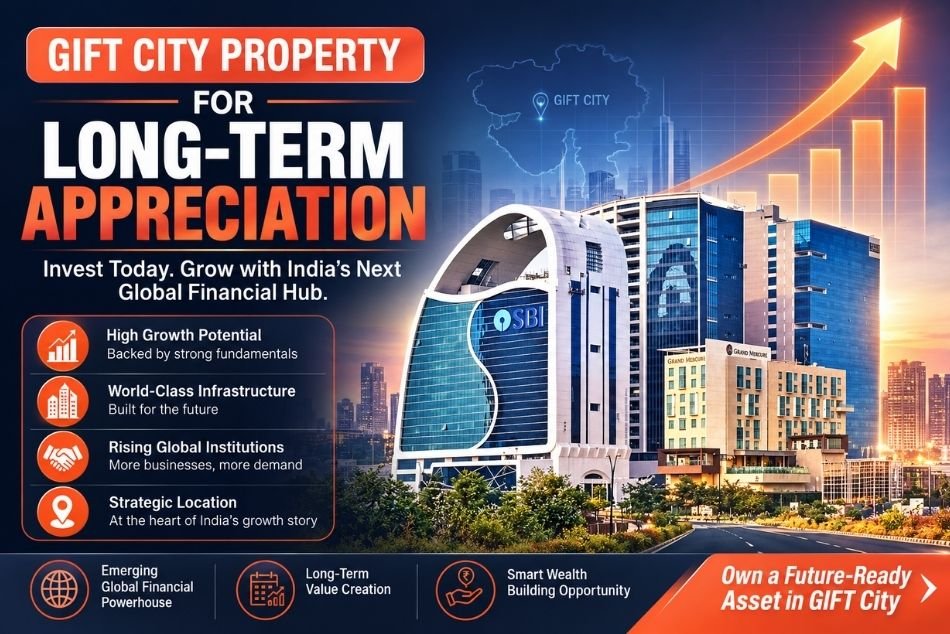
Gift City property for long term appreciation has become one of the most discussed real estate themes in Gujarat. That is not just because of hype or branding.
It is because GIFT City is being developed with a very different vision compared to a regular township or business district.
Instead of growing randomly like many urban pockets, GIFT City is being built as a structured financial and technology hub. It combines office space, infrastructure, residential development, and urban planning in one ecosystem.
That matters a lot for long-term real estate investors.
According to the official GIFT City platform, the project has already crossed 29 million sq. ft. allotted, 1,000+ operational entities, 20,000+ jobs generated, and USD 100 billion+ banking asset size as of September 2025. These are not small milestones. They indicate that the city is already moving beyond just future promise into visible economic activity.
For investors, the real question is not whether GIFT City looks impressive on paper. The real question is whether it can create sustained property value growth over the next 10 to 15 years.
That is where the long-term appreciation case becomes interesting.
GIFT City Is Not a Typical Real Estate Location
Most property markets rise because of one or two common factors.
It could be a metro line, a highway, or spillover demand from a nearby city.
GIFT City is different.
It has been positioned as India’s first operational smart city and the country’s only International Financial Services Centre (IFSC). It’s designed to attract global and domestic financial institutions, technology players, and allied businesses into one integrated environment.
This is important because real estate performs better over the long term when it is linked to a strong economic purpose, not just residential speculation.
In simple words, GIFT City is not only being sold as a place to buy property. It is being built as a place where businesses, professionals, institutions, and urban life can grow together.
That gives it a stronger long-term foundation than many conventional investment zones.
The Real Driver of Appreciation Is Employment, Not Just Construction
One of the biggest mistakes investors make is assuming that infrastructure alone creates price growth.
It does not.
Roads, towers, and smart systems help. But sustainable appreciation comes from employment and occupancy.
That is one of the strongest arguments in favor of GIFT City.
Its official ecosystem is built around sectors such as:
- Banking
- Capital markets
- Insurance
- Fund management
- FinTech
- Aircraft leasing
- Ship leasing
- IT and ITES
- Bullion
- Global in-house centers
- Ancillary business services
These are not low-value or random sectors. These are industries that usually generate high-value white-collar jobs, stronger rental capacity, and long-term business demand.
This matters because property values tend to appreciate more reliably when an area attracts people with stable, higher-paying employment.
That is how a location gradually shifts from being investor-driven to becoming end-user supported.
And that transition often creates stronger and more durable appreciation.
Why GIFT City’s Infrastructure Can Support Long-Term Value
A lot of investors focus only on project pricing, launch offers, or possession dates.
But in premium real estate, infrastructure quality often has a much bigger impact on long-term value than people realize.
GIFT City has been marketed and planned as a high-efficiency urban environment. Officially highlighted infrastructure features include:
- Utility tunnel systems
- District cooling
- Smart water systems
- Automated waste collection
- Reliable power infrastructure
- Advanced surveillance and command systems
- Smart urban management
These are not just technical selling points.
They directly affect how the city functions on a daily basis. Better infrastructure can improve business efficiency, urban maintenance, convenience, and overall perception.
In real estate, perception becomes value over time.
If a city consistently feels better managed, more modern, and more livable than competing locations, that often supports stronger pricing over the long run.
The Walk-to-Work Ecosystem Can Be a Big Appreciation Trigger
One of the most underrated aspects of GIFT City is its walk-to-work urban model.
That phrase gets used a lot in marketing, but in this case, it actually matters.
A successful modern urban district cannot depend only on office buildings. It also needs housing, convenience, social infrastructure, and lifestyle support.
Official GIFT City communication highlights an integrated city model that includes:
- Residential developments
- Hotels
- Restaurants
- Schools
- Clubs
- Parks
- Medical facilities
- Recreational spaces
This is important because people increasingly prefer locations where work and life are more efficiently connected.
If professionals working in GIFT City can also live there or very close to it, demand becomes much more stable.
That kind of integrated ecosystem often supports both rental demand and capital appreciation more effectively than a pure office district.
Limited Land Supply Can Strengthen Long-Term Pricing
One of the strongest reasons investors are studying gift city property for long term appreciation is that land supply is not unlimited.
This is not a location where development can keep expanding endlessly in all directions.
GIFT City spans roughly 886 acres and is a master-planned urban zone with defined boundaries. That naturally creates scarcity over time.
Scarcity alone does not guarantee appreciation.
But scarcity combined with rising demand often becomes a powerful price driver.
If the number of businesses, professionals, and end-users keeps increasing while the best quality supply remains limited, then premium property values can strengthen over time.
This is one of the biggest long-term positives in GIFT City’s favor.
Why Institutional Presence Matters for Appreciation
In emerging real estate markets, institutional credibility matters more than most retail investors think.
A location becomes much stronger when serious institutions, developers, and global business players begin participating in it.
GIFT City’s official ecosystem showcases the presence of major Indian and international organizations, along with branded developers and business participants. This is significant because institutional participation often improves:
- Market confidence
- Product quality
- Long-term visibility
- Capital inflow
- Buyer trust
The official GIFT City platform also highlights participation from well-known developers and ecosystem partners, which strengthens the overall investment narrative.
This does not mean every project inside GIFT City will appreciate equally.
But it does mean the market is being shaped by more than just speculative local activity.
That is usually a healthy sign.
Connectivity Is Another Major Long-Term Strength
No matter how premium or futuristic a city looks, it must still be practical.
That is why connectivity matters so much.
According to official GIFT City information, the location benefits from:
- Access to Ahmedabad and Gandhinagar
- Metro connectivity
- Proximity to Ahmedabad International Airport
- Access to the bullet train terminal
- Strong road connectivity through key regional routes
This improves not just convenience, but also long-term usability for professionals, businesses, residents, and visitors.
In property investment, strong connectivity reduces friction.
And when friction reduces, adoption usually improves.
That is another reason GIFT City has a stronger long-term case than many isolated “future growth” zones.
Appreciation Will Depend on Occupancy, Not Just Announcements
This is where investors need to stay realistic.
A lot of people assume that because GIFT City has strong branding and policy backing, every property there will automatically deliver great returns.
That is not how real estate works.
Long-term appreciation depends far more on real occupancy than on announcements or launch buzz.
The biggest indicators to watch over time are:
- Office occupancy levels
- Number of active companies
- Employee base growth
- Residential move-ins
- Rental demand quality
- Retail activity
- Social infrastructure usage
The positive part is that GIFT City is no longer just an idea. It is already operational and growing.
But for serious appreciation, that ecosystem needs to keep deepening over the next decade.
That is why this market should be viewed as a long-term compounding story, not a quick flip.
Residential Property in GIFT City Could Become a Strong Long-Term Theme
When people first hear about GIFT City, they often think mainly about office towers and commercial development.
But residential property may actually become one of the most interesting long-term opportunities here.
Why?
Because if a financial and business district matures properly, it naturally creates demand for quality housing nearby.
That demand can come from:
- Senior professionals
- Corporate employees
- Families wanting proximity to work
- NRIs
- HNIs
- Investors targeting executive rentals
This is especially relevant in a place like GIFT City, where the urban model is designed to support both work and living.
If job creation and business presence continue growing faster than premium residential supply, then well-located residential projects could benefit from stronger pricing over time.
That is one of the biggest reasons many investors are now studying this market more closely.
Why Residential Demand Can Become More Valuable Over Time
In the early years of an emerging business district, investor activity is usually higher than actual residential demand.
But over time, if the ecosystem matures, the market often changes.
More people begin asking practical questions such as:
- Can I live close to work?
- Is the area comfortable for family life?
- Are there schools, services, and social spaces?
- Does the location feel premium and convenient enough for long-term living?
Once a market starts getting those kinds of buyers, it often becomes much healthier.
That is when residential demand becomes more meaningful and less speculative.
If GIFT City continues to build a complete urban lifestyle environment, this could become a strong support factor for long-term appreciation.
Commercial vs Residential: Which Can Appreciate Better?
This is one of the most common investor questions.
The honest answer is that both can work, but they serve different strategies.
Commercial Property May Appeal More to Investors Looking for
- Business-led demand
- Potentially stronger yields
- Corporate tenant exposure
- Long-term income orientation
Residential Property May Appeal More to Investors Looking for
- Broader resale audience
- End-user support
- Lifestyle-led demand
- Easier emotional marketability
For pure long-term appreciation, residential can become especially powerful if GIFT City evolves into a complete live-work urban destination rather than remaining mainly an office-centric zone.
That is why many long-horizon investors are keeping a close eye on the residential segment.
What Can Push Property Values Higher in the Future?
Several long-term triggers could strengthen the case for gift city property for long term appreciation over the next 10 years.
- More Job Creation: If more companies continue to establish and expand operations here, property demand can strengthen further.
- Higher Residential Occupancy: When more people actually live in the area, the market becomes more stable and more self-sustaining.
- Better Lifestyle Infrastructure: As schools, healthcare, food, recreation, and daily conveniences improve, end-user appeal rises.
- Global Relevance of the IFSC Ecosystem: Since GIFT City is linked to India’s larger financial ambitions, its strategic relevance may continue to grow.
- Controlled Supply: If future development remains quality-focused and not excessively speculative, pricing may remain healthier.
- Better Regional Integration: As connectivity and surrounding infrastructure improve further, practical demand can also rise.
These are the kinds of real drivers that support long-term value creation.
Not short-term noise.
Risks Investors Should Keep in Mind
A balanced investment view should never ignore the risks.
Yes, GIFT City has strong long-term potential.
But smart investors should still stay careful and selective.
- Appreciation May Take Time: This is not necessarily a market for instant returns. Wealth creation here may depend on patience.
- Ecosystem Maturity Is Still Evolving: The city is operational, but its full residential and urban maturity is still under development.
- Not Every Project Will Perform Equally: Location quality alone does not guarantee the same outcome for every project.
- Short-Term Resale Liquidity May Vary: In emerging premium markets, resale demand can sometimes be uneven in the early years.
- Buying at the Wrong Price Can Reduce Upside: Even a strong market can underperform if an investor enters too aggressively.
This is why project selection and entry price matter just as much as location selection.
Who Should Consider Investing in GIFT City?
This theme is usually better suited for investors who think long term.
It may be especially relevant for:
- Long-term property investors
- NRIs
- HNIs
- Professionals with patient capital
- Buyers seeking future-oriented urban assets
- Investors comfortable holding for 7 to 15 years
It may be less suitable for buyers who want immediate resale gains within a short period.
That is because GIFT City’s strongest case is based on structural growth, not fast speculation.
How to Evaluate a GIFT City Property Properly
If you are considering investing, do not buy only because the location sounds premium.
A proper evaluation is essential.
- Check the Developer Quality: Execution track record matters a lot in premium urban markets.
- Study the Exact Micro-location: Even inside a strong ecosystem, some parcels and projects can outperform others.
- Understand the Future Tenant or Buyer Profile: Ask who will realistically rent or buy the property later.
- Assess Livability, Not Just Brochure Appeal: A good investment should also make sense as a place people would actually want to live in.
- Verify Legal and Project Details: This is basic but critical in every real estate purchase.
- Think About Your Holding Power: If you cannot comfortably hold the asset long enough, you may not benefit from the full appreciation cycle.
This kind of discipline is what separates informed investing from emotional buying.
Why Branding and Positioning Can Also Influence Value
Real estate is not driven only by numbers.
Perception matters too.
GIFT City is not positioned as an ordinary development corridor. It is being presented as:
- India’s first operational smart city
- India’s only IFSC
- A global finance and technology hub
- A secure, integrated, future-ready urban ecosystem
That kind of positioning can matter a lot over time, especially in premium real estate.
If GIFT City continues to strengthen its national and international profile, that brand value itself can contribute to long-term demand.
And in many premium markets, aspirational value becomes part of price appreciation.
Final Thoughts: Is Gift City Property for Long Term Appreciation Worth Considering?
Yes, gift city property for long term appreciation is a serious theme worth considering for long-horizon investors.
The strongest case for it comes from a combination of:
- Economic purpose
- IFSC-led relevance
- Smart city infrastructure
- Integrated urban planning
- Growing business activity
- Limited land availability
- Strong connectivity
- Long-term ecosystem potential
That said, the opportunity is not in blindly buying anything that carries a GIFT City label.
The real opportunity lies in choosing the right project, the right location, the right pricing, and the right holding period.
If GIFT City continues growing as a high-value financial and business ecosystem, then gift city property for long term appreciation could become one of Gujarat’s most compelling long-term real estate opportunities.
For patient investors, the biggest upside may not come from short-term excitement.
It may come from owning property in a location that is still evolving, but is being built with a much bigger long-term vision.
FAQs About Gift City Property for Long Term Appreciation
Q1) Is GIFT City Property Good for Long-Term Investment?
Yes, GIFT City can be a strong long-term investment option, especially for buyers looking at future-driven real estate rather than short-term speculation.
Its biggest strengths include planned infrastructure, IFSC-led growth, business activity, and limited land availability.
If the ecosystem continues to expand with more jobs, residential demand, and urban convenience, property values may strengthen over time.
That is why many investors are now evaluating gift city property for long term appreciation as a serious long-horizon opportunity.
Q2) Can Property Prices in GIFT City Rise in the Future?
They can, but price growth will depend on actual demand, not just branding.
If more companies, professionals, and residents continue moving into the ecosystem, then both residential and commercial values can benefit.
Long-term appreciation usually becomes stronger when a location shifts from being investor-led to end-user supported.
That is one of the key reasons GIFT City is getting attention from patient investors.
Q3) Is Residential Property in GIFT City Better Than Commercial Property?
It depends on your investment goal.
Commercial property may suit investors looking for rental income and business-led demand.
Residential property may suit investors who want broader resale appeal, future end-user demand, and lifestyle-led growth.
For many buyers, residential projects may become attractive if GIFT City evolves into a stronger live-work urban destination.
Q4) What Makes GIFT City Different From Other Real Estate Locations in Gujarat?
GIFT City is not just another residential or commercial zone.
It is India’s first operational smart city and the country’s only IFSC, which gives it a unique economic identity.
Its growth is linked to financial services, technology, global business participation, and planned infrastructure rather than only local housing demand.
That gives it a different long-term investment profile compared to a regular real estate market.
Q5) Is GIFT City Property Only for Rich Investors?
Not necessarily.
While many premium projects in GIFT City may target higher-budget buyers, the area can still attract different kinds of investors depending on the project type and ticket size.
What matters more is whether the property makes sense from a long-term value perspective.
Investors should focus on location quality, developer credibility, and future demand instead of only market hype.
Q6) What Are the Main Risks of Investing in GIFT City Property?
The biggest risks include slow appreciation, overpaying at launch, project selection mistakes, and short-term resale uncertainty.
Like any developing premium market, GIFT City may take time to reach full maturity.
That is why investors should enter with realistic expectations and a long holding period.
A good location can still underperform if the purchase decision is not made carefully.
Q7) Is Now a Good Time to Invest in GIFT City Property?
That depends on your investment horizon and the project you are considering.
For investors who believe in the long-term growth of the IFSC ecosystem, entering at the right stage may offer future upside.
But the decision should not be based only on future promise.
It should also be based on current pricing, project quality, livability, and long-term holding comfort.
Q8) Who Should Consider Gift City Property for Long Term Appreciation?
This type of investment may suit long-term investors, NRIs, HNIs, professionals, and buyers who are comfortable holding property for several years.
It is generally more suitable for people looking at structural growth rather than quick resale gains.
If you want exposure to a future-oriented business and urban ecosystem, gift city property for long term appreciation can be worth exploring with the right strategy.