
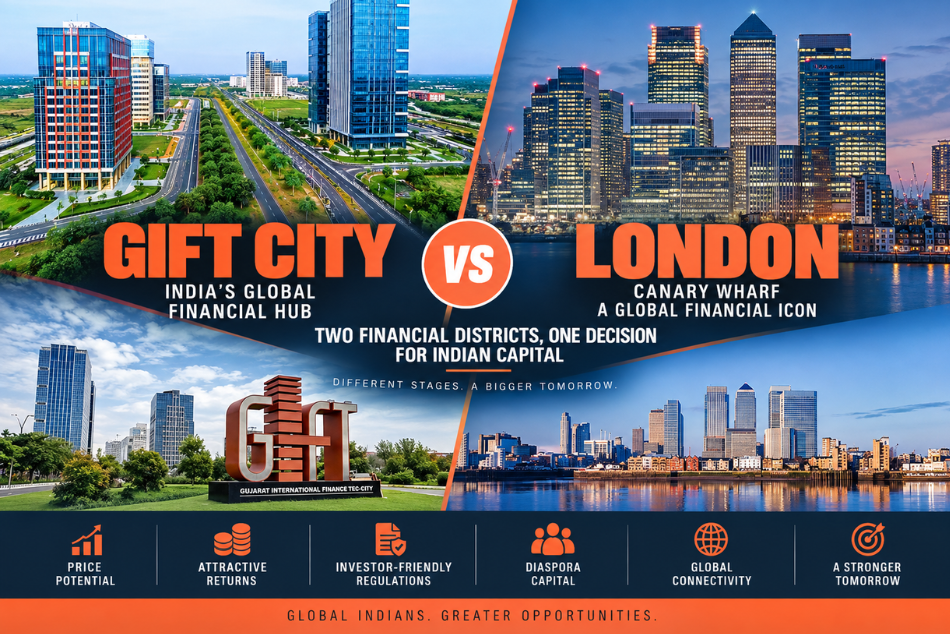
GIFT City vs London: Two Financial Districts, One Decision for Indian Capital
GIFT City vs London is a comparison more Indian families are running today than at any point in the last decade. A lot of Indian diaspora wealth has flowed into London property over the past thirty years — Canary Wharf especially, given how naturally it reads to an Indian investor: a planned financial district, built from nothing, now home to global banks. GIFT City is telling a similar story, except it is still being written.
This article runs the GIFT City vs London comparison properly — not London in the abstract, but specifically against Canary Wharf, the closest structural cousin GIFT City has anywhere in the world. Both were built on reclaimed land, both were designed around a single sector, and both asked global finance to move somewhere it had never been before.
Where the two diverge is timing. Canary Wharf finished that journey decades ago. GIFT City is roughly a third of the way through it. That gap is the entire point of this comparison.
| Factor | GIFT City (IFSC) | London (Canary Wharf) |
|---|---|---|
| What It Is | India’s only International Financial Services Centre, master-planned from scratch since 2015 | London’s second financial district, built on reclaimed docklands since the late 1980s |
| Regulator | IFSCA — single unified authority | FCA, PRA and standard UK tax residence rules |
| Entities / Scale (2026) | 1,147+ IFSCA registrations, USD 111bn+ banking assets | One of two major UK financial clusters alongside the City of London |
| Residential Price | Rs. 10,500/sq ft average, up from Rs. 4,500 in 2020 | £631/sq ft in E14 (Canary Wharf postcode); median home £471,000 (H1 2026) |
| Recent Price Trend | Up 130% since 2020 | Down 7.2% year-on-year (H1 2026 data) |
| Residential Gross Yield | 4.5% – 6% | 4% – 5% |
| Commercial Gross Yield | 6% – 10% (IFSC zone) | Typically 3% – 5% for Grade-A office |
| Tax on Foreign Income/Gains | 10-year holiday for IFSC businesses; no STT/CTT/stamp duty on exchange trades | UK Non-Dom regime abolished April 2025 — residents now taxed on worldwide income as it arises |
| Currency Access for Indian Capital | No LRS cap — this is an onshore Indian investment | Subject to India’s USD 250,000/year Liberalised Remittance Scheme limit per individual |
| Market Stage | Roughly 35–40% of master plan built | Fully mature, built out since the 1990s |
Figures are indicative market data as of 2026 and move regularly on both sides. Always verify current numbers before transacting.
Why Canary Wharf, Specifically, and Not “London” in General
London is not one property market. Mayfair, Kensington, and the City of London behave nothing like each other, let alone like Canary Wharf. Comparing GIFT City to “London” as a whole is comparing a single planned financial district to an entire metropolitan region with 800 years of history.
Canary Wharf is the fair comparison because it shares GIFT City’s actual DNA. It was reclaimed from derelict docklands. It was purpose-built for finance. It was empty and unconvincing for its first several years before global banks committed. GIFT City has followed almost exactly the same script, on a faster and cheaper timeline.
The Origin Story: A Reclaimed Dock vs a Reclaimed Riverbank
Canary Wharf’s story began in the late 1980s, when the old West India Docks sat empty after London’s shipping trade moved elsewhere. Olympia & York took on the redevelopment, One Canada Square rose as its centrepiece, and for several years the towers sat under-leased while sceptics wrote the project off entirely.
It took most of the 1990s for Canary Wharf to convince the City of London’s established banks to relocate east. Once they did — HSBC, Barclays, Citigroup, Morgan Stanley — the district never looked back. Today it is one of Europe’s largest financial clusters, and property in and around it has compounded for three decades.
GIFT City’s script is nearly identical, minus the multi-decade wait. It was carved out of 886 acres between Ahmedabad and Gandhinagar starting in 2015. It has its own single regulator, its own planned skyline, and its own scepticism to overcome in the early years. What took Canary Wharf most of a decade to prove, GIFT City has compressed into roughly five years since IFSCA was established in 2020.
Canary Wharf spent its first decade convincing global banks to show up. GIFT City has spent its first five years doing the same thing, faster, with the benefit of watching exactly how the Canary Wharf story played out.
Price per Square Foot: What Your Money Actually Buys
This is where the GIFT City vs London comparison gets concrete. Canary Wharf residential currently averages around £631 per square foot in the E14 postcode, with the median home price sitting near £471,000 as of the first half of 2026 — and that figure has actually softened, down roughly 7.2% year-on-year.
GIFT City residential, by contrast, has moved from roughly Rs. 4,500 per square foot in 2020 to around Rs. 10,500 today — close to a 130% rise over six years. Converted at current exchange rates, that is still a fraction of Canary Wharf’s per-square-foot price, for a market with a longer runway still ahead of it.
Neither number tells the whole story alone. Canary Wharf is priced like a finished product — mature, liquid, and fully built out. GIFT City is priced like a district still filling in its master plan, which is roughly 35 to 40% complete. The price gap reflects that difference in stage, not a difference in ambition.
Rental Yields: Two Different Stories With Two Different Trajectories
Canary Wharf residential yields currently run in the 4% to 5% range — solid, dependable, and backed by three decades of institutional tenant demand from finance and law firms. That stability is exactly what makes Canary Wharf attractive to a buyer who wants a known quantity.
GIFT City residential yields sit close by at 4.5% to 6%, but the trajectory runs the other way. Canary Wharf’s yield has been broadly flat for years, in a market where capital values have recently softened. GIFT City’s yield has been climbing, as employer-backed IFSC tenancies become a larger share of the rental base.
Commercial is where the gap widens further. Grade-A office in Canary Wharf typically yields 3% to 5% at today’s entry prices. GIFT City’s IFSC-zone commercial currently yields 6% to 10% for well-leased space — nearly double, on an asset class with a policy-backed tenant floor that Canary Wharf’s more general commercial demand does not have.
The Tax Picture Has Genuinely Flipped
For decades, London held a structural tax advantage that made it the default parking spot for Indian offshore wealth: the non-domicile regime. A Non-Dom UK resident could hold foreign income and gains outside UK tax entirely, as long as it stayed offshore.
That regime was abolished on 6 April 2025. UK residents are now taxed on worldwide income and gains as they arise, with only a narrow four-year relief window for genuinely new arrivals who have not been UK-resident in the prior decade. For long-settled diaspora families, the old shelter is gone.
GIFT City’s IFSC framework, meanwhile, has moved in the opposite direction. A 100% tax holiday on business profits for any 10 consecutive years within a 15-year block, no Securities Transaction Tax, no Commodities Transaction Tax, and no stamp duty on IFSC exchange trades are all still firmly in place. One jurisdiction tightened. The other did not.
Property ownership itself is taxed conventionally on both sides — IFSC’s holidays apply to operating businesses, not to a residential landlord, and standard UK income tax applies to London rental income too. But the broader financial architecture around each address has moved in clearly different directions since 2025.
Currency, Remittance, and a Cap Most Buyers Forget About
Buying in London from India means moving money out through the Liberalised Remittance Scheme, capped at USD 250,000 per person per financial year. A London flat at Canary Wharf prices can comfortably exceed that cap for a single buyer, forcing multi-year staggering or joint family remittances to close one purchase.
GIFT City carries no such ceiling, because it is an onshore Indian investment. A resident Indian, an NRI, or an OCI can deploy capital here without touching LRS limits at all. For a buyer moving serious capital, that is not a footnote — it is the difference between a straightforward transaction and a multi-year remittance plan.
On the IFSC side specifically, transactions run in foreign currency and the zone is treated as a non-resident jurisdiction under FEMA for specified purposes — giving investors a taste of offshore-style currency access without ever routing money out of India in the first place.
For the Indian Diaspora Already Holding Canary Wharf Property
A meaningful share of Indian-origin wealth in the UK sits in exactly this kind of asset — a Canary Wharf flat bought fifteen or twenty years ago, still delivering a steady 4% to 5%, still a perfectly respectable holding. Nothing here suggests selling it.
What has changed is the calculation for where the next allocation goes. Canary Wharf has already had its re-rating. The families who bought in the 1990s and early 2000s captured that curve. A new entrant today is buying a mature, slower-growing asset at a price that has softened over the past year, inside a tax regime that no longer favours non-resident-style structuring.
GIFT City vs London, for this specific buyer, is really a question of which decade you want to be early in. The Canary Wharf window closed years ago. The equivalent GIFT City window — sub-Rs. 5,000 pricing — has also closed, but the city is still only a third built out, with a decade or more of infrastructure and institutional deepening still ahead.
The Indian family that bought a Canary Wharf flat in 2003 rode three decades of compounding. GIFT City today is roughly where Canary Wharf was in the early-to-mid 1990s — built, credible, but still filling in. That window does not stay open indefinitely either.
Diaspora families already holding UK property are also the ones best positioned to move quickly here. They understand international financial districts. They have already lived through one such re-rating. GIFT City is asking them to recognise the same pattern a second time, earlier in its cycle.
Infrastructure: A Newer City Catching Up Fast
Canary Wharf’s infrastructure took decades to mature into what residents enjoy today — the Elizabeth Line, the shopping centre, the restaurant density, the full residential ecosystem around the original towers.
GIFT City is compressing a similar build-out into a fraction of the time. The Ahmedabad Metro’s Violet Line extension is now live, connecting the city to the wider Ahmedabad-Gandhinagar corridor. Two foreign universities are running active campuses. Lilavati Hospital has opened outpatient services. District cooling, underground utility tunnels, and round-the-clock monitoring were built in from day one rather than retrofitted decades later — an advantage Canary Wharf itself did not have in its own first years.
Both Can Be Owned — And for Many Families, Both Should Be
This is not really an either-or decision. Canary Wharf offers a mature, liquid, GBP-denominated holding with three decades of proof behind it. GIFT City offers a growth-stage, INR-denominated position inside a market that is still roughly a third built out, with yields and appreciation running ahead of London’s.
A blended approach — keeping an existing Canary Wharf holding for stability while adding a GIFT City position for growth — captures both stories at once. One is the compounding that already happened. The other is the compounding that is still ahead.
Wrapping Up: GIFT City vs London
GIFT City vs London ultimately comes down to which stage of the story you want exposure to. London, and Canary Wharf specifically, is the finished chapter — proven, liquid, and now taxed less favourably for non-resident-style wealth than it was before April 2025.
GIFT City is the chapter still being written — Rs. 10,500 per square foot against decades of eventual build-out, tax holidays still fully intact, and no LRS ceiling standing between an Indian investor and the transaction. Both addresses deserve respect. Only one of them is still this early.
FAQs: GIFT City vs London
Q1) Is GIFT City Actually Comparable to Canary Wharf, or Is That a Stretch?
It holds up well. Both were built on reclaimed land specifically for international finance, both faced early scepticism before global banks committed, and both are organised around a single regulator-anchored district rather than organic city growth. The main difference is stage — Canary Wharf is fully mature; GIFT City is roughly a third built out.
Q2) Does the End of the UK Non-Dom Regime Actually Affect Property Investors, or Just High Earners?
It affects anyone who becomes UK tax resident and holds significant foreign income or gains, not just ultra-high earners. Since April 2025, worldwide income and gains are taxed as they arise for residents, with only a narrow four-year window for genuinely new arrivals. It does not directly tax the property itself, but it removes a structural advantage that made London attractive to internationally mobile Indian wealth.
Q3) Is GIFT City Property Actually Cheaper Than Canary Wharf Once Currency Is Converted?
Yes, meaningfully so, even after adjusting for GBP-INR exchange rates. Canary Wharf sits at a mature, fully-priced-in level near £631 per square foot. GIFT City remains materially cheaper on a like-for-like basis, reflecting its earlier stage of development.
Q4) Do I Need to Use the LRS Limit to Invest in GIFT City?
No. GIFT City is an onshore Indian investment, so purchases here do not draw against the USD 250,000 annual Liberalised Remittance Scheme cap that applies to buying property abroad, including in London.
Q5) Should Someone Who Already Owns a Canary Wharf Flat Sell It to Buy in GIFT City?
Not necessarily. Canary Wharf remains a stable, liquid, income-generating asset. The more common approach among diaspora families is to keep the existing London holding and add a GIFT City position alongside it, capturing a mature market and a growth-stage one at the same time.
Q6) What Is the Realistic Holding Horizon for a GIFT City Investment Compared to London?
GIFT City residential works best with a 7 to 10-year horizon, given the city is still filling in its master plan. Canary Wharf, being fully mature, suits both shorter holds and long-term ownership, since its liquidity and rental demand are already well established.
Sources & References
GIFT City official portal — master plan, zone data, and entity statistics
https://giftgujarat.in
IFSCA — GIFT IFSC Key Highlights (1,147+ registrations/authorisations; USD 111bn+ banking assets, as on March 2026)
https://www.ifsca.gov.in
Rightmove / HM Land Registry — Canary Wharf house price data (updated July 2026)
https://www.rightmove.co.uk/house-prices/canary-wharf.html
Construction Capital — Canary Wharf House Prices, H1 2026 market report
https://constructioncapital.co.uk/market-reports/canary-wharf-greater-london-property-market-h1-2026
Investropa — Buying Property in Canary Wharf 2026 (price per sq ft data)
https://investropa.com/blogs/news/buying-property-canary-wharf
HaysMac — Abolition of the UK Non-Dom Regime from April 2025
https://haysmac.com/insights/abolition-of-the-uk-non-dom-regime-from-april-2025-what-you-need-to-know/
Reserve Bank of India — Liberalised Remittance Scheme (LRS) framework
https://www.rbi.org.in
Canary Wharf Group — company and development history
https://en.wikipedia.org/wiki/Canary_Wharf_Group
Source note: Property pricing, tax rules, and remittance regulations referenced in this article change regularly on both the Indian and UK sides. Readers should confirm current figures with official sources and a qualified property, tax, or FEMA advisor before making any investment decision.