GIFT City vs Mumbai: Two Financial Districts, One Big Decision
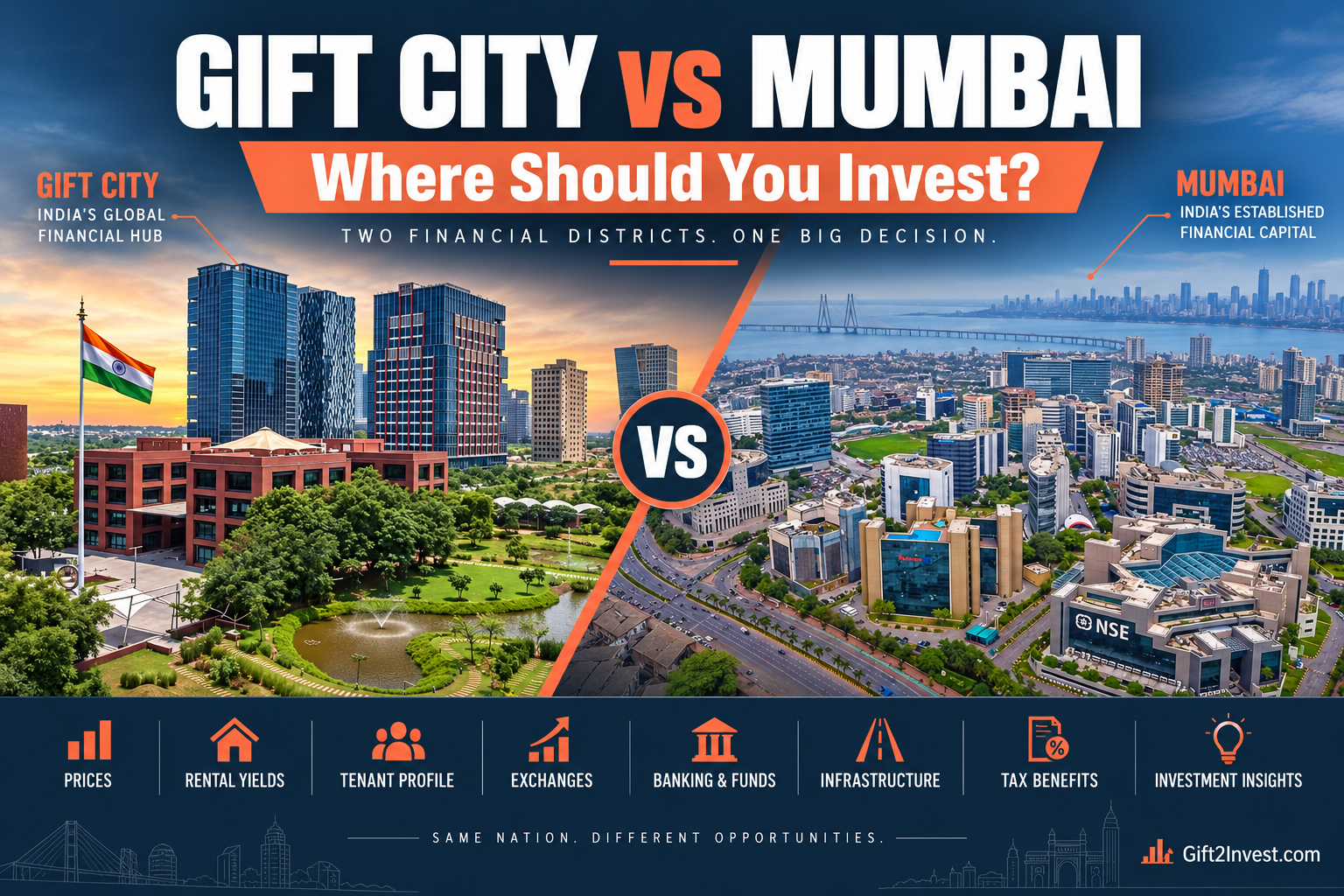
The GIFT City vs Mumbai question comes up in almost every serious conversation about where to place financial-sector real estate capital in India today. Mumbai has been the country’s undisputed financial capital for decades. GIFT City is the newer, purpose-built challenger with a regulatory structure Mumbai simply does not have.
Both cities matter. But they are not really competing for the same rupee, or the same reason. This article breaks down GIFT City vs Mumbai across price, yield, tenants, exchanges, infrastructure, and tax — so you can see exactly where each one fits, and why GIFT City increasingly belongs in a serious investor’s portfolio, not just Mumbai’s.
| GIFT City | Mumbai |
|---|---|
| GIFT City’s commercial and business district | BKC |
| GIFT City’s established financial ecosystem | Nariman Point |
| GIFT City / India INX ecosystem | NSE |
| GIFT City / India INX ecosystem | BSE |
| GIFT City’s IFSC banking ecosystem | Mumbai’s banking and financial services |
| GIFT City’s IFSC fund ecosystem | Mumbai’s fund and asset-management ecosystem |
| GIFT City’s commercial real estate | Mumbai’s commercial real estate |
| GIFT City’s infrastructure | Mumbai’s connectivity and infrastructure |
| GIFT City’s emerging international financial ecosystem | Mumbai’s established financial ecosystem |
Two Financial Capitals, Built Very Differently
Mumbai’s financial districts grew organically over more than a century. Nariman Point rose as the original business address of the city. BKC came later, purpose-built in the 1990s to relieve pressure on South Mumbai, and it has since become India’s most expensive commercial address.
GIFT City did not grow organically at all. It was master-planned from a blank 886-acre site between Ahmedabad and Gandhinagar, with underground utilities, district cooling, and a single regulator built in from day one.
That difference in origin explains almost everything else in the GIFT City vs Mumbai comparison. Mumbai’s strength is history, density, and depth. GIFT City’s strength is a clean slate, a purpose-built regulatory framework, and room still left to grow.
NSE and BSE vs India INX and NSE IFSC
Mumbai is home to the NSE and the BSE, India’s two dominant domestic stock exchanges. They have decades of liquidity, retail participation, and institutional depth behind them. That is not going to change.
GIFT City runs its own exchange ecosystem instead — NSE International Exchange (NSE IX) and India INX, both operating inside the IFSC and settling in foreign currency. Daily trade volumes on this ecosystem have already crossed the tens of billions of dollars mark, and GIFT Nifty has become a genuine global hedging instrument for India exposure.
The two exchange ecosystems are not really rivals. NSE and BSE serve domestic rupee markets. NSE IX and India INX serve the offshore, foreign-currency side of Indian capital markets that used to route entirely through Singapore and Dubai. GIFT City captured that business by building an exchange India never had before.
Banking and Financial Services: Depth vs a Different Model
Mumbai’s banking sector is the largest and deepest in India. Every major domestic bank has its headquarters or principal operations here, alongside the RBI’s own head office. That depth is real and it is not being replicated anywhere else.
GIFT City’s banking ecosystem works on a different model entirely — International Banking Units, or IBUs, that operate in foreign currency and lend and borrow across borders under IFSCA rather than RBI’s domestic banking rules. Over three dozen IBUs, including branches of SBI, HDFC Bank, ICICI, Standard Chartered, HSBC, Deutsche Bank, and Barclays, now run out of GIFT IFSC.
Mumbai’s banking sector serves India’s domestic economy. GIFT City’s IFSC banking ecosystem serves the cross-border, foreign-currency slice of that same economy — the exact business that used to leave India for Singapore, Dubai, or Mauritius before GIFT City existed.
The Fund and Asset-Management Ecosystem
Mumbai’s fund and asset-management industry is India’s largest by a wide margin. Nearly every major domestic AMC, PMS provider, and PE fund runs its principal office out of Mumbai, largely because SEBI, the exchanges, and the institutional investor base all sit here too.
GIFT City’s IFSC fund ecosystem is smaller in absolute terms but structurally different — over 270 funds and 170-plus fund managers now operate here, many structured as AIFs targeting NRIs and offshore investors specifically. Category III AIFs in GIFT City carry meaningfully lighter capital gains treatment for non-resident investors than an equivalent Mumbai-based structure.
A fund manager choosing between Mumbai and GIFT City today is really choosing between depth and tax efficiency. Increasingly, Indian managers are running both — a domestic Mumbai desk and a GIFT City IFSC arm for offshore capital.
GIFT City vs Mumbai on Price Per Square Foot
This is where the GIFT City vs Mumbai comparison gets concrete for a property investor, and where the numbers make the strongest case for GIFT City real estate right now.
Prime BKC office space in Mumbai currently commands rents in the range of roughly Rs. 250 to Rs. 400 per square foot per month on a weighted average basis, with several recent marquee leases — BNP Paribas, Tesla — signed above Rs. 800 per square foot. Entry prices for BKC commercial ownership run into the tens of thousands of rupees per square foot.
GIFT City commercial office space, by contrast, currently trades in the Rs. 6,000 to Rs. 14,000 per square foot ownership range, with office rents running at roughly 30 to 40 percent of BKC’s rate for comparable Grade-A specification. That gap is the entire investment thesis in one sentence.
| Factor | GIFT City (IFSC) | Mumbai (BKC / Nariman Point) |
|---|---|---|
| Commercial entry price (per sq ft) | Rs. 6,000 – 14,000 | Rs. 35,000 – 60,000+ |
| Prime office rent (per sq ft/month) | Roughly 30–40% of BKC rate | Rs. 250 – 400, up to Rs. 800+ |
| Typical gross commercial yield | 6% – 10% | 4% – 6% |
| Residential price (per sq ft) | Rs. 10,500 and up | Rs. 25,000 and well above in premium pockets |
| Residential gross rental yield | 4.5% – 6% | 2% – 3% |
| Regulator | IFSCA — single unified authority | RBI / SEBI / standard Indian framework |
| Market maturity | Mid-way through its master plan | Fully mature, deep, and priced in |
| Resale liquidity | Thinner, improving quickly | Deep and immediate |
A GIFT City commercial buyer gets an entry price roughly a fraction of BKC’s, a yield band that runs meaningfully higher, and a regulatory demand floor that no Mumbai commercial address can offer — because IFSC tenants must be physically present inside the zone to keep their license.
Commercial Real Estate: Two Different Demand Engines
Mumbai’s commercial real estate demand is broad-based — banking, media, law, consulting, retail headquarters, and everything in between. That breadth is Mumbai’s strength. It means demand rarely depends on any single sector’s fortunes.
GIFT City’s commercial real estate demand is narrower but structurally guaranteed within the IFSC. A bank, fund manager, or insurer registered under IFSCA cannot simply relocate to a cheaper address and keep its regulatory license. That is a demand floor Mumbai’s commercial market, for all its depth, does not have.
Both models work. But an investor buying into GIFT City today is buying into a market where the next decade of tenant growth is tied directly to IFSCA’s own regulatory calendar — aircraft leasing, family investment funds, virtual assets — each one adding fresh commercial demand before the market has fully priced it in.
Connectivity and Infrastructure
Mumbai’s infrastructure is extensive but strained. The Coastal Road and the Trans-Harbour Link have helped, yet traffic congestion, an overloaded suburban rail network, and housing shortages remain real constraints on daily life and business efficiency.
GIFT City’s infrastructure was built to a single specification from the outset — underground utility tunnels, India’s first district cooling system, automated waste collection, and a 24/7 city command centre. There is no legacy congestion to work around, because none of it existed before the master plan.
The Ahmedabad Metro’s Violet Line now connects GIFT City to the wider Ahmedabad-Gandhinagar corridor, and Ahmedabad’s international airport sits under 30 minutes away. That is a meaningfully shorter, more predictable commute profile than most of Mumbai’s own suburbs offer their own workforce.
The Tax Framework Mumbai Cannot Match
This is the single biggest structural difference in the entire GIFT City vs Mumbai comparison, and it is worth being direct about it.
Mumbai operates under standard Indian corporate and property tax rules. GIFT City’s IFSC offers a 100 percent tax holiday on profits for any 10 consecutive years within a 15-year block, no Securities Transaction Tax, no Commodities Transaction Tax, no stamp duty on IFSC exchange trades, and GST relief on a wide range of specified services.
That framework is exactly why global institutions — HSBC, Deutsche Bank, Barclays, JP Morgan — have chosen to run IFSC operations out of GIFT City rather than adding headcount in Mumbai alone. Every one of those entities needs office space. Every employee they hire needs somewhere to live.
The Residential Angle: A Fresh Tenant Pool vs a Saturated One
Mumbai’s residential market is mature and largely saturated in its premium pockets. Capital values have already run far ahead of rental growth, which is exactly why gross yields in South Mumbai and BKC-adjacent residential sit at just 2 to 3 percent.
GIFT City residential serves a narrower but fresher tenant pool — IFSC professionals, expat executives, and returning NRIs, many with employer-backed housing allowances. Gross yields currently run 4.5 to 6 percent, notably ahead of Mumbai’s premium residential band.
For an investor comparing GIFT City vs Mumbai on residential income alone, GIFT City’s numbers are already the better proposition today — before even factoring in the appreciation runway that comes from buying into a city that is still roughly 35 to 40 percent built out.
Being Honest About the Risk Difference
Mumbai’s biggest advantage is liquidity. If you need to sell a BKC office or a South Mumbai flat, there is a deep, immediate buyer pool ready to transact. GIFT City’s secondary market is still forming, and a forced exit on a tight timeline may take longer.
GIFT City’s commercial demand is also more concentrated — tied closely to IFSCA’s pace of regulatory expansion. A sustained slowdown in new permitted activities would soften tenant growth, even though existing IFSC tenants are not going anywhere.
Neither risk profile is inherently worse. Mumbai rewards buyers who want proven depth and easy resale. GIFT City rewards buyers who can tolerate a narrower, newer market in exchange for a structurally higher yield and a longer growth runway still ahead of it.
Who Should Actually Choose GIFT City Over Mumbai
An investor who needs immediate liquidity, or who is buying a single unit purely for quick resale, is generally better served staying in Mumbai’s proven market.
An NRI, a working professional inside GIFT IFSC, a family office, or any investor with a five-to-ten-year horizon looking for higher yield and a regulatory tailwind that Mumbai simply cannot replicate is better served by GIFT City.
Many serious investors are not choosing one over the other at all. A blended position — a liquid Mumbai holding paired with a GIFT City position — captures Mumbai’s depth and GIFT City’s yield and appreciation runway at the same time.
Wrapping Up: GIFT City vs Mumbai Comes Down to Timing
GIFT City vs Mumbai is not really a contest with one winner. Mumbai offers scale, history, and a proven, deep market that will remain India’s largest financial hub for a long time to come.
GIFT City offers something Mumbai cannot — a purpose-built international regulatory framework, meaningfully higher yields, a fraction of Mumbai’s entry price, and a growth curve that is still mostly ahead of it rather than behind it.
For an investor thinking about the next five to ten years rather than the next five months, that combination is difficult to ignore. GIFT2Invest.com carries current GIFT City residential and commercial listings with zone classification and project details specified upfront — a practical place to turn this comparison into an actual decision.
FAQs: GIFT City vs Mumbai
Q1) Is GIFT City Cheaper to Invest in Than Mumbai?
Yes, significantly. GIFT City commercial space currently trades at roughly Rs. 6,000 to Rs. 14,000 per square foot, against Rs. 35,000 and above for prime BKC space. Residential entry prices show a similar, if smaller, gap.
Q2) Does GIFT City Offer Better Rental Yields Than Mumbai?
Yes. GIFT City commercial yields run 6 to 10 percent against Mumbai’s 4 to 6 percent, and GIFT City residential yields run 4.5 to 6 percent against Mumbai’s premium residential band of 2 to 3 percent.
Q3) Will GIFT City Eventually Replace Mumbai As India’s Financial Capital?
Unlikely, and that is not really the comparison. Mumbai serves India’s domestic financial economy. GIFT City serves the cross-border, IFSC-regulated segment that used to leave India entirely for Singapore or Dubai. The two increasingly work alongside each other rather than in competition.
Q4) Is Mumbai Property Still a Better Choice for Quick Resale?
Yes. Mumbai’s secondary market is deep and liquid across nearly every locality. GIFT City’s resale market is improving quickly as the entity base grows, but it remains thinner than an established Mumbai address today.
Q5) Should an NRI Choose GIFT City or Mumbai?
For NRIs specifically, GIFT City’s IFSC framework, foreign-currency structures, and tax treatment are usually the stronger fit, particularly for anyone already familiar with international financial centres. Mumbai remains a reasonable choice for NRIs who want a liquid, traditional Indian residential or commercial asset alongside it.
Sources & References
This article was checked against the following sources at the time of writing. Entity counts, banking assets, and pricing move regularly in both markets — always verify current figures before relying on them for a transaction.
GIFT City official portal — master plan, IFSC data, and ecosystem statistics
https://giftgujarat.in
IFSCA — GIFT IFSC key highlights, registrations, and banking assets
https://www.ifsca.gov.in
Business Standard — BKC office lease rates and BNP Paribas / Tesla lease deals (2025)
https://www.business-standard.com
Gujarat Metro Rail Corporation — Ahmedabad Metro Phase-II / Violet Line, GIFT City connectivity
https://www.gujaratmetrorail.com/project-overview2
Reserve Bank of India — Master Circular on Acquisition and Transfer of Immovable Property in India
https://www.rbi.org.in
Gujarat Real Estate Regulatory Authority (RERA) — project registration verification
https://gujrera.gujarat.gov.in
Source note: Regulatory, pricing, and market figures referenced in this article can change. Readers should confirm current numbers with official sources before making an investment decision.