
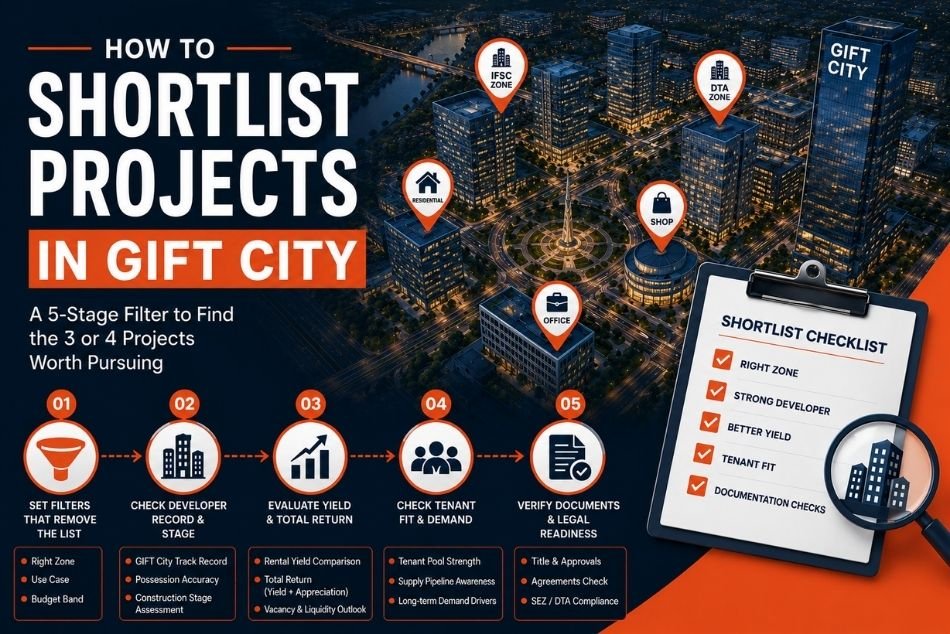
How to Shortlist Projects in Gift City When Every Listing Looks Equally Convincing
GIFT City now has enough live inventory that the hard part isn’t finding a project. It’s narrowing forty options down to the two or three actually worth your time. Knowing how to shortlist projects in GIFT City is a different skill from knowing whether GIFT City itself is a good market — that question has been settled for most serious buyers already. What hasn’t been settled is which specific building, in which zone, from which developer, deserves your capital.
This article is a working method, not a motivational case for the city. It walks through the filters that eliminate most of a listing set quickly, the comparisons worth running on whatever survives, and the final checks before you commit. Use it against your own shortlist, whether you’re comparing residential towers, DTA offices, or commercial shops.
Why a Shortlisting Process Actually Matters Here
Of GIFT City’s approved buildings, a majority are now operational and the rest are under active construction. That’s a genuinely large and growing set of options across both the IFSC and the Domestic Tariff Area. A buyer comparing five or six brochures side by side, without a consistent method, tends to default to whichever sales team was most persuasive in the room.
That’s a weak way to deploy capital in a market this specific. GIFT City has two zones with different tenant eligibility, multiple developers with very different GIFT City-specific delivery records, and price bands that vary meaningfully by proximity to the operational IFSC core. A structured shortlisting process removes most of that noise before you ever schedule a site visit.
A good shortlist isn’t the longest list of things you liked. It’s the shortest list of things you couldn’t find a reason to eliminate.
Stage 1) Set the Filters That Remove Most of the List Immediately
The first stage of learning how to shortlist projects in GIFT City is deciding what you’re actually buying before you look at a single listing. Three filters do most of the work here, and applying them early saves weeks.
Filter by Zone First
IFSC-notified space and DTA space are not interchangeable products. SEZ commercial units can only be occupied by SEZ-registered entities — that alone removes most retail rental-income buyers from that column entirely, unless you’re structuring specifically to lease to an SEZ tenant. If passive rental income is your goal, the DTA filter should come before anything else.
Filter by Use Case
Residential, DTA office, commercial shop, and SEZ commercial behave as four separate markets with different yield ranges and different tenant pools. Trying to shortlist across all four at once is how buyers end up comparing assets that were never actually competing with each other.
Filter by Budget Band
Set a realistic ceiling before you browse. GIFT City pricing spans a wide range depending on configuration, zone, and proximity to the operational core, and without a budget filter in place first, it’s easy to fall for a project that’s technically excellent but outside what you can comfortably carry.
Run these three filters against any list of listings and you’ll typically cut it by more than half before doing any real comparison work. That’s the point of stage one — it’s not analysis yet, it’s elimination.
Stage 2) Compare What Survives on Developer Record and Construction Stage
Whatever remains after stage one deserves a closer look at two things most buyers under-research: the developer’s specific GIFT City track record, and the honest construction stage of each project.
Delivering inside GIFT City’s Special Investment Region involves Development Corporation approvals, SEZ-specific construction protocols, and utility connections that don’t exist in a standard Ahmedabad project. A developer’s reputation elsewhere in Gujarat is a reasonable secondary indicator, but it’s not a substitute for their record inside GIFT City specifically. Ask each shortlisted project for the developer’s list of completed GIFT City buildings, their possession-date accuracy, and any post-handover disputes.
Construction stage matters just as much when you’re comparing multiple live projects. A ready-to-move unit and a project at 40 percent construction aren’t directly comparable on price — one carries no construction risk; the other requires carry-cost modelling through to possession. When you shortlist projects in GIFT City side by side, note the stage of each honestly rather than letting a lower headline price obscure a longer, riskier runway to income.
Stage 3) Run the Numbers Across the Shortlist, Not Just One Listing
This is where most buyers stop comparing altogether and just pick whichever project felt right. That’s a mistake once you have three or four genuinely comparable options in front of you. Put them side by side on the same numbers.
For each shortlisted project, note the price per square foot, the achievable rent or lease rate for a comparable unit in the same building, the resulting gross yield, and the maintenance charge per square foot. GIFT City’s maintenance costs run above typical Indian residential and commercial societies because of the district cooling and underground utility infrastructure — leaving that out of a yield comparison flatters projects with lower upfront maintenance disclosure and penalises the ones that quoted honestly.
| Factor | IFSC / SEZ Listings | DTA Listings | Residential Listings | Commercial Listings | What It Narrows |
|---|---|---|---|---|---|
| Eligible Occupant | SEZ-registered entities only | Any domestic company | Any buyer or tenant | Depends on zone | Removes listings your intended use can’t legally serve |
| Typical Gross Yield | 6% – 10% | 5% – 7% | 4.5% – 6% | 5% – 10% | Sets a realistic yield band per shortlist |
| Demand Driver | IFSCA policy expansion | General economy | Employer-backed tenancy | Zone-specific | Flags which projects carry policy risk |
| Best Suited To | Own IFSC entity or structured lease | Passive landlord model | Appreciation or self-use | Income or appreciation | Matches project type to your actual goal |
The table above is a starting reference, not a substitute for your own numbers on the specific projects you’re comparing. Use it to sanity-check whether a listing’s advertised yield is plausible for its zone and use case before it goes any further in your shortlist.
Two projects with the same headline yield can be very different investments once maintenance, zone eligibility, and construction stage are actually lined up next to each other.
Stage 4) Test Tenant or Buyer Fit Before You Finalise
A project can clear every financial filter and still be the wrong choice if the tenant or buyer profile doesn’t match what you’re actually offering. This step gets skipped often, and it’s where otherwise sound shortlists go wrong.
For residential projects, check the configuration against the dominant tenant pool near that specific building. A studio close to the IFSC core suits the analyst and junior fintech segment; a 3BHK suits senior hires on corporate leases. A well-built project in the wrong configuration for its location will underperform a mediocre one in the right configuration.
For DTA commercial, check who actually leases in that specific micro-location — GCC support functions, professional services firms, or domestic IT and fintech tenants each have slightly different space and specification expectations. For SEZ commercial, confirm upfront whether you have a route to a qualifying tenant at all, since this is the single most common reason a shortlisted SEZ unit turns out not to fit an investor’s actual plan.
Stage 5) Verify Documentation on the Final Two or Three
By this stage, your list should be down to two or three genuinely comparable projects. This is where the effort shifts from comparison to verification, and it’s worth doing properly rather than rushing to a decision.
- Pull the RERA registration certificate and confirm the stated possession date against the developer’s actual delivery history.
- Request the GIFT City Development Corporation’s allotment letter confirming zone classification — not the brochure, not a verbal assurance.
- For commercial units, ask for the floor’s mechanical and electrical specification sheet — power redundancy, raised flooring, cooling capacity.
- Confirm whether an existing tenant or a signed letter of intent is already in place, and how that changes the effective entry price.
- Get the maintenance charge per square foot in writing, and rerun your net yield number against the confirmed figure rather than an estimate.
A project that survives all five stages — zone fit, developer record, honest numbers, tenant fit, and clean documentation — is a genuinely strong candidate. A project that stumbles at any single stage isn’t necessarily disqualified, but it should move to the bottom of your shortlist rather than the top.
How This Differs From Shortlisting Anywhere Else in Gujarat
Buyers who’ve shortlisted property in Ahmedabad or Gandhinagar before sometimes assume the same instincts transfer directly to GIFT City. Mostly they don’t, and the gap shows up fastest at the zone-eligibility stage.
In a standard Ahmedabad locality, two similarly priced flats in the same neighbourhood are genuinely comparable on price, configuration, and builder reputation alone. In GIFT City, two units in adjacent towers can sit in different zones with completely different legal tenant pools, even though they look identical from the street. That single structural difference is why a generic property checklist quietly fails here — it simply wasn’t built to catch a distinction this specific.
The same applies to developer diligence. Elsewhere in Gujarat, a builder’s overall reputation is a fair proxy for what to expect. Inside GIFT City’s Special Investment Region, that reputation only tells you part of the story, because delivering here involves allotment processes and utility coordination that a standard residential project never encounters. A developer can be excellent in Ahmedabad and still be inexperienced at GIFT City-specific execution. Knowing how to shortlist projects in GIFT City means treating that as two separate questions, not one.
How Long the Shortlisting Process Should Actually Take
There’s no fixed timeline, but a reasonable pace helps you avoid two opposite mistakes: moving so slowly that a genuinely strong project gets sold out from under you, or moving so fast that you skip verification on a project that turns out to have a documentation gap.
For most buyers, stage one filtering can be done in an afternoon once you know your zone, use case, and budget. Stage two and three — developer record and numbers comparison across three or four survivors — typically takes a week or two, largely spent waiting on developers to share specification sheets and occupancy figures. Stage four and five, tenant fit and documentation verification, are worth another one to two weeks, especially if a property lawyer with SEZ and RERA experience needs to review the allotment paperwork.
A month from first list to final decision is a realistic, unhurried pace for most buyers. Compressing that timeline is possible if a specific project is moving quickly, but it should never come at the cost of skipping the allotment-document check or the developer’s GIFT City-specific track record. Those two checks are the ones that catch the most expensive mistakes, and they’re also the ones most tempting to skip under time pressure.
#5 Common Traps While Shortlisting
A few patterns show up repeatedly among buyers working through this process, and most are easy to avoid once you know to look for them.
- Comparing a ready-to-move unit against an under-construction one purely on headline price, without adjusting for carry cost and construction risk.
- Letting proximity to GIFT City stand in for being inside it — some listings in the surrounding corridor use the name without sitting inside the Special Investment Region.
- Shortlisting on yield alone, without checking whether the zone actually permits the rental model you’re planning to run.
- Treating a developer’s pan-Gujarat reputation as equivalent to their GIFT City-specific delivery record.
- Finalising a decision before the allotment documentation has confirmed zone classification in writing.
Wrapping Up: How to Shortlist Projects in Gift City in Practice
Learning how to shortlist projects in GIFT City isn’t about finding a shortcut past due diligence — it’s about sequencing that due diligence so you’re not applying the same depth of effort to forty listings that you should be applying to your final two. Filter by zone and use case first. Compare developer record and construction stage on whatever survives. Run the actual numbers side by side, not in isolation. Test tenant fit before you commit. Verify documentation on the final shortlist, not after you’ve already decided.
GIFT City’s fundamentals — the entity growth, the live metro connection, the operating universities and hospital, the expanding IFSCA activity list — make the underlying case for the city. This process is what turns that case into the right specific purchase. Gift2Invest.com lists current GIFT City residential and commercial inventory with zone classification and project details specified upfront, which is a reasonable place to start building your own shortlist before you engage a developer’s sales team directly.
FAQs: How to Shortlist Projects in Gift City
Q1) How Many Projects Should I Actually Shortlist Before Doing Deep Due Diligence?
Start broad — ten to fifteen listings that clear your zone, use case, and budget filters. Stage two and three should narrow that to three or four genuinely comparable projects. Deep documentation checks in stage five are worth doing thoroughly on that final two or three, not on the original broad list.
Q2) Is Zone Classification Really the First Filter, Even for Residential Buyers?
Yes, though it works differently for residential. It’s less about eligibility and more about proximity — how close a project sits to the operational IFSC core determines the tenant pool it can attract and how quickly it will lease or resell. Confirm it early rather than after you’ve already picked a favourite.
Q3) What’s the Biggest Reason a Project Should Be Dropped From a Shortlist Rather Than Held?
An SEZ commercial unit with no realistic route to a qualifying tenant, for a buyer whose goal is passive rental income, is the clearest drop. A zone-eligibility mismatch with your actual plan is a structural problem that no amount of price negotiation fixes.
Q4) How Much Weight Should Price per Square Foot Carry in the Comparison?
Less than most buyers give it. Price per square foot without zone, construction stage, maintenance charges, and tenant fit factored in is close to meaningless as a comparison metric. Use it as one column in the worksheet, not the deciding factor on its own.
Q5) Should I Shortlist Across Both Residential and Commercial at the Same Time?
Generally no, unless you’re deploying capital large enough to hold a blended portfolio deliberately. Residential and commercial serve different objectives — appreciation versus income — and comparing them against each other on the same worksheet usually produces confused conclusions rather than a clear shortlist.
Q6) Where Can I Find Current Listings to Build My Initial List From?
Gift2Invest.com carries current residential and commercial listings across GIFT City with zone classification and project status specified upfront, which is a practical starting point before applying the filters covered in this article.
References & Sources
GIFT City official portal — master plan, zone data, and project status
https://giftgujarat.in
IFSCA — GIFT IFSC registrations, authorisations, and regulatory updates
https://www.ifsca.gov.in
Gujarat Real Estate Regulatory Authority (RERA) — project registration verification
https://gujrera.gujarat.gov.in
Gujarat Metro Rail Corporation — Ahmedabad Metro Phase-II / Violet Line, GIFT City connectivity
https://www.gujaratmetrorail.com/project-overview2
Reserve Bank of India — Master Circular on Acquisition and Transfer of Immovable Property in India
https://www.rbi.org.in/commonperson/English/scripts/Notification.aspx?Id=845