
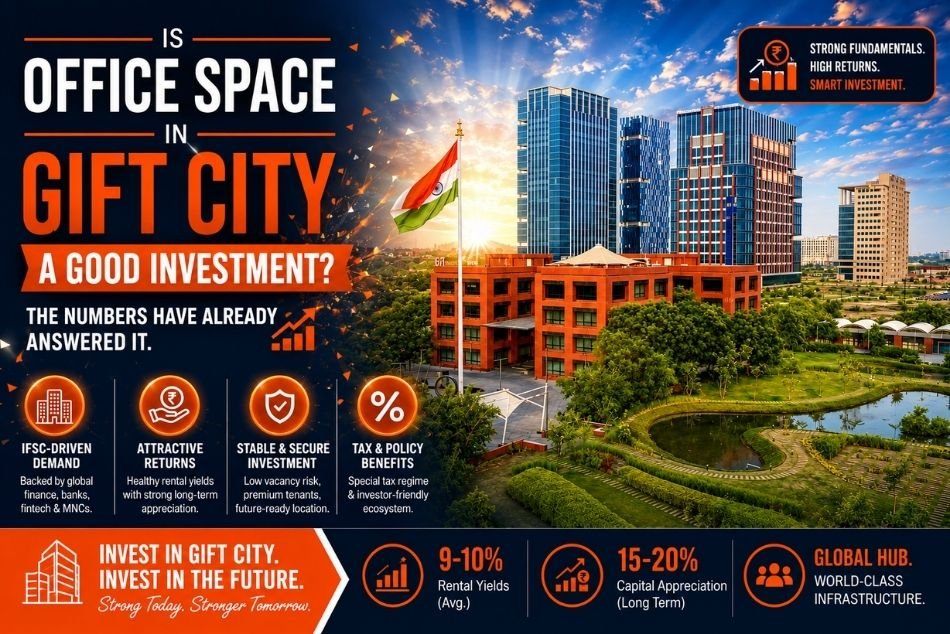
Is Office Space in Gift City a Good Investment? The Numbers Have Already Answered It
Is office space in GIFT City a good investment — or is the story still ahead of the reality? Thirty-seven banks. USD 106.7 billion in banking assets. A regulator that has expanded permitted activities every single year since 2020. These are not projections. They are the operating figures for February 2026, and they represent the demand backdrop sitting underneath every commercial listing in GIFT City right now.
Most investors who ask the question are still running a 2019 mental model of the city: half-built towers, thin occupancy, uncertain regulation. That picture is years out of date. The institutions that waited for certainty before committing are already here. The question for a buyer today is not whether GIFT City is real. It is whether you move before the pricing reflects what is already on the ground.
This article runs the actual numbers — yields, entry prices, carry costs, and a head-to-head against competing asset classes — so you can make that decision with data rather than a brochure.
The Demand Floor That No Other Indian Commercial Market Has
Before the numbers, one structural fact shapes everything else about office investment here.
IFSC-registered tenants — banks, fund managers, insurance firms, aircraft leasing SPVs — must maintain a physical presence inside the IFSC boundary to hold their IFSCA license. This is not a preference. It is a compliance requirement. They cannot save money by moving to a cheaper park in Ahmedabad and keep their regulatory standing. The address is part of the operating license.
That creates a demand floor with no equivalent anywhere else in India. When IFSCA adds a new permitted activity — and it has added new ones every year since 2020 — it creates an entirely new category of tenant that needs GIFT City office space to exist. Aircraft leasing. Family investment funds. Virtual asset providers. Each one is a fresh wave of absorption before the broader market has even priced it in.
Every IFSCA announcement creates new tenants. The question is whether your unit is already in the zone when they arrive.
Non-IFSC commercial space in the Domestic Tariff Area follows a different logic — GCCs, professional services firms, IT and fintech companies. Solid demand, good infrastructure, but it responds to the general economy rather than regulatory expansion. Both zones are worth owning. But they are different bets, and knowing which one you are buying is the first step.
What Office Space Actually Costs and What It Yields
Current listings across GIFT City put commercial office rates in the Rs. 6,000 to Rs. 14,000 per square foot range. Premium towers and plug-and-play units with institutional-grade specifications sit at the upper end. Larger bare-shell floor plates in mid-tier buildings run closer to the lower end.
Gross rental yields on leased, quality office space currently run 6% to 10%, depending on zone, building, and tenant profile. Some managed and co-working formats cite 11%, though that often reflects operator economics rather than what flows through to a passive landlord.
Net yield — after maintenance, property management, and a realistic vacancy allowance — typically lands two to three percentage points below the gross. A well-leased IFSC unit at 8% gross is a solid 5.5% to 6% net proposition. That is where the comparison against alternatives gets interesting.
A bank fixed deposit pays 6.5% to 7.5% pre-tax with daily liquidity and zero management effort. A listed REIT covering Grade-A office across Mumbai and Bengaluru yields 6% to 8% with exchange liquidity. On net yield alone, GIFT City office has to work harder to justify the illiquidity.
It does — once appreciation is added to the stack. And that is exactly what a five to seven year hold in GIFT City is built to capture.
How Gift City Office Pricing Compares to Other Indian Markets
Here is the side-by-side most buyers should run before committing.
| Market | Entry Price (per sq ft) | Typical Gross Yield | Liquidity |
|---|---|---|---|
| GIFT City (IFSC zone) | Rs. 6,000 – Rs. 14,000 | 6% – 10% | Thin, improving fast |
| Mumbai BKC | Rs. 35,000 – Rs. 60,000+ | 4% – 6% | Deep |
| Bengaluru SBD/CBD | Rs. 12,000 – Rs. 18,000 | 6% – 7.5% | Moderate |
| Hyderabad HITEC City | Rs. 8,000 – Rs. 13,000 | 7% – 8.5% | Moderate |
GIFT City’s entry price is a fraction of BKC and at or below Bengaluru and Hyderabad — while its yield band sits at or above all three. The trade-off is liquidity. GIFT City’s secondary market is thinner than established hubs. A forced exit on a short timeline may take longer than expected.
For a long-horizon buyer who can hold five to seven years, that liquidity trade-off is worth making. For a buyer who might need capital back within two years, it is a real constraint to price in before you sign.
BKC gives you depth. GIFT City gives you yield and a runway. For a long-horizon buyer, that is the better trade at current entry prices.
The Carry Cost Maths Most Buyers Skip
A unit that costs Rs. 1 crore and yields 6.5% net earns roughly Rs. 6.5 lakh a year. Add 3% to 4% annual capital appreciation — conservative given GIFT City’s track record and the catalysts still ahead of it — and total annual return lands at 10% to 10.5%. That clears a fixed deposit decisively, and it includes a real asset that appreciates rather than a number on a bank statement.
The carry picture for a leased unit is genuinely comfortable. For a vacant one, the arithmetic flips fast. Maintenance, opportunity cost on parked capital, and a six to nine month fit-out window before the first rupee of rent arrives — all of that erodes year-one returns materially.
The lesson is not to avoid GIFT City commercial. It is to buy the right product: a leased unit, or a building where the developer has an established track record of tenant placement. A vacant bare-shell unit bought on the city’s growth story alone requires patience and capital that most buyers underestimate.
Currency and Tax — Two Details That Change Your Actual Return
IFSC tenants, particularly foreign bank branches and international fund managers, sometimes negotiate rent in USD or with escalation benchmarked to USD rates. For a landlord, that is either a currency hedge or an exposure depending on how the rupee moves. Know which currency your lease is denominated in before you model returns.
On tax: the IFSC’s profit exemptions, GST relief, and transaction tax holidays apply to the businesses operating inside the zone — not to the property owner. Rental income and capital gains on a GIFT City commercial unit follow standard Indian income tax rules, the same as anywhere else in the country. Run your net return numbers on that basis, and verify your specific position with a chartered accountant before committing.
These details do not weaken the investment case. They sharpen it — because buyers who model them correctly make better decisions than those who discover them after the purchase.
The Sectors Still Arriving — And Why They Matter for Your Unit
Most buyers evaluate GIFT City office space against the tenants already there. The smarter frame is the tenants still arriving.
Aircraft leasing is one of the fastest-growing demand categories in GIFT IFSC. India’s aviation finance has historically been routed through Ireland. IFSCA’s Aircraft Leasing Regulations, introduced in 2021, were built specifically to change that. Indian airlines have already executed sale-leaseback transactions through GIFT City SPVs — and each transaction requires a physical address, legal teams on the ground, and asset managers working from inside the zone. The India Aircraft Leasing and Financing Summit 2.0, held at GIFT City in May 2026, is a clear signal that aviation finance here is not a one-cycle story.
Family Investment Funds are the quietest but most durable new demand layer. The FIF framework requires a minimum USD 10 million net worth for the family entity. These are not speculative tenants — they take long leases, fit out to high standards, and generate almost zero management friction. India’s large private wealth market has historically managed offshore assets through Singapore and Mauritius. As those structures face increasing substance requirements and compliance costs, GIFT City FIFs are where the capital is migrating. Each family office that arrives needs 3,000 to 5,000 square feet of premium, private office space.
Fintech companies graduating from IFSCA’s regulatory sandbox are a steady and renewable source of small-to-mid-sized tenancy. Sandbox cohorts are approved on a rolling basis. The ones that graduate to full IFSCA registration become permanent occupiers. They are bandwidth-heavy, proximity-driven, and they cluster — which means one fintech anchor in a building tends to attract others.
Every one of these sectors was generating zero GIFT City office demand three to four years ago. Each is now generating real absorption. The commercial inventory available at today’s pricing was not built for the entity count that GIFT City will have in 2028. Buyers who move now are buying at prices set by the ecosystem of today, not the one that is forming.
The tenants who will fill GIFT City’s next wave of office space are being licensed right now. The buildings that will house them are available today, at today’s prices.
Where Office Space in Gift City Outperforms Clearly
The clearest wins are well-defined.
A unit inside the IFSC notification boundary, already leased to a regulated entity on a five-year-plus term, is a structurally different asset from almost anything else available in Indian commercial real estate. The tenant cannot leave without losing their license. That covenant quality is not available in any IT park, any BKC tower, any Bengaluru tech corridor.
Smaller boutique formats — 2,000 to 6,000 square feet — targeting family offices, aircraft leasing SPVs, and advisory firms are currently the most undersupplied product in the zone. Demand from aviation finance and wealth management is outpacing purpose-built supply. Buyers who get into this format now are entering a segment where the supply-demand imbalance is actively working in their favour.
Every IFSCA regulatory expansion is a fresh demand event. The aircraft leasing framework. Family Investment Funds. Virtual asset service providers. The India Aircraft Leasing and Financing Summit 2.0 was held at GIFT City in May 2026 — a signal that the aviation finance cluster is deepening, not plateauing. Each new entrant needs a desk. Most of them need more than one.
The investors already inside the IFSC boundary are not sitting on a story. They are sitting on a regulatory demand floor that gets wider every year.
Factors to Verify Before You Move — Not Reasons to Wait
A few checks separate a strong GIFT City commercial purchase from a weak one. None of them are reasons to defer — they are reasons to buy the right unit rather than the wrong one.
- Zone classification: IFSC or DTA. Confirm from the GIFT City Development Corporation’s allotment document, not the brochure. This determines your entire tenant universe.
- Existing lease or letter of intent: a leased unit and a vacant one are different risk categories, not different flavours of the same investment.
- Floor specification: power redundancy, raised flooring, financial-grade broadband. IFSC tenants will not sign without these. Verify the mechanical and electrical spec, not the rendering.
- Developer track record inside GIFT City specifically. Delivering inside a Special Investment Region is different from a standard project. Ask for their GIFT City-specific completion history.
- Holding horizon: five to seven years is the window where the appreciation thesis does the heaviest lifting. Below three years, liquidity is the binding constraint.
Buyers who run through these five checks move with confidence. The city’s fundamentals do the rest.
Wrapping Up: Is Office Space in Gift City a Good Investment?
Is office space in GIFT City a good investment? For a leased unit in the right zone, from a developer with a proven GIFT City record, held over the right horizon — yes, clearly. The structural case is not speculative. It is sitting in the operating numbers: 37 banks running IBUs, USD 106.7 billion in banking assets, and a regulator that has never contracted the list of permitted activities since it was established in 2020.
The window that buyers who entered in 2021 and 2022 had — sub-Rs. 6,000 per square foot, thin competition, fresh-slate entry prices — is closed. But the appreciation runway is not. With 37 buildings still under construction, with IFSCA’s regulatory calendar still adding new categories, and with aviation finance now entering its second major summit cycle at the city, the demand story has distance ahead of it.
Office space in GIFT City rewards buyers who understand the product they are buying, match it to the right tenant profile, and give the hold enough time to work. Those who wait for the city to feel ‘finished’ before moving will buy at prices that already reflect everything that has arrived. The buyers who act now — on a leased unit in the right zone at the right spec — are the ones who will look back in five years and understand exactly what they locked in.
FAQs: Office Space Investment in Gift City
Q1) What Is a Realistic Net Rental Yield on Office Space in Gift City Right Now?
Net yields on leased, well-located IFSC office units currently run 5.5% to 7% after maintenance, property management, and a fair vacancy allowance. Headline gross figures of 9% to 11% seen in marketing material reflect operator economics in managed formats, not what a passive landlord typically takes home.
Q2) Is Office Space a Better Investment Than Residential Property in Gift City?
For income, yes — commercial yields are meaningfully higher than residential’s 3% to 4%. For pure long-horizon appreciation, residential competes because it is less tightly tied to IFSCA’s policy pace. They serve different goals. Commercial is the income play; residential is the appreciation play. Both are worth owning for different reasons.
Q3) How Long Does It Take to Lease a Vacant Gift City Office Unit?
A well-specified unit inside the IFSC boundary with the right infrastructure typically takes a few months to place a tenant, followed by six to nine months for fit-out before full rent begins. Units lacking institutional-grade spec, or sitting outside the IFSC boundary, take considerably longer.
Q4) Does Buying a Unit With an Existing Tenant Cost More?
Usually yes. The premium is almost always worth paying. A leased unit gives you income from day one, removes the fit-out risk from your side of the ledger, and gives you covenant quality that a vacant unit cannot replicate.
Q5) What Is the Single Biggest Mistake First-Time Commercial Buyers Make in Gift City?
Anchoring on the headline gross yield without checking zone classification, tenant status, and maintenance charges. Those three factors alone can compress a 9% headline yield to a 6% real one — and that gap is what decides whether the investment actually beats a fixed deposit.