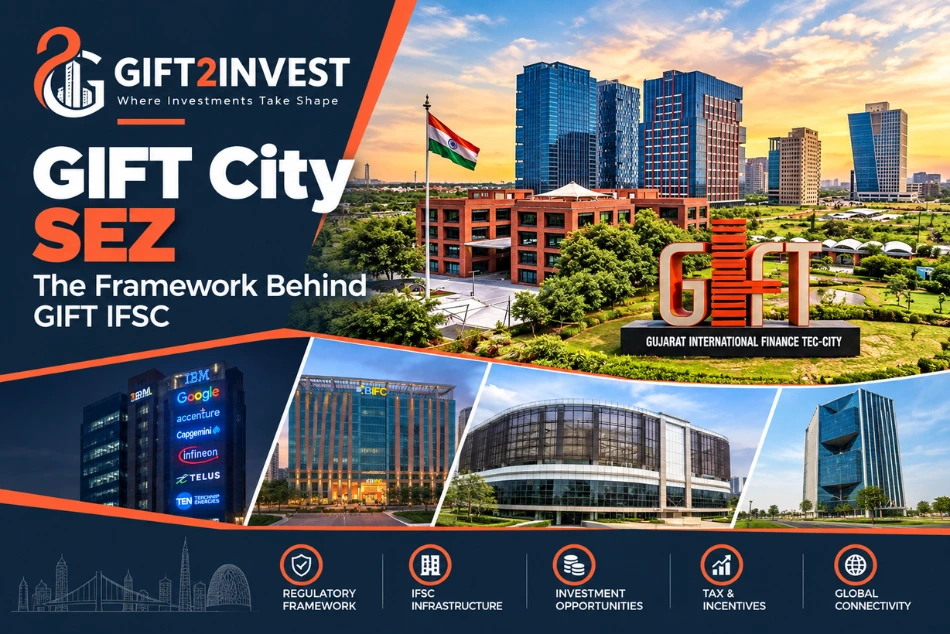
What Is GIFT City SEZ? Understanding the SEZ Framework for IFSC Units
Most people run into GIFT City SEZ before they run into a clear explanation of it. They hear GIFT City, GIFT IFSC, IFSCA, and SEZ used almost interchangeably in the same conversation, and it’s rarely obvious which term means what. That confusion is worth clearing up before anything else, because the SEZ layer is not a footnote. It’s the legal structure that GIFT IFSC sits inside.
This article explains what GIFT City SEZ actually is, how it connects to GIFT IFSC, who regulates it, and what it means in practical terms for a unit operating there and, separately, for someone buying property nearby. It’s a foundational explainer, not a compliance manual. For step-by-step procedures — registration, the Letter of Approval, BLUT, leasing, exit — those live in their own dedicated guides.
A Special Economic Zone, in the plain sense, is a designated area where a different set of rules applies than in the rest of the country — typically built around export orientation, streamlined approvals, and specific fiscal incentives for eligible units. GIFT City’s SEZ is that same concept, applied to financial services rather than manufacturing or goods trade.
GIFT SEZ is formally notified as a Multi-Services Special Economic Zone under the Special Economic Zones Act, 2005. It occupies a defined footprint within the broader 886-acre GIFT City master plan — roughly 261 acres, separate from the Domestic Tariff Area that makes up the rest of the city. GIFT City SEZ status is not a marketing label attached to the skyline. It’s a statutory zone with its own rules, its own approval process, and its own obligations for the units that operate inside it.
GIFT City vs GIFT SEZ vs GIFT IFSC: What’s the Difference
These three terms describe three different layers of the same project, and keeping them separate makes everything else in this article easier to follow.
| Layer | What It Actually Is |
|---|---|
| GIFT City | The full master-planned development — 886 acres between Ahmedabad and Gandhinagar, covering both the SEZ and the Domestic Tariff Area. |
| GIFT SEZ | The Multi-Services Special Economic Zone carved out within GIFT City, notified under the SEZ Act, 2005. |
| GIFT IFSC | The International Financial Services Centre operating inside GIFT SEZ, regulated by IFSCA. |
| Eligible IFSC Unit | An entity that has obtained a Letter of Approval and IFSCA registration to operate within GIFT IFSC. |
This is a simplified conceptual layering, not a legal org chart. In practice, some functions and approvals overlap across these layers rather than sitting in strict sequence.
GIFT City is the whole development — the 886-acre master plan, both zones, all the residential and commercial inventory across it. GIFT SEZ is the specific notified zone within that master plan. GIFT IFSC is the International Financial Services Centre that operates inside the SEZ. And an IFSC unit is an individual company that has been approved to actually operate there. Each layer sits inside the one before it, not alongside it.
Why Was GIFT City Developed as an IFSC?
The short version: India had no domestic venue for cross-border financial business, so that business routed through Singapore, Dubai, and Mauritius by default. GIFT IFSC was built to give international financial services — banking, fund management, insurance, capital markets, and more recently aircraft and ship leasing, bullion trading, and fintech — a regulated home inside India instead.
The SEZ framework is what made that possible under Indian law. Section 18 of the SEZ Act specifically allows an International Financial Services Centre to be set up within an SEZ, and GIFT IFSC — established in 2015 as an SEZ, with IFSCA becoming operational in 2020 — was the first, and remains the only, IFSC in the country built on that provision.
How the SEZ Framework and IFSC Regulation Work Together
The SEZ framework and the IFSC regulatory framework aren’t the same thing, even though they overlap almost completely for units inside GIFT IFSC. The SEZ framework governs the zone itself — approvals to set up a unit, export obligations, customs and duty treatment, lease and land matters. The IFSC framework, administered by IFSCA, governs the financial-services activity a licensed unit is allowed to carry out.
Because an IFSC operates within an SEZ under Section 18 of the SEZ Act, an IFSC unit is also an SEZ unit and must comply with the applicable SEZ provisions alongside the IFSCA regulatory framework for its financial-services activity. The v2.0 IFSCA booklet treats the SEZ side and the IFSCA regulatory side as connected parts of the unit’s regulatory lifecycle. To simplify the SEZ administration for IFSC units, specified SEZ functions are handled by the Administrator (IFSCA).
Who Regulates GIFT City IFSC and Its SEZ Framework?
IFSCA — the International Financial Services Centres Authority — is the unified regulator for financial services activity inside GIFT IFSC. It consolidates powers that would otherwise sit separately with the RBI, SEBI, IRDAI, and PFRDA, giving banking, capital markets, insurance, and fund management a single regulatory point of contact within the IFSC.
The SEZ side is a related but distinct function. The Administrator (IFSCA) — a designated senior IFSCA officer — exercises the powers of Development Commissioner specifically for SEZ matters affecting IFSC units: unit approvals, the Unit Approval Committee process, lease and BLUT formalities, and exit. It’s precise to say IFSCA is the financial regulator for the IFSC, and that its Administrator performs specified SEZ functions for IFSC units. It would be imprecise to say IFSCA regulates every activity across the whole of GIFT City, including the Domestic Tariff Area and general commercial or residential activity outside the SEZ.
What Is an IFSC Unit?
An IFSC unit is a company that has been formally approved to carry out a permitted financial-services activity inside GIFT IFSC. It is not simply any business with an office address in GIFT City.
Becoming an IFSC unit involves obtaining the relevant SEZ Letter of Approval and the applicable IFSCA regulatory approval or registration for the permitted financial activity. Under the current v2.0 process, applications for activities enabled through SWIT use the Common Application Form, with the SEZ LOA portion flowing to the SEZ Online portal for processing. Renting a desk or a floor inside the SEZ boundary does not, on its own, make an entity an IFSC unit. The approval and regulatory authorisation are what establish that status, subject to the conditions attached to them.
What Activities Run Through GIFT City IFSC?
Broadly, and subject to the current regulatory framework: banking through International Banking Units, capital markets and exchange activity, fund management including AIFs and family investment funds, insurance, aircraft and ship leasing, bullion trading through IIBX, and fintech operating through IFSCA’s regulatory sandbox and permitted categories. This list is illustrative, not exhaustive — IFSCA has added new permitted categories most years since 2020, and the current, complete list sits with IFSCA’s own regulatory publications rather than any single summary article.
How Does a Unit Enter the GIFT City SEZ Framework?
At a high level, the lifecycle runs from identifying the permitted activity and premises, through the relevant IFSCA/SEZ application process, review and issuance of the Letter of Approval, completion of SEZ formalities such as the Bond-cum-Legal Undertaking, commencement of operations, ongoing reporting and compliance, and eventual renewal or exit. For activities enabled through SWIT, the applicant submits the Common Application Form and the SEZ LOA portion is forwarded to SEZ Online. The v2.0 booklet also confirms that a BLUT may now be executed as an e-BLUT under Instruction No. 123 dated 23 February 2026. Detailed LOA and BLUT procedures are covered in the dedicated guides.
A regulatory update worth flagging here: in February 2026, the government notified an amendment to the SEZ Rules introducing a standardised Letter of Approval format — Form GA — specifically for units setting up in an IFSC. The LOA under that framework is valid for one year for project implementation, and units are required to sustain positive net foreign exchange earnings by exporting financial services over the following years. None of that sequence happens by simply signing a lease. Each step in the GIFT City SEZ lifecycle — registration, LOA, BLUT, lease execution, commencement, and eventual exit — has its own detailed procedure, and those live in their own dedicated guides on this site rather than compressed here.
What the SEZ Framework Means for a Unit, Day to Day
Once operational, a unit inside GIFT City SEZ carries ongoing obligations across a handful of practical areas: staying within its approved activities, maintaining its premises and documentation in line with SEZ requirements, filing periodic reports, seeking approval for any material changes to its activity or structure, and following a defined process if it ever needs to exit the zone.
None of this is unusual by SEZ standards generally — it mirrors the lifecycle obligations that apply to SEZ units elsewhere in India, adapted for a financial-services context rather than manufacturing or trading. The detail in each of these areas is substantial enough to warrant its own article; this piece is deliberately keeping each one at a summary level.
Does GIFT City SEZ Status Mean Tax Benefits?
Eligible GIFT-IFSC/SEZ units may receive tax, duty or other fiscal incentives under applicable law, but the availability and extent of any benefit depend on the relevant activity, legal provisions in force, and the unit meeting the applicable conditions. Because these provisions can change, this article keeps the point at framework level. The dedicated GIFT City SEZ Benefits article should cover specific incentives and their conditions in greater detail.
SEZ/IFSC incentives available to an eligible operating unit should not be assumed to apply to an individual simply because that person owns property in GIFT City. A business operating as an IFSC unit inside the SEZ and a person who owns a residential apartment or a Domestic Tariff Area commercial unit are different legal and tax situations. Property ownership therefore requires separate consideration of the applicable tax rules rather than an assumption that SEZ status transfers to the property owner.
What GIFT City SEZ Means for Real Estate Investors
For someone evaluating commercial property, the SEZ layer matters directly. Space inside the SEZ boundary can generally only be occupied by SEZ-approved, IFSCA-registered entities — that’s the tenant universe a commercial buyer in that zone is actually selling into, and it’s a narrower, more regulated pool than a standard Domestic Tariff Area or open-market commercial listing. Understanding GIFT City SEZ rules, at least at the level this article covers, is a reasonable starting point before evaluating any SEZ-zoned commercial unit specifically.
For residential buyers, the connection is more indirect. SEZ status itself is not a reason to buy a specific apartment — it doesn’t change the unit’s tax treatment, and it doesn’t by itself tell you anything about that project’s price, developer track record, rental demand, or exit liquidity. What the SEZ framework does explain is why GIFT IFSC keeps adding regulated tenants, and why those tenants keep bringing employees who need somewhere to live nearby. That’s useful context for a residential decision. It’s not a substitute for the property-level due diligence — location, developer, price, demand, and holding horizon — that any GIFT City purchase still requires.
Common Misconceptions About GIFT City SEZ
- GIFT City and GIFT SEZ are treated as identical, when GIFT SEZ is a specific notified zone within the larger GIFT City development, not the whole city.
- Every business with a GIFT City address is assumed to be an IFSC unit, when unit status requires specific SEZ and IFSCA approval, not just an office lease.
- Buying property is assumed to carry SEZ tax benefits automatically, when those incentives attach to eligible operating businesses, not to a residential or DTA property owner.
- Getting SEZ approval is treated as the finish line, when it’s the start of an ongoing compliance relationship covering reporting, renewals, and any changes to activity.
- IFSCA is assumed to regulate every activity across all of GIFT City, when its financial-services mandate and its Administrator’s SEZ functions apply specifically to IFSC units, not to the DTA or general city activity.
- SEZ status is treated as proof that a specific property is a good investment, when zone status says nothing about that project’s price, developer, or demand fundamentals.
What to Understand Before Going Deeper
GIFT City is the broader development. GIFT SEZ is the notified Special Economic Zone within it. GIFT IFSC operates inside that SEZ. Units that want to operate there need SEZ approval — an LOA — followed by IFSCA registration for their specific financial activity. IFSCA regulates the financial-services side; its Administrator carries out specified SEZ functions for those same units. And a tax or regulatory incentive that belongs to an operating business should never be assumed to belong to a property investor simply because both sit inside GIFT City.
Wrapping Up: GIFT City SEZ in One Frame
GIFT City SEZ is the statutory zone that makes GIFT IFSC legally possible — not a marketing term, and not, by itself, a reason to buy a specific property. GIFT City is the development. GIFT SEZ is the notified zone within it. GIFT IFSC operates inside that zone under IFSCA’s regulation, with its Administrator handling the SEZ-specific side of a unit’s lifecycle from approval through to exit.
For anyone evaluating GIFT City property — commercial or residential — understanding GIFT City SEZ is useful background for reading a listing correctly, particularly on the commercial side where zone status decides the tenant pool. It’s context, not a substitute for checking the specific project, developer, price, and demand on their own merits. GIFT2Invest.com tracks current GIFT City residential and commercial listings with zone classification specified upfront, which is where that property-level work actually starts.
FAQs: GIFT City SEZ
Q1) What Is GIFT City SEZ?
It’s the Multi-Services Special Economic Zone notified within the broader GIFT City development, established under the SEZ Act, 2005. GIFT IFSC operates inside this zone.
Q2) Is GIFT City the Same As GIFT SEZ?
No. GIFT City is the full 886-acre master plan, covering both the SEZ and the Domestic Tariff Area. GIFT SEZ is the specific notified zone within it.
Q3) What’s the Difference Between GIFT SEZ and GIFT IFSC?
GIFT SEZ is the statutory zone. GIFT IFSC is the International Financial Services Centre that the SEZ Act permits to be established inside that zone, regulated by IFSCA.
Q4) Who Regulates GIFT City IFSC?
IFSCA regulates financial-services activity inside GIFT IFSC. A designated Administrator (IFSCA) separately performs specified SEZ functions — approvals, BLUT, exit — for IFSC units, under powers vested by the central government.
Q5) What Is an IFSC Unit?
A company approved, through an LOA and subsequent IFSCA registration, to carry out a specific permitted financial-services activity inside GIFT IFSC. An office address alone does not confer this status.
Q6) Does Every Company in GIFT City Operate as an IFSC Unit?
No. Only entities that have gone through SEZ and IFSCA approval for GIFT IFSC are IFSC units. Businesses in the Domestic Tariff Area operate under standard Indian rules instead.
Q7) Does SEZ Status Automatically Give Property Buyers Tax Benefits?
No. SEZ and IFSC tax incentives apply to eligible operating units, not to individuals who buy residential or DTA commercial property. Rental income and capital gains for a property owner follow standard Indian tax rules.
Q8) Why Should a GIFT City Property Investor Understand the SEZ Framework?
It explains the tenant universe for SEZ-zoned commercial space and the regulatory momentum behind GIFT IFSC’s growth — useful context, though it doesn’t replace ordinary property-level due diligence.
For the full set of GIFT City buyer questions — property, NRI and OCI rules, taxes, connectivity, and the buying process — see GIFT2Invest.com’s complete FAQ.
Sources & References
This article has been checked against the current IFSCA SEZ Compliance FAQ Booklet (v2.0), August 2026, together with the other official sources listed below. SEZ rules, IFSCA regulations, notifications and compliance requirements can change, so the latest official provisions should always be verified before relying on them for a transaction or compliance decision.
GIFT City official portal — master plan and zone information
https://giftgujarat.in
IFSCA — official website and regulatory updates
https://www.ifsca.gov.in
IFSCA — SEZ Compliance FAQ Booklet (v2.0), August 2026 — Office of Administrator (IFSCA)
https://ifsca.gov.in
Ministry of Commerce and Industry — Special Economic Zones Act, 2005
https://www.sezindia.gov.in
Ministry of Commerce and Industry — Special Economic Zones Rules, 2006 and amendments
https://www.sezindia.gov.in
Gujarat Real Estate Regulatory Authority (RERA) — project registration verification
https://gujrera.gujarat.gov.in
Regulatory Note: SEZ and IFSC rules, procedures, notifications, and compliance requirements may change. This article is intended as an educational guide and should be read alongside the latest applicable notifications, regulations, and official IFSCA guidance. Nothing here is legal, tax, or investment advice.