Your Gift City Property Investment Guide Starts Here
If you’ve been following India’s real estate and financial news over the last few years, GIFT City has come up more times than you can count. Gujarat International Finance Tec-City — GIFT City — sits on the outskirts of Ahmedabad and Gandhinagar, and it isn’t just another township project. It’s India’s first operational International Financial Services Centre (IFSC), and it has been pulling in global banks, fund managers, insurance companies, and fintech firms at a pace that was hard to imagine even five years ago.
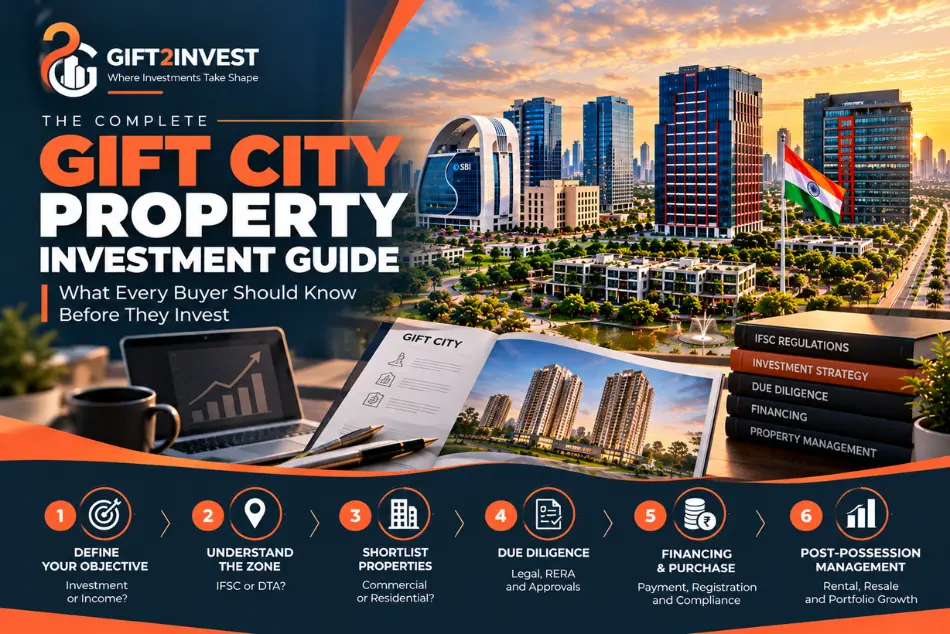
This gift city property investment guide walks you through what the city is, why its real estate market is drawing attention from individual buyers and institutional investors alike, what the risks actually look like (not the glossy version), and how to approach an investment decision here without getting ahead of yourself.
What GIFT City Actually Is — And Why It Matters for Property
Before you think about property, you need to understand what GIFT City was designed to do.
The project started as a government-driven ambition to create a world-class financial hub that could compete with Singapore, Dubai’s DIFC, and Hong Kong. The IFSC within GIFT City operates under a distinct regulatory framework — one that sits outside India’s standard domestic tax and regulatory structure.
This matters enormously for real estate. The people moving into GIFT City — employees of global banks, GICs (Global In-House Centers), fund houses, fintech companies — are often earning in USD or dealing with international clients. They want housing that matches the international standard of the workplace, and they want it close by.
As of 2025-26, the city has allotted over 29 million sq ft of space, has more than 1,000 entities operational, and has generated over 20,000 jobs. Those aren’t just statistics. Each employed professional is a potential tenant or buyer. That’s the demand engine underneath the property story.
The Walk-to-Work City: Why Location Logic Works Differently Here
GIFT City was built around the walk-to-work concept. That’s not marketing language — the urban planning actually reflects it.
Most Indian cities grew organically. Workers move to wherever jobs are and deal with whatever commute results. GIFT City inverted this. Housing, offices, schools, clubs, parks, and retail are all being developed in an integrated township so residents don’t need to leave unless they want to.
This changes the property calculus in a meaningful way. In a typical Indian city, you buy near a job hub because of access. Here, the hub and the housing are the same place. That co-location logic is why early investors in GIFT City residential aren’t necessarily wrong even when the city feels quieter than expected on a given weekday afternoon — the build-out is still underway.
Developers like Hiranandani, Sobha, Brigade, Savvy, and Shivalik are already active here. These aren’t fringe players. When names like these commit capital to a location, it says something about demand confidence.
It’s also worth noting the geography. GIFT City sits between Ahmedabad and Gandhinagar — two cities with very different characters. Ahmedabad is a busy commercial hub; Gandhinagar is the state capital with a quieter, more planned character. GIFT City sits in the corridor between them, accessible from both. The Sabarmati riverfront is nearby. Ahmedabad airport is under 30 minutes away. For professionals who travel frequently — and most senior financial services employees do — that connectivity matters more than people account for when they’re buying.
The city is also close enough to Ahmedabad’s established residential areas that buyers who want the investment exposure without living there full-time have a viable base nearby. This is relevant if you’re considering GIFT City property as a buy-to-let rather than a primary residence.
The IFSC Advantage: Why Global Finance Drives Property Demand
The IFSC status of GIFT City creates a demand profile unlike any other Indian city.
Companies operating out of the IFSC include global banks — HSBC, Bank of America, Standard Chartered — along with tech players like IBM, Oracle, and Google, and hundreds of smaller financial firms. The talent these companies hire tends to skew senior, international, and well-compensated.
Senior finance professionals don’t want a 45-minute commute. They want a well-managed apartment, reliable power, clean streets, and a decent school nearby. GIFT City’s infrastructure was designed to deliver that: underground utility tunnels, India’s first district cooling system, smart water infrastructure, a City Command and Control Centre, and automated waste management. It runs.
For property investors, this means the tenant pool here is likely to stay high-quality. Rental yields in emerging urban clusters can be volatile, but the underlying tenant demand in GIFT City is tied to a regulated financial services sector. It doesn’t evaporate overnight.
Property Types in GIFT City: What’s Actually Available
GIFT City’s real estate breaks into a few distinct categories.
Commercial office space is the most developed segment. The SEZ and the domestic zone both have significant office supply. If you’re looking at commercial property purely from a yield standpoint, this is the more mature market — though entry prices reflect that maturity.
Residential apartments are where the growth story is right now. Several developers have launched or are in the process of launching residential towers within GIFT City’s master plan. These range from mid-range to premium configurations, targeting professionals working in the financial district.
Mixed-use developments are coming up too — buildings with retail at the base, offices in the middle, and residences on top. This format suits the walk-to-work philosophy well.
The Tax and Regulatory Environment: The Part Most Guides Gloss Over
This is where things get genuinely interesting — and where a lot of investors go wrong by oversimplifying.
Units in the IFSC zone operate under a significantly different tax regime compared to the domestic zone. The IFSC Authority (IFSCA) governs businesses within the SEZ under rules that differ from standard Indian corporate tax law. For businesses, this means tax holidays, exemptions on certain transaction taxes, and a streamlined regulatory framework.
But if you’re buying a residential apartment as an Indian resident investing from outside the SEZ, the tax treatment of your rental income and capital gains follows standard Indian income tax rules. The IFSC status of the businesses in the zone doesn’t automatically extend special tax treatment to residential property owned by domestic investors.
This nuance gets lost in a lot of promotional material. Before committing capital, sit down with a chartered accountant who understands both real estate taxation and IFSC-specific regulations. Don’t rely on a developer’s sales pitch for tax structuring advice.
Infrastructure: What Makes GIFT City Different From Other Smart City Projects
India has announced a lot of smart city initiatives over the years. Most have underdelivered. GIFT City is one of the few cases where the infrastructure is built and operational, not just promised.
The district cooling system is the first of its kind in India. Instead of individual AC units in every apartment and office, chilled water is supplied centrally. This cuts energy consumption and maintenance headaches, and it has been running for years.
The automated waste collection system uses underground pneumatic pipes to move garbage from buildings to a central collection point — no garbage trucks clogging streets during business hours.
Uninterrupted power supply is backed by infrastructure design, not just a brochure promise. For financial services firms that cannot afford downtime, this is a real operational differentiator.
The City Command and Control Centre (C4) monitors the entire township in real time — security, utilities, traffic, emergencies. Round-the-clock surveillance of this kind is rare in Indian cities.
For residential investors, this quality of infrastructure matters because it supports both rental demand and long-term asset value. Well-maintained environments hold value more stubbornly.
The Honest Case for Risk: What Could Go Wrong
Any gift city property investment guide that skips the risks isn’t doing you a service.
Slower-than-expected absorption. GIFT City has been in development for over a decade, and ramp-up has been gradual. The demand has built, but if you’re expecting Singapore-speed density, you’ll wait longer than you want. This is less a critique of the project and more just the reality of greenfield city development. These things take time.
Rental yield vs. capital appreciation timing mismatch. If you buy residential property in anticipation of rental income but the city takes another 3-4 years to reach critical mass, you could be carrying costs longer than your projections assumed. Anyone who’s bought into an early-stage development project in India — even good ones — will recognise this pattern.
Regulatory changes. The IFSC framework is relatively new. Policy shifts by IFSCA or changes in international tax treaties could affect the attractiveness of the city to specific types of businesses — and therefore affect tenant demand. The framework has been fairly stable so far, but ‘so far’ is not a guarantee.
Oversupply in specific micro-markets. Several residential towers are under construction simultaneously. If the pace of residential delivery outstrips the pace of job creation in the near term, you could see vacancy rates rise before they fall. Location within GIFT City — proximity to the operational IFSC zone versus the quieter peripheral plots — will matter a great deal for rental performance.
Liquidity. Reselling a property in an emerging cluster before that cluster matures is hard. Exit timelines for early investors in similar projects globally have often stretched considerably. If you need your capital back within three years, this probably isn’t the right asset class.
None of this means the investment is wrong. It means it needs to fit your timeline and risk appetite.
What’s Driving Demand in 2025–26
The demand story has strengthened meaningfully over the last two years.
India’s push to offer a credible alternative to established financial centres — backed by regulatory support, infrastructure delivery, and a large domestic talent pool — has brought more serious institutional occupiers to GIFT City. The banking asset size crossing $100 billion is a marker of real activity, not announced intentions.
Foreign universities are now permitted to set up campuses in GIFT City. That’s a significant policy move — it means the city will eventually have its own educational ecosystem, reducing the need for residents to travel elsewhere for quality schooling.
The fintech ecosystem within the IFSC continues to grow. Fintech companies, unlike large banks, can scale up and down quickly. Their presence adds daily activity to the city, which in turn makes residential living more attractive.
GIFT City vs. Other Indian Real Estate Markets: A Realistic Comparison
People who are serious about this investment usually ask the same question: why here and not Bengaluru, Hyderabad, Pune, or a Mumbai suburb?
It’s a fair question and the answer isn’t that GIFT City is obviously better. It’s that it’s different.
Bengaluru and Hyderabad are established tech and finance hubs with liquid property markets, a wide range of developers, and strong secondary sale activity. The downside is that entry prices in good micro-markets are already high, and in some areas the supply pipeline is genuinely large.
Pune has good fundamentals in specific corridors but the property market is fragmented and hyperlocal — micro-market selection matters enormously and is hard to get right from a distance.
GIFT City doesn’t have the liquidity depth of these markets yet. But it has something they don’t: a purpose-built regulatory framework designed to attract international financial capital, and an infrastructure standard that actually competes with what that capital is accustomed to from its other offices globally.
The comparison that makes more sense is against Navi Mumbai (JNPT / BKC overspill), Hyderabad’s HITECH City early days, or even early-stage development in Gurugram’s Cyber Hub corridor. In each of those cases, investors who bought early when the city felt ‘too quiet’ did well. They also had to wait. That’s the honest historical comparison.
Whether GIFT City follows that trajectory depends on execution — both by the GIFT City Development Corporation and by the businesses choosing to set up there. So far, the execution has been credible.
How to Approach Your Investment Decision
There’s no single right answer on whether to buy in GIFT City right now. It depends on factors specific to you.
If you’re a long-horizon investor — 7 to 10 years — the risk-reward is more defensible. The city’s trajectory is upward, the regulatory environment is supportive, and the infrastructure is genuinely good. You’re buying into a story that’s being written, not one that’s finished.
If you need rental yield from year one, be more selective. Look at projects closer to operational zones with existing footfalls, not greenfield plots on the city’s periphery. The occupancy gap between well-located and poorly-located apartments within GIFT City is real and worth researching before you commit.
If you’re a commercial property investor, the SEZ office market is more mature than residential. Entry prices are higher, but tenant quality tends to be stronger too. Lease terms and tenant covenants matter more here than in residential.
If you’re an NRI, the GIFT City residential story has a particular appeal. You might already be familiar with international financial centres from working abroad. The infrastructure standard, the professional tenant profile, and the IFSC regulatory environment will all feel recognisable. The question is whether you’re comfortable holding an asset in an emerging market with a longer maturity timeline than, say, a Mumbai or Bengaluru address.
Budget for carrying costs honestly. This means maintenance, property management (you probably won’t be in Ahmedabad to manage a tenant yourself), property tax, and any loan servicing. Do the maths at different occupancy rate assumptions — 60%, 75%, 90% — and make sure you can carry the investment at the lower end before expecting the higher end.
Always verify RERA registration for any project you’re considering. GIFT City developments fall under Gujarat RERA, and checking a project’s compliance status before signing anything is basic hygiene you don’t skip.
Wrapping Up: The Gift City Property Investment Guide in Plain Terms
GIFT City is a real infrastructure story backed by real policy, real capital, and real global tenants. It isn’t perfect, and it isn’t a sure thing. But for investors who understand what they’re buying — an emerging international financial district with strong state and central government backing — it deserves serious consideration.
The key is going in with clear eyes. Know your investment horizon. Understand the tax treatment applicable to your specific situation. Pick projects from developers with track records. And don’t confuse the ambition of the project with the pace of its execution.
The city is being built. The question is whether your timeline aligns with its pace.
Frequently Asked Questions
Q1) Is GIFT City a Good Place to Invest in Property Right Now?
It depends entirely on your timeline.
If you’re looking to park money for 7–10 years, the case is reasonably solid — good infrastructure, a growing tenant base, and strong government backing.
If you need returns in 2–3 years, it’s a harder argument. The city is still building out, and expecting it to behave like a mature market before it is one is where a lot of early investors go wrong.
Use this gift city property investment guide as a starting point, but pair it with your own financial reality check before committing.
Q2) Who Is Actually Buying and Renting Property in GIFT City?
Mostly professionals working in or around the IFSC — employees of global banks, fintech firms, insurance companies, and GICs (Global In-House Centers).
A share of buyers are also NRIs who are familiar with international financial centres and see GIFT City as a recognisable format in a home-country context.
Rental demand is tied directly to how fast the city’s corporate ecosystem grows. That’s why tracking new entity setups in the IFSC matters more than watching general Ahmedabad property trends.
Q3) Does the IFSC Tax Advantage Apply to Residential Property Buyers?
Not directly — and this is a point that gets glossed over a lot.
The IFSC tax benefits — holidays, transaction tax exemptions, and so on — apply to businesses operating within the SEZ. If you’re an Indian resident buying a residential apartment in GIFT City, your rental income and capital gains are taxed under standard Indian income tax rules.
The business-friendly regulatory environment doesn’t automatically translate into a tax break for the person buying the flat above it.
Get a chartered accountant involved before you structure anything.
Q4. What Types of Property Are Available in GIFT City?
Three main categories: commercial office space, residential apartments, and mixed-use buildings with retail at the base.
Commercial is the most mature segment, concentrated in the SEZ and domestic zones. Entry prices are higher but tenant quality tends to be more stable.
On the residential side, location within the city matters a lot. Apartments near the operational IFSC zone will lease faster than those on the quieter periphery.
Q5) How Does GIFT City’s Infrastructure Compare to Other Indian Cities?
Genuinely better, in specific ways.
The district cooling system (India’s first), automated underground waste collection, uninterrupted power supply backed by infrastructure design, and a 24/7 city command and control centre are all operational — not announced, not under construction, running.
Most Indian smart city projects have struggled to deliver on their infrastructure promises. GIFT City has delivered more than most, which is part of why global financial firms have actually moved in rather than just signing MOUs.
Q6) What Are the Biggest Risks Specific to GIFT City Property?
Four worth taking seriously.
First, absorption has been slower than early projections — the city is growing, but not fast. Second, several residential towers are going up simultaneously, and if delivery outpaces job creation in the near term, vacancy could climb before it falls.
Third, the IFSC regulatory framework is relatively new. Policy changes could affect how attractive the city is to specific business types.
Fourth, liquidity is thin. This is an emerging market, and finding a buyer quickly if you need to exit isn’t guaranteed.
None of these are dealbreakers, but they’re real.
Q7) How Do I Find Verified Property Listings in GIFT City?
General property portals carry GIFT City listings, but they’re often incomplete, outdated, or missing the IFSC-specific context that actually matters for investment decisions.
Gift2Invest.com is built specifically around this market — residential and commercial listings, project-level details, and regular updates on what’s new in the city.
It’s a more practical first stop than trawling a national portal that treats GIFT City as one pin among thousands.
Q8) Is GIFT City Only for Commercial Investors, or Can Individual Buyers Participate?
Individual buyers can and do invest here — both in residential apartments for personal use or rental, and in commercial units.
The residential market is the more accessible entry point for most. That said, this isn’t a market where you buy, place a tenant within a month, and sit back.
Buyers who do well here tend to be those who understand they’re investing in an emerging district, not a fully operational one. Going through a proper gift city property investment guide and doing project-level due diligence matters more here than it would in a city with an established secondary market.
Q9) How Does GIFT City Compare to Investing in Bengaluru or Hyderabad Real Estate?
The markets aren’t really comparable in structure.
Bengaluru and Hyderabad have liquid, well-established property markets with active secondary sales, wider developer choice, and deeper rental pools. GIFT City doesn’t have that depth yet.
What it does have is a purpose-built regulatory framework for international finance and an infrastructure standard those cities don’t match.
The honest comparison is to those cities in their early phases — HITECH City Hyderabad circa 2005, Bengaluru’s Whitefield in the early 2000s. People who bought early in those corridors did well. They also had to be patient.
GIFT City is a similar bet, with a different sector driving it.