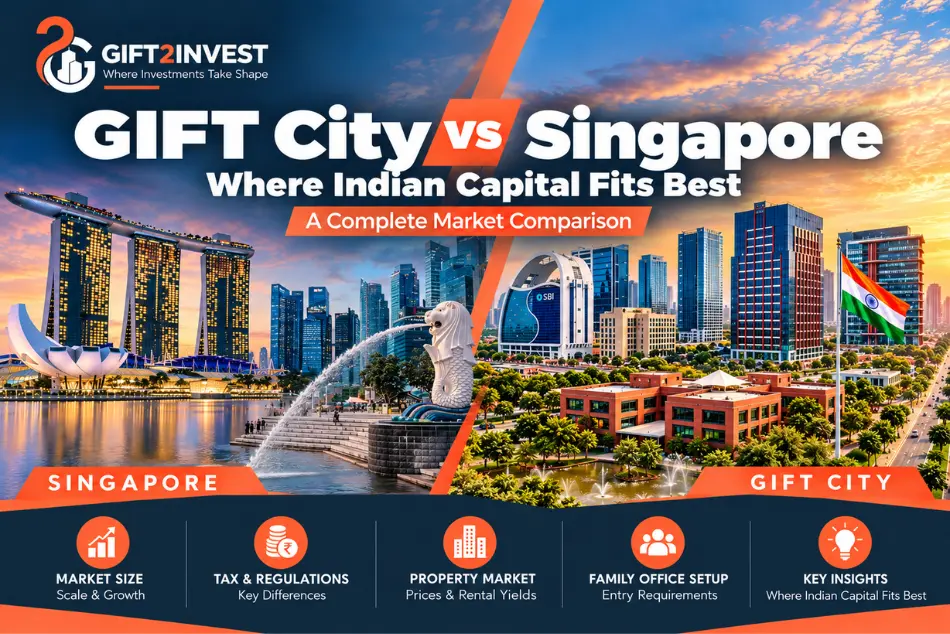
GIFT City vs Singapore: Two Hubs, Two Different Jobs
GIFT City vs Singapore is a question more Indian families, fund managers and NRIs ask today than five years ago. Singapore became the default home for India-linked wealth because India had no international financial centre of its own. GIFT City was built to change that.
The two aren’t mirror images. Singapore is deep, liquid and fully mature. GIFT City is the onshore Indian alternative, still filling in its master plan and growing fast.
This comparison skips the generic “which is better” verdict. It looks at three things most articles miss: how family office and fund structures differ, what Singapore’s foreign-buyer stamp duty does to a property purchase, and what each centre’s growth means for real estate inside GIFT City.
Start with the side-by-side view.
| Factor | GIFT City | Singapore |
|---|---|---|
| Regulator | IFSCA, one unified authority | MAS (Monetary Authority of Singapore) |
| Global Ranking (GFCI 40, Sept 2026) | 37th, up from 46th | 4th, behind New York, London and Hong Kong |
| Scale | 1,260 registrations and USD 120 bn+ banking assets (June 2026) | S$6.7 trillion assets under management (2025); 1,320 licensed fund managers |
| Family Office Entry Ticket | Family Investment Fund: USD 10 million corpus within three years | Section 13O: S$20 million; Section 13U: S$50 million |
| Business Tax | 100% deduction on eligible IFSC business income for 20 of 25 years, then 15% | Headline corporate rate 17%; fund incentives under 13O and 13U |
| Stamp Duty for a Foreign Home Buyer | No foreigner-only surcharge; standard state duty applies | ABSD of 60% for foreigners, 65% for entities |
| Residential Price (Approx.) | About Rs. 10,500 per sq ft (indicative estimate) | S$2,000 to S$2,900 per sq ft, roughly Rs. 1.5 to 2.2 lakh |
| Gross Residential Yield | About 4.5% to 6% (indicative) | About 3.0% to 3.8% (indicative) |
| Resale Liquidity | Thinner, improving | Deep and global |
| Currency | INR for property; foreign currency inside the IFSC | SGD, freely convertible |
Indicative figures as of October 2026, converted at roughly Rs. 74 to 75 per Singapore dollar. Verify current numbers before transacting.
Ranking, Scale and Momentum
Singapore sits fourth in the Global Financial Centres Index. GIFT City ranks 37th in GFCI 40, published in September 2026. That’s a jump of nine places from 46th, and it makes GIFT City the only Indian centre in the Asia-Pacific top 15. Mumbai ranks 49th.
GFCI 40 also lists GIFT City among 15 centres expected to become more significant over the next two to three years. Seven Asia-Pacific centres now sit in the global top 15, so the field is competitive.
The gap in scale is real. Singapore’s asset management industry held S$6.7 trillion in 2025, and about 76% of that money came from overseas investors.
GIFT City is smaller but moving quickly. IFSCA’s official page shows 1,147 registrations and authorisations and USD 111 billion-plus in banking assets at March 2026. By June 2026, IFSCA’s official highlights listed 1,260 registrations and authorisations, USD 120 billion-plus in banking assets, and cumulative fund commitments above USD 45 billion.
That’s roughly 110 new registrations in a single quarter. Each one may need office space, and each hire may need a home.
Singapore’s story is mostly written. GIFT City’s is being written now, and property demand can follow new registrations, depending on actual operations and staffing.
Where GIFT City Is Building Its Own Lane
GIFT City isn’t trying to copy Singapore line by line. It’s building around India-linked niches that Singapore never had to serve.
Aircraft and ship leasing is one. IFSCA data shows 410 aviation and ship assets leased by March 2026, rising to 454 by June. Bullion is another: 668 intermediaries and participants were on the India International Bullion Exchange at June 2026.
Exchanges are active too. IFSC exchanges averaged more than USD 112 billion in monthly turnover during the January to March 2026 quarter. GIFT City also moved up three places to 26th in the global FinTech ranking.
Why does this matter to a property buyer? Each niche brings its own kind of occupier. Leasing structures and fund managers tend to want smaller, private offices, not full floors. That’s a different demand profile from a conventional business park.
Family Offices: Where GIFT City Competes Head-On
Singapore’s single family office boom shows what a well-designed incentive can do. MAS confirmed that more than 2,000 single family offices held tax incentives at the end of 2025.
The entry rules are strict. Section 13O needs at least S$20 million in designated investments, held throughout the incentive period. Section 13U needs S$50 million. A 13O family office must employ two investment professionals, at least one from outside the family. It must also spend S$200,000 a year locally and place the lower of 10% of assets or S$10 million in qualifying local investments.
GIFT City’s Family Investment Fund asks for less on paper. The minimum is a USD 10 million corpus within three years of registration, with no separate net worth test. NRIs and foreign entities owned by the family can invest without a cap. Resident Indians funding through the Liberalised Remittance Scheme are limited to USD 250,000 each per financial year.
Speed matters too. MAS has targeted a three-month turnaround on complete family office applications since July 2025. IFSCA says it strives to decide complete applications within 45 days of submission. Both are targets, not guarantees, and queries can extend either timeline.
In April 2026, IFSCA registered the first Foreign Family Investment Fund. That gives overseas Indian families a regulated structure on Indian soil, with the fund treated as a non-resident for foreign exchange purposes.
The GIFT City vs Singapore family office comparison isn’t about thresholds alone. Singapore offers a proven ecosystem of private banks, trustees and advisers built over decades. GIFT City offers an Indian regulator and direct onshore access to Indian assets.
One detail to confirm with counsel before you plan around it. Reports on the 2025 fund regulations list real estate among the physical assets a family fund may hold. Whether your fund can hold GIFT City property depends on its approval terms and the purchase route.
Tax: Two Designs, One Shared Limit
Singapore’s headline corporate tax rate is 17%. Family offices use Sections 13O and 13U to exempt specified investment income. Singapore generally doesn’t tax capital gains, unless the gains count as trading income.
GIFT City took a different route. Budget 2026-27 extended the IFSC income-tax holiday to 20 consecutive years out of 25, effective 1 April 2026. After that, eligible business income from the IFSC is taxed at 15%, subject to the applicable law. That gives operating businesses a long, visible runway.
The designs suit different readers. Singapore’s incentive rewards families who build real local substance: staff, spending and local investments. GIFT City’s rewards businesses that commit to operating from the zone for the long term.
Both benefits belong to the operating entity or fund. Neither passes to someone who simply buys an apartment or an office. A GIFT City homeowner pays standard Indian tax on rent and gains. A Singapore homeowner follows Singapore’s property rules. Run your property numbers on that basis.
The Property Gap: Singapore’s 60% Wall
Here’s where the comparison stops being close.
A foreigner buying any home in Singapore pays Additional Buyer’s Stamp Duty of 60%. It applies whether the home is the first or the fifth. Entities generally pay 65%, subject to the applicable rules and exceptions. The rate has stood since April 2023 and was left unchanged at Budget 2026.
Take a S$2 million condo. The ABSD alone is S$1.2 million. At about Rs. 74 to 75 per Singapore dollar, that’s close to Rs. 9 crore, before you’ve paid for the home itself.
Permanent residents pay 5% on a first home and 30% on a second. Citizens pay nothing on a first home. So the barrier is really about status. For an NRI who isn’t a Singapore PR, buying a home there as an investment is expensive by design. ABSD applies to residential property, not commercial.
GIFT City has no equivalent foreigner-only surcharge. NRIs and OCIs may acquire eligible residential and commercial property under RBI’s rules, subject to permitted payment routes and other conditions. Standard state stamp duty and registration still apply, so confirm current rates with your lawyer.
Price and Yield
The pricing gap is just as wide. Singapore private condos trade around S$2,000 per sq ft on average, with central addresses nearer S$2,900. That’s roughly Rs. 1.5 lakh to Rs. 2.2 lakh. GIFT City’s residential average is around Rs. 10,500 per sq ft. Singapore costs about 14 to 20 times more per square foot.
Yields tell a similar story. Singapore condo gross yields sit around 3.0% to 3.8% in 2026. Private home vacancy rose to 6.2% in the first quarter and 6.4% in the second quarter, while prices rose 0.5% in the second quarter. GIFT City residential gross yields run roughly 4.5% to 6%, with many leases backed by employer housing allowances.
Singapore is a safe place to hold property. It’s an expensive place to buy it as a foreigner, and the income is thin. For a long-horizon investor, that’s the core of the GIFT City vs Singapore property case.
A Quick Illustration
Say you have Rs. 3 crore to deploy, which is roughly S$400,000. In Singapore, a foreigner pays 60% ABSD on top of the price. So the property itself can cost only about S$250,000. At S$2,000 per sq ft, that buys around 125 sq ft.
In GIFT City, Rs. 3 crore at the city-wide average of Rs. 10,500 per sq ft is nearly 2,850 sq ft in nominal terms. Real units are priced by tower, floor and developer, and you’ll pay stamp duty and registration too. A 2BHK in many projects sits well inside that budget.
The illustration ignores other buying costs on both sides. It’s there to show scale, not to quote a deal.
What Singapore Still Does Better
Be honest about this before you commit capital. Singapore wins on liquidity. Its resale market is deep, transparent and global. If you might need your money back in two or three years, a Singapore holding is easier to exit.
It also wins on track record. Its legal system, its private banking depth and its fund ecosystem have been tested through several cycles. GIFT City is building that history now.
Currency is another point. The Singapore dollar is freely convertible and widely held, which suits families who want assets outside India. GIFT City property sits in rupees, under FEMA rules, and that’s a feature for families consolidating capital back home.
That’s why a GIFT City position suits a seven-to-ten-year hold. Treat it as growth capital, not emergency money.
What GIFT City’s Growth Means for Property
The demand chain is simple. New IFSC registrations may need office space. Their staff may need homes. Fund and family office structures need small, private offices close to banks and exchanges.
Supply is finite by design. Official planning figures show roughly 22% of GIFT City’s planned built area is residential, against 67% commercial. The residential share doesn’t expand with demand.
Ground reality also keeps improving. Two foreign universities, Deakin and Wollongong, are running campuses. The Ahmedabad Metro’s Phase II connection now reaches GIFT City. Lilavati Hospital has begun outpatient services. Retail and dining are still thin, so check daily-life gaps before you buy for self-use.
Price is the other half. At 14 to 20 times cheaper per square foot than Singapore, GIFT City has room to re-rate if the ecosystem keeps deepening. That’s not a guarantee. It’s a reason to look closely now rather than later.
Risks to Price In on the GIFT City Side
A fair comparison names the trade-offs. GIFT City’s commercial demand depends heavily on IFSCA’s pace of new permitted activities. If that pace slowed for several years, tenant growth would slow with it.
Resale is thinner than in Singapore. Under-construction projects can run late, so model carry costs honestly. Retail and dining are still catching up to the office population.
None of this changes the long-hold case. It does mean you should size the position sensibly, check zone classification for every unit, and avoid buying on a brochure alone.
Who Should Choose What
NRI based in Singapore, not a PR. The 60% ABSD makes a Singapore investment home hard to justify. GIFT City is the more practical way to add Indian property, with INR purchase rules you already know from other Indian cities.
Singapore PR. Your ABSD drops to 5% on a first home. The price-per-square-foot and yield gaps still apply, so compare the full numbers before you decide.
Indian family weighing a family office. Compare the Family Investment Fund against Section 13O on corpus, local substance and where your assets actually sit. Get advice on both before choosing.
Office buyer. Singapore’s entry prices are far higher. GIFT City commercial space is listed around Rs. 11,000 to Rs. 14,000 per sq ft (an indicative listing range), and the IFSC or DTA zone check decides your tenant pool. Confirm zone status in writing.
For many serious investors, the answer in GIFT City vs Singapore isn’t either-or. Singapore holds liquid global assets. GIFT City holds the India growth position.
Wrapping Up: GIFT City vs Singapore
There’s no single winner here. Singapore offers depth, liquidity and a proven ecosystem. GIFT City offers an Indian regulator, a 20-year tax runway for operating businesses, and property priced a fraction of Singapore’s, without a foreigner surcharge.
The momentum is measurable. GIFT City climbed nine places in the latest global ranking, and registrations grew by roughly 110 in a quarter. Residential inventory is limited by design.
In the end, GIFT City vs Singapore is a question of matching the hub to the job. Use Singapore for liquidity. Use GIFT City for Indian growth and property. Gift2Invest.com lists residential and commercial inventory with zone classification stated upfront, which is a practical place to start.
Frequently Asked Questions
Q1) Is GIFT City a Substitute for Singapore?
Not yet, and it doesn’t need to be. Singapore is far larger and more liquid. GIFT City serves the India-linked slice of cross-border finance, onshore.
Q2) Can an NRI in Singapore Buy Property in GIFT City?
Yes. NRIs and OCIs may buy eligible residential and commercial property under RBI’s rules, subject to permitted payment routes and other conditions. Confirm repatriation rules with a CA before you transfer funds.
Q3) Why Is Singapore Property So Expensive for Foreigners?
Foreigners pay 60% ABSD on any home, on top of the price and standard stamp duty. It’s a cooling measure, and it has stayed in place through Budget 2026.
Q4) Which Has the Lower Family Office Entry Ticket?
On headline numbers, GIFT City. The Family Investment Fund needs USD 10 million within three years. Singapore’s 13O needs S$20 million and 13U needs S$50 million. Local spending and staffing rules differ too, so compare the full conditions.
Q5) Does the Ifsc Tax Holiday Benefit a Homebuyer?
No. The 20-year holiday applies to operating IFSC units. A homeowner’s rent and gains follow standard Indian tax rules.
Q6) Is Singapore Property a Better Hedge Than GIFT City Property?
It depends on what you’re hedging. Singapore gives you a strong currency and liquidity, but a foreigner pays 60% ABSD up front. GIFT City gives you Indian growth exposure at a much lower entry cost. Many investors hold both.
Q7) How Long Should I Hold GIFT City Property?
Plan for seven to ten years for residential, since the district is still maturing. A leased commercial unit can work over a shorter hold, because income starts earlier. Avoid short-term plans in either case.
Sources and References
Checked October 2026. Figures, rates and rules change; verify with the official source before relying on them.
GIFT City official portal
https://giftgujarat.in
IFSCA, GIFT IFSC Key Highlights (1,260 registrations/authorisations; USD 120 bn+ banking assets; 454 leased aviation/ship assets; 668 bullion participants; June 2026)
https://www.ifsca.gov.in
Business Today, GIFT City jumps from 46th to 37th in GFCI 40, 17 September 2026:
https://www.businesstoday.in/india/story/gift-city-jumps-from-46th-to-37th-in-global-financial-centres-index-enters-top-15-in-asia-pacific-556147-2026-09-17
DeshGujarat, GIFT City rises to 37th in GFCI 40; Mumbai 49th
https://deshgujarat.com/2026/09/17/gift-city-rises-to-37th-globally-in-latest-financial-centres-ranking-in-gfci-40
Shabari Seva, GIFT City climbs to 37th, citing IFSCA June 2026 figures (1,260 registrations; USD 120 bn+ banking assets; USD 45 bn+ fund commitments)
https://www.shabariseva.com/post/gift-city-climbs-to-37th-globally-strengthening-india-s-emerging-financial-hub
Union Budget 2026, IFSC tax holiday extended to 20 of 25 years (Mondaq)
https://www.mondaq.com/india/capital-gains-tax/1740484/union-budget-2026
PwC, India Budget 2026: impact on foreign investors
https://www.pwc.com/us/en/tax-services/publications/insights/assets/pwc-india-budget-2026-impact-on-foreign-investors-and-multinationals.pdf
Nishith Desai Associates, Family Offices in GIFT City
https://www.nishithdesai.com/NewsDetails/10759
IQ-EQ and Dhruva Advisors, GIFT City fund management regulations for NRIs
https://iqeq.com/in/insights/gift-city-unlocking-nri-investment-opportunities-through-fund-management-regulations
GIFT CFO, first Foreign Family Investment Fund registration
https://www.giftcfo.com/post/ifsca-family-investment-fund-gift-city-growth
Opalesque, Singapore confirms over 2,000 tax-incentivised single family offices (August 2026)
https://www.opalesque.com/715797/Singapore_confirms_over_2000_Single_Family_Offices579.html
Singapore Asset Management Survey 2025 (MAS), summary
https://www.caproasia.com/ and https://sg.linkedin.com/in/markvoumard
Mondaq, Updates to Tax Incentives for Single Family Offices (13O and 13U)
https://www.mondaq.com/updates-to-tax-incentives-for-single-family-offices/1380594
Private Law Wiki, Section 13O conditions, updated July 2026
https://wiki.private.law/en/singapore-sfo-13o
Expat Arrivals, Renting vs buying in Singapore: what the 60% rule means (April 2026)
https://expatarrivals.com/article/renting-vs-buying-singapore-expat-what-60-rule-actually-means
Redbrick, ABSD Singapore 2026 rates
https://www.redbrick.sg/blog/absd-singapore
PropNex via Real Estate Asia, Singapore private home prices Q2 2026
https://realestateasia.com/residential/news/landed-housing-lifts-singapore-private-home-prices-in-second-quarter
PropertyNet, Singapore condo rental yields and vacancy 2026
https://propertynet.sg/singapore-condo-rental-yields-under-pressure-2026-rising-vacancy-investors
IRAS, Singapore corporate income tax rates
https://www.iras.gov.sg
Housing.com, GIFT City property price trends
https://housing.com/price-trends/property-rates-for-buy-in-gift_city_gandhinagar-P67h8d534bdssrn60
GradRight, Foreign university campuses in India, July 2026 (Deakin and Wollongong at GIFT City)
https://gradright.com/foreign-university-campuses-in-india-the-complete-2026-guide
Gujarat Metro Rail Corporation, Ahmedabad Metro Phase II
https://www.gujaratmetrorail.com/project-overview2
Reserve Bank of India, Foreign Exchange Management (Acquisition and Transfer of Immovable Property in India) Regulations
https://m.rbi.org.in/scripts/BS_FemaNotifications.aspx?Id=11248
IFSCA, GIFT IFSC Key Highlights (June 2026)
https://www.ifsca.gov.in
Government of India, Union Budget 2026 Memorandum, IFSC deduction period and 15% post-deduction rate
https://www.indiabudget.gov.in/doc/memo.pdf
Inland Revenue Authority of Singapore (IRAS), Additional Buyer’s Stamp Duty rates
https://www.iras.gov.sg/taxes/stamp-duty/for-property/buying-or-acquiring-property/additional-buyer%27s-stamp-duty-%28absd%29
Urban Redevelopment Authority (URA), Q2 2026 private residential property statistics
https://www.ura.gov.sg/news/media/pr26-57
IFSCA, Family Investment Fund eligibility conditions
https://www.ifsca.gov.in/LegalDatabase/VersionDetailView?CatEncryptedId=mizvnmwVAgs%3D&EncryptedId=-ubwPcis0NY%3D&Index1Id=6&Index2Id=884&LegalDetaileId=47&SubEncryptedId=KMZ5djvTZ4U%3D&VersionNumber=V1
Gujarat Metro Rail Corporation, Ahmedabad Metro Phase II project overview
https://www.gujaratmetrorail.com/project-overview2v
Source note: This article is general information, not legal, tax or investment advice. Confirm current figures with official sources and a qualified CA, FEMA specialist or property lawyer before transacting.