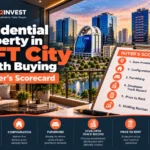
Residential Property in GIFT City Worth Buying: The Window Is Open — But It Will Not Stay That Way
If you have been watching GIFT City closely, you already sense what is happening. Banking assets have crossed USD 111 billion. Over 1,150 entities are now registered under IFSCA. Two foreign universities are running live campuses, with three more set to begin. The metro is live. Lilavati Hospital is open. The city’s footprint is expanding by 15 percent. The question of whether GIFT City is real has been settled. The sharper question now — and the one this article answers — is which residential property in GIFT City is worth buying right now, before pricing catches up to everything that has already arrived.
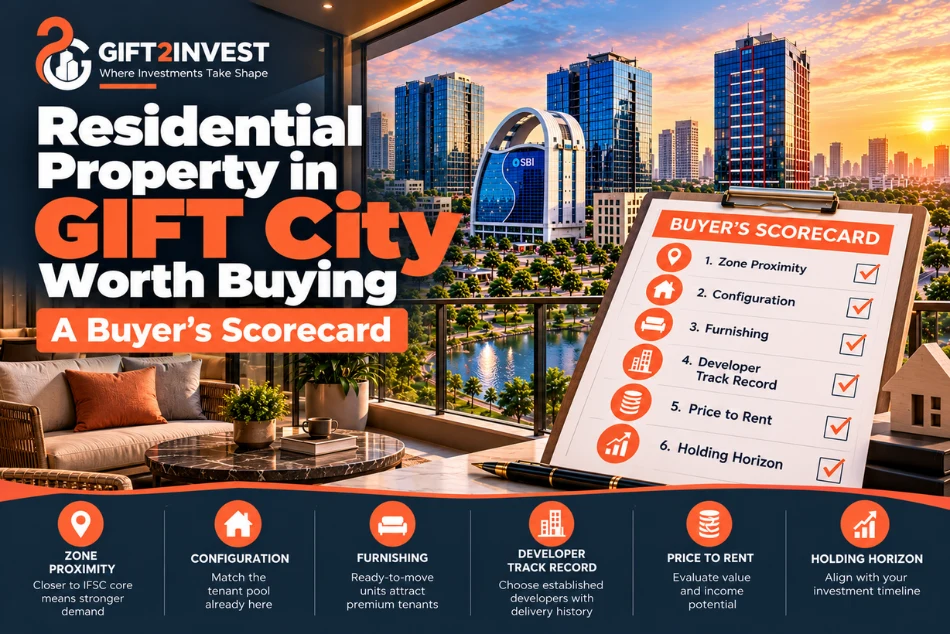
This is a six-factor scorecard that serious buyers can run against any specific listing. Use it to identify units with the strongest near-term income potential and the longest appreciation runway — because in a market moving this fast, choosing the right unit is the difference between early-mover advantage and arriving just after the crowd.
The investors who do well in GIFT City are not the ones who waited for certainty. They are the ones who learned to read the signals before the wider market did.
Why This Is Exactly the Right Time to Be Buying
GIFT City’s residential market is at a specific inflection point. The infrastructure is built. The institutional tenants are here. The social ecosystem — schools, hospital, universities, the GIFT International Club — has crossed from partial to functional. And yet residential pricing has not fully reflected what ground reality now delivers.
That gap between operational maturity and reflected pricing is where residential investors in every great financial district have made their best returns. Canary Wharf, Marina Bay, BKC in Mumbai. In every case, the buyers who moved while the district felt ‘still developing’ captured the full run. The ones who waited for it to feel ‘finished’ arrived after the repricing.
Of the 71 approved buildings in GIFT City, 37 are still under construction. The full 62 million square feet of planned development means the city will be materially larger and more self-sufficient in three to five years than it is today. Buying the right unit now means locking into the appreciation curve before it steepens.
Prices move on expectation, not on completion. The buyers who benefit most are the ones who act while the story is still being written.
Factor One: Zone Proximity — The Single Biggest Performance Multiplier
The most powerful advantage you can buy in GIFT City residential is proximity to the operational IFSC core — the cluster of 25 live buildings where banking teams, fund managers, compliance officers, and fintech professionals are at their desks every day.
A residential unit within a five to ten minute walk of this core has something no other Indian real estate market can match: a captive, creditworthy, employer-backed tenant pool that physically cannot commute from somewhere else. These are professionals on international postings with housing allowances. They do not want to commute. They want to walk.
As the 37 under-construction buildings complete and the active professional population grows, rental demand radiates outward from the core — lifting values in sequence. Buying close to the core today means you are already inside the radius that benefits first and benefits most.
The scorecard move: prioritise listings where working professionals are already employed within a comfortable walk of the unit right now. If yes, your rental clock starts from possession day, not from whenever the surrounding zone eventually fills in.
Factor Two: Configuration — Match the Tenant Pool That Is Already Here
GIFT City’s residential market has a tenant profile unlike any other in India. The IFSC workforce skews international, highly paid, and often employer-housed. Matching your unit to the dominant tenant category maximises both lease-up speed and rental income.
Studios and compact 1BHK units are absorbing the largest slice of current GIFT City demand — younger compliance executives, fintech engineers, and junior fund professionals who want quality and proximity, not square footage. Smaller units also deliver the broadest resale buyer pool when you exit.
2BHK units are the sweet spot for mid-level professionals. Employers commonly benchmark housing allowances for this tier at Rs. 40,000 to Rs. 1,20,000 per month — meaning rent is decided by the employer’s compensation policy, not by local market sentiment. That income certainty is a structural advantage most Indian residential markets simply do not have.
3BHK and premium units serve senior executives and returning NRIs. The demand pool is narrower, but the per-unit rent is higher and leases often run on long corporate contracts. When the right 3BHK is in the right building, the tenant’s HR department becomes the rent collector.
When the employer pays the rent, the landlord wins twice — on the cheque amount and on the certainty of payment.
Factor Three: Furnished Units — Where Rental Premiums Are Being Left on the Table
Furnished and semi-furnished units command meaningfully higher rents, lease significantly faster, and attract better tenant profiles than bare-shell equivalents. This is one of the most consistently underexploited advantages in GIFT City’s residential market.
The IFSC and expat tenant segment is almost entirely relocating. Whether they are arriving from Mumbai, Singapore, or London, they are not here to shop for furniture. A move-in-ready unit removes that friction — and tenants in this income bracket pay a genuine premium for the convenience.
A 2BHK fitted out well — Rs. 8 to 12 lakhs for quality furnishing — typically leases in four to six weeks and achieves monthly rents meaningfully above an unfurnished equivalent in the same building. Annualise that gap and the furnishing investment pays back within the first year. Every subsequent year, the yield advantage compounds.
Many buyers still treat furnishing as an afterthought. That gap in the market is a direct opportunity for buyers who go in prepared. The supply of truly move-in-ready, well-finished GIFT City units is still thin relative to the demand for them.
Factor Four: Developer Track Record — The Shortcut to Confidence
GIFT City’s strongest developers have done something genuinely difficult: delivered inside a Special Investment Region with its own utility tunnel system, allotment infrastructure, and construction protocols. That is not comparable to completing a standard residential tower elsewhere in Gujarat.
Names like Hiranandani, Sobha, Brigade, and Savvy have already navigated the GIFT City Development Corporation’s allotment process, managed the underground utility connections, and handed over buildings with district cooling and pneumatic waste systems live from day one. Buying from a developer who has done this inside GIFT City before means your possession timeline and post-handover experience are backed by demonstrated, zone-specific competence.
Projects from established developers inside GIFT City have shown the clearest appreciation trajectories and the fastest lease-up rates. Ask for the developer’s GIFT City-specific project list, confirm their delivery history inside the SEZ, and let that track record do the heavy lifting in your decision.
Factor Five: Price-to-Rent — Finding Units Where Entry Pricing Still Has Room
Residential rental yields in GIFT City currently run 3 to 4 percent, with well-located furnished units close to the IFSC core touching the upper end. The more important number is not today’s yield — it is the rent trajectory ahead.
Every major ecosystem addition is creating new upward pressure on residential rents. The two operational universities have added student and faculty housing demand that did not exist a year ago. Three more universities beginning shortly add another layer. The live metro connection has expanded the professional catchment. The incoming Destination Mall — over 7.5 lakh square feet — will complete GIFT City’s transition from partial-amenity environment to fully self-sufficient urban district.
Each of these additions historically produces a rent step-change, because each one makes the city more livable and more in-demand simultaneously. Buyers entering now are locking in today’s purchase price against a rent trajectory pointing firmly upward.
Scorecard move: annualise comparable furnished-unit rents in the same building and divide by asking price. A 3 percent entry-level yield with clear catalysts in the near-term pipeline is not a thin yield — it is a growing one.
Factor Six: Holding Horizon — The Longer You Can Hold, the Stronger the Position
In GIFT City’s residential market, time works actively for you. The development pipeline is funded, phased, and moving. Every quarter brings the masterplan closer to completion — and every completion adds to the demand pulling residential prices upward.
A unit near the operational IFSC core held for five to seven years delivers income through the hold plus an appreciation lift as the surrounding city fills in. A unit in an earlier-stage zone held for seven to ten years captures the full transformation curve — from a partially built city to one approaching full operational maturity. That appreciation is not linear. It accelerates as critical mass approaches.
The investors best positioned in GIFT City right now matched their holding horizon to their specific unit’s stage — and entered while entry pricing still reflected the construction phase rather than the operational one. That gap is where the return lives.
In every great financial district, the window to buy at construction-phase prices while collecting income from an already-functioning tenant base is short. GIFT City is in that window today.
The Numbers Behind the Opportunity
The city-level data shows exactly where GIFT City sits in its growth cycle — and why the residential opportunity is sharpest right now.
- 1,150+ entities registered under IFSCA, including 37 banks with global names running IBUs
- Banking assets crossed USD 111 billion as of March 2026 — up from USD 14 billion in 2020
- 29.45 million sq ft allotted — close to 50% of the planned 62 million sq ft, with full allotment targeted by 2030
- 25 buildings fully operational, 37 under construction — the pipeline ahead is larger than what is already built
- 217 Fund Management Entities managing 360 schemes with capital commitments crossing USD 39 billion
- Two foreign universities operational on campus, three more beginning shortly
- Lilavati Hospital open and expanding in phases toward a 375-bed multi-specialty facility
- Ahmedabad Metro Violet Line live since January 2026, connecting GIFT City to the wider metropolitan corridor
- City footprint expanded by approximately 15%, adding over 160 acres to the original 886 acres
These are current operating numbers, not projections. The residential appreciation story has a long, well-funded runway ahead of it.
Your Six-Factor Scorecard at a Glance
Run any listing through these six factors before you commit. The units that score well across most of them are the ones positioned to deliver the strongest combination of near-term income and long-term appreciation.
| Factor | What to Look For | Why It Matters |
|---|---|---|
| Zone Proximity | Within 5–10 min walk of the operational IFSC core cluster | Short income timeline and immediate appreciation runway |
| Configuration | Matches the dominant tenant pool already employed nearby | Fastest lease-up and broadest resale audience at exit |
| Furnishing | Furnished or semi-furnished, fit-out cost budgeted from day one | Higher rent, faster tenanting, better tenant quality |
| Developer Record | Proven GIFT City delivery — buildings handed over on time inside the SEZ | Possession confidence and working infrastructure from day one |
| Rent vs Price | Entry yield around 3%+ with a clear upward trajectory from near-term catalysts | Income that grows with the city rather than plateaus |
| Holding Horizon | Horizon matched to unit’s stage — 5–7 yrs near core, 7–10 yrs for earlier-stage zones | Full appreciation capture through the masterplan curve |
A listing that scores well on four or more of these six factors is a genuinely strong unit to buy. One that scores well on all six is rare — and those units move quickly.
What Buyers Already in Understand That Most People Are Still Missing
A large part of the investor market is still running a 2018 mental model of GIFT City — half-built towers, uncertain regulation, thin ecosystem. That picture is years out of date. Buyers who recognised the inflection point early have already captured a meaningful portion of the residential appreciation that has occurred since 2020.
The pattern they recognised is consistent across global financial districts. Once institutional anchor tenants are established, once a dedicated regulator creates a structural demand floor, once social infrastructure crosses from absent to functional — the residential repricing begins and does not reverse. Every quarter that passes in GIFT City ticks another item from ‘coming soon’ to ‘already here.’
NRIs working in Singapore, Dubai, and London have been among the fastest to act. They recognise GIFT City’s infrastructure standard immediately — it mirrors what they are used to in the financial districts they currently work in. They are buying a base they can use when they return, in a city that will feel familiar rather than like a compromise. That demand layer is quietly compressing the available supply of good units near the IFSC core.
The investors who win in emerging financial districts are not the ones with the best information. They are the ones who act on the information that is already available, before the wider market processes it.
Wrapping Up: The Best Residential Property in GIFT City Worth Buying Will Not Wait
The window to buy residential property in GIFT City at pre-maturity pricing, while collecting income from an already-functioning professional tenant base, is open right now. It will not stay open indefinitely.
The six-factor scorecard in this article is designed to help you move with confidence — to identify the specific unit that delivers the strongest combination of near-term rental income, medium-term rent growth, and long-term appreciation. Buyers who apply this framework and act are the ones who will look back in five years and understand exactly what they captured.
USD 111 billion in banking assets. 1,150-plus operational entities. Two universities live, three more beginning. Metro connection open. Hospital running. Land expansion underway. Residential property in GIFT City worth buying exists across multiple price points right now — the scorecard tells you which ones to prioritise. Use it, then use Gift2Invest.com to find the current listings that match it.
FAQs: Residential Property in GIFT City Worth Buying
Q1) Is Now a Good Time to Buy, or Have I Missed the Early Window?
You have not missed it. With 37 buildings still under construction, three universities beginning shortly, a Destination Mall at planning stage, and full masterplan allotment targeted for 2030, the appreciation curve has significant distance ahead. The sub-Rs. 5,000 per sq ft commercial pricing of the early years is gone. The residential appreciation story is very much open.
Q2) What Rental Income Can I Realistically Expect?
A furnished 2BHK close to the IFSC core is currently achieving Rs. 40,000 to Rs. 60,000 per month, with corporate tenants sometimes above that band. The trajectory is upward as the professional population grows and each new catalyst adds fresh residential demand.
Q3) Why Do NRIs Specifically Find GIFT City Compelling?
NRIs in financial centres — Singapore, Dubai, London — recognise GIFT City’s infrastructure standard immediately. The professional community, infrastructure quality, and IFSC regulatory environment all mirror what they are used to. They are buying a property they can actually live in when they return, not one that sits empty in a city they no longer have ties to.
Q4) How Does GIFT City Residential Compare to Ahmedabad’s Established Corridors?
Ahmedabad’s corridors offer a liquid, end-user market with broad resale depth. GIFT City offers a captive professional tenant base with employer-backed housing allowances and appreciation tied to a financial district in its growth phase. For investors with a five-plus year horizon, the income certainty and appreciation thesis are both stronger in GIFT City.
Q5) What Signals That a Specific Listing Is Worth Moving On Quickly?
Three things in combination: within five to ten minutes of the operational IFSC cluster, a developer with a clean GIFT City delivery history, and the unit available furnished or seller open to it. When all three align at a fair price, equivalent options are thin and do not stay on the market long.
Q6) Where Do I Verify Zone Classification and Project Status?
The GIFT City Development Corporation’s allotment documentation is the definitive source for zone classification. Gift2Invest.com lists GIFT City residential inventory with zone status and project details verified — the most focused starting point before engaging a developer’s sales team.