GIFT City Registration Benefits Begin With Getting the Approvals Right
GIFT City registration benefits are real, but they reach only the units that complete the process properly. Setting up in GIFT IFSC means winning two separate approvals: an SEZ Letter of Approval, and the IFSCA registration, licence or authorisation for your activity. There is no single licence that fits every business. The route, the forms and the extra permissions change with the activity and the entity structure.
The ecosystem you are joining is already large. A September 2026 secondary-source summary of IFSCA data reports 1,260 registrations and authorisations as of June 2026, with banking assets near USD 120.7 billion; verify these figures against the latest IFSCA release before publication. Every one of those units came through the same gateway.
This guide is a practical setup walkthrough. For the wider framework, read our explainer on the GIFT City SEZ. Here, we stay on the process.
| Track | What It Decides | Who Issues It | Typical Form or Route |
|---|---|---|---|
| SEZ Approval | Whether you can operate as an SEZ unit, and which activities the unit may carry out | Administrator (IFSCA), after Unit Approval Committee review | Form FA to apply; Letter of Approval in Form GA |
| IFSCA Regulatory Approval | Whether you may carry on the regulated activity under the relevant regulation | IFSCA | Common Application Form plus activity annexures on SWIT |
| Premises | Where the unit will sit | Developer or co-developer | Provisional Letter of Allotment, then a registered lease deed |
What Does GIFT City Registration Mean?
GIFT City is the full planned district. GIFT IFSC operates inside the notified SEZ within it. When people say gift city registration, they usually mean three linked things.
First, choosing premises. Second, receiving SEZ unit approval, known as the Letter of Approval or LOA. Third, receiving the relevant IFSCA registration, authorisation or permission.
These are related, but they are not interchangeable. A property allotment or a lease does not authorise regulated financial activity. The LOA does not replace the IFSCA licence either.
Not every business in GIFT City goes through this route. A company in the Domestic Tariff Area runs under standard Indian rules and does not need IFSCA registration to occupy space.
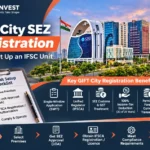
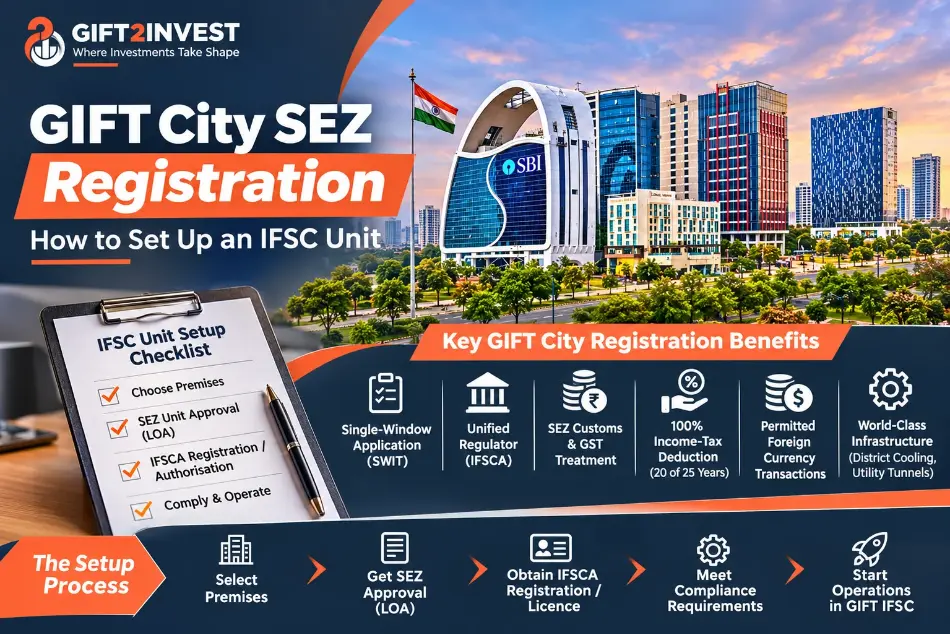
So why do firms accept the paperwork? Because the GIFT City registration benefits are significant for eligible units:
- A single-window application route through SWIT, and one SEZ approving office for IFSC units, subject to the current route for the activity.
- One unified regulator for banking, capital markets, insurance and fund management.
- SEZ customs and GST treatment for goods and services used in authorised operations.
- From 1 April 2026, a 100% income-tax deduction for eligible IFSC units for 20 years out of 25, under conditions.
- Ability to transact in foreign currency where permitted under the applicable IFSC framework.
- Planned infrastructure: district cooling, utility tunnels and round-the-clock monitoring.
Every item on that list is conditional. Our guide to GIFT City SEZ benefits explains the conditions.
Who Can Apply to Set Up an IFSC Unit?
Eligible applicants include companies and LLPs incorporated for the purpose, and branches of eligible entities, where the relevant framework allows. Permitted categories include banking, capital markets, fund management, insurance, aircraft and ship leasing, fintech, global in-house centres and other ancillary services.
That list is illustrative, not complete. Each activity has its own eligibility, capital and fit-and-proper conditions.
Start with one question: what exact service will you provide? Then find the IFSCA regulation or framework that covers it.
Some applicants sit outside the standard route. IFSCA guidance identifies market infrastructure institutions, foreign universities and payment service providers as categories that may not use the Common Application Form; confirm the current route for the specific category. Two foreign universities, Deakin and Wollongong, run active campuses in GIFT City today, so that route is no longer theoretical.
Structure matters too. A new company or LLP and a branch of an existing entity follow different paths. Name reservation and incorporation apply only to the first. A branch needs parent authorisations and home-regulator evidence. The activity-specific regulation tells you which structures it accepts.
Before you commit to premises or costs, confirm in writing that your proposed activity is permitted in GIFT IFSC.
Understand the Two Approval Tracks: SEZ and IFSCA
The SEZ track deals with your status as a unit and the activities you are authorised to carry out. It runs under the SEZ Act, 2005 and the SEZ Rules, 2006.
The IFSCA track asks a different question. Can you carry on the proposed regulated activity under the applicable regulations? Depending on your business, other registrations may also be needed.
A Ministry of Finance notification dated 28 February 2024 changed how the SEZ track works for IFSC units. The Administrator (IFSCA) now exercises the Development Commissioner’s powers for these units and chairs the Approval Committee. Applications go to the Administrator in Form FA, not the older Form F. This arrangement is specific to IFSC units in GIFT-SEZ. It does not apply to every SEZ in India.
The SEZ Rules were amended again on 3 February 2026. The amendment introduced a standard Letter of Approval format, Form GA, for units set up in an IFSC. Older guides may still show earlier forms.
SWIT, IFSCA’s Single Window IT System, ties the two tracks together. One Common Application Form carries the IFSCA application and the SEZ application. The SEZ part then flows to the SEZ Online portal, where deficiencies, clarifications and the LOA are handled.
SWIT does not remove any legal requirement. It only sends the same information to the right desks. A small number of activities are not yet enabled on it, and those file directly on SEZ Online. Always check the current instructions for your category.
Step-by-Step Process for GIFT City Registration
IFSCA published an indicative workflow for setting up through SWIT in July 2026. The steps below follow it, with the caveat that sequence and parallel filing vary by activity.
- Define the activity. Write down the business model, target clients and the regulatory category. This drives every later choice.
- Check the framework. Read the IFSCA regulation for your activity. Note eligibility, capital or net-worth conditions and fit-and-proper tests.
- Talk to the support team. Discuss the proposal with the GIFT City business-support team or IFSCA’s development team. A short video meeting is available on request.
- Identify premises. Choose space within the relevant SEZ area, sign a letter of intent with the co-developer and obtain a Provisional Letter of Allotment.
- Set up the legal entity. Reserve a name, incorporate the company or LLP and obtain PAN and TAN. Branches skip name reservation and incorporation.
- Prepare the application. Complete the Common Application Form, Form FA details and your activity-specific annexures.
- Submit through SWIT. File the joint application. Activities not enabled on SWIT use SEZ Online or the route IFSCA specifies.
- Answer queries. IFSCA’s published guidance says its team will reach out within 7 working days of a successful submission. Rectify SEZ deficiencies and, if asked, appear before the Unit Approval Committee.
- Receive the approvals. The Administrator (IFSCA) issues the LOA. IFSCA separately grants in-principle approval, then the final registration, where the regulation provides for it.
- Complete pre-commencement steps. Execute the Bond-cum-Legal Undertaking, obtain IEC and RCMC, open bank accounts, apply for GST and register the lease.
- Start only when ready. Begin regulated activity only after every mandatory approval and condition is in place.
Several of these steps overlap. Premises and incorporation can run side by side, and most post-approval items run in parallel. Plan your calendar around the slowest item, which is often the committee date or a document from a parent entity.
Documents and Information to Prepare
Treat this as a preparation list, not a universal checklist. The required set depends on your structure, your activity and the current form. Use the latest IFSCA checklist before you file.
- Incorporation and constitutional documents, PAN and registered-office details.
- Ownership and shareholding, including ultimate beneficial owners.
- Details of directors, partners, promoters and key managerial personnel.
- Group or parent details, with parent authorisations and home-regulator evidence for branches.
- A business plan with projected activities and financials.
- Net-worth or capital evidence and source-of-funds information, where required.
- Regulatory history and declarations, plus an affidavit supporting Form FA.
- AML/CFT, compliance and governance policies relevant to your activity.
- Authorised signatory details and a board resolution.
- Premises details or the provisional allotment letter.
Form FA asks whether the applicant or its directors have faced proceedings under specified trade, customs or foreign-exchange laws. Answer it fully. Approvals obtained on incorrect statements can be cancelled.
Keep names and addresses identical across every document. Small mismatches cause queries.
Office Space, Incorporation and Premises Documents
Premises selection and approvals move together. The address you pick appears in your PLOA, your SEZ application and later your lease. Changing it after approval is not a simple amendment.
A provisional allotment is not a lease. The PLOA confirms the space is reserved for you. The registered lease deed comes later, and a copy must reach IFSCA within six months of the LOA date. Our guides on the GIFT City PLOA and the GIFT City lease deed cover both documents.
Office space alone does not guarantee approval. Confirm the exact premises requirement with the developer and the relevant authority before you sign anything binding.
Zone matters as well. SEZ space is meant for SEZ-registered occupiers. If you are comparing buildings, our SEZ office space guide lists what to check. Property selection is a separate decision from regulatory approval.
How Long Does GIFT City Registration Take?
No honest guide can promise a single end-to-end number. Timing depends on your category, how complete your documents are, the clarifications raised, committee scheduling, incorporation and premises readiness.
IFSCA’s published guidance says its regulatory team will contact applicants within 7 working days of a successful submission. It also says IFSCA will strive to decide applications within 45 days. Those are targets for the regulator’s stage. They are not the total time to launch.
Deadlines to fix deficiencies are short, often counted in days or a few weeks. Slow replies are the most common source of delay.
Build your own plan with separate milestones: incorporation, application, approval, premises, banking and launch. Run what you can in parallel.
Fees, Taxes and Other Costs to Consider
Costs vary by activity and legal structure. Plan for application and registration fees, annual fees, advisory support, incorporation, premises deposits and rent, fit-out, staffing, compliance systems and banking.
IFSCA’s fee structure for FY 2026-27 sits in Circular IFSCA-DTFA/1/2026 dated 2 March 2026. It covers application, licence or registration, recurring, activity-based, processing and late-payment charges. Under the cited FY 2026–27 fee circular, licence or registration fees generally fall due within 15 days of provisional approval, while recurring fees are due each 1 April and payable by 30 April; verify the schedule for the relevant activity. The cited FY 2026–27 fee circular should be checked for the applicable Form FA application payment; the article currently states Rs 5,000.
Amounts differ by activity, so read Schedule I of the circular for yours. Do not rely on a figure from a blog.
On tax, be precise. From 1 April 2026, Section 147 of the Income-tax Act, 2025 provides a 100% deduction on specified qualifying income for eligible IFSC units for 20 consecutive years out of 25, subject to statutory conditions. Confirm the relevant income category and eligibility under the current law. That is one of the headline GIFT City registration benefits.
It is not automatic, and it is not a blanket exemption. Eligibility turns on your entity, your activity and the law in force. The deduction belongs to the operating unit. It does not reach a landlord or a property buyer. Take advice from a chartered accountant who works on IFSC units.
What Happens After Approval? Pre-Commencement and Ongoing Compliance
An approval is not permission to start trading. IFSCA’s workflow lists several steps after the LOA, and many can run in parallel.
- Execute the Bond-cum-Legal Undertaking in Form H. Since February 2026 it can be signed electronically. See our GIFT City BLUT guide.
- Receive the Eligibility Certificate by email once the BLUT is approved. See the Eligibility Certificate article.
- Obtain the Importer-Exporter Code and the RCMC.
- Open a foreign currency account with an IFSC Banking Unit and, where needed, a special non-resident rupee account with a domestic bank.
- Apply for GST registration through SWIT.
- Register the lease and obtain the final IFSCA registration.
- Complete shops-and-establishment and professional-tax registrations, and obtain SEZ employee ID cards.
- Record the date of commencement on the SEZ portal and tell IFSCA when operations begin.
After launch, expect reporting, audits, recordkeeping and activity-specific prudential and AML/CFT duties. SEZ units also file performance reports.
GIFT City LOA Validity matters too. The article states that the LOA runs for one year before commencement and five years after commencement; verify the current rule and any activity-specific conditions with IFSCA before relying on these periods. By a circular dated 10 August 2026, IFSCA directed regulated entities to hold a valid LOA and their IFSCA registration at all times. Seek renewal at least two months before expiry. Our GIFT City LOA guide covers extensions.
Keeping approvals alive is part of the GIFT City registration benefits story. A lapsed or invalid LOA may expose the unit to regulatory consequences, including action affecting its approval or registration, depending on the applicable rules and circumstances.
Common Mistakes to Avoid
- Treating a lease as approval. Premises and regulatory permission are different things.
- Using a generic checklist. Each activity has its own annexures and conditions.
- Picking the activity first, the rules later. Check the framework before you spend on space.
- Mixing up the LOA and IFSCA authorisation. One is the SEZ approval. The other is permission for the regulated activity.
- Relying on old forms and fee tables. Forms changed in 2024 and again in 2026.
- Assuming every application uses the same portal path. Some categories file elsewhere.
- Starting operations early. Begin only when all mandatory conditions are met.
An incomplete or inconsistent application triggers queries and slows everything. It is cheaper to prepare once than to answer twice.
Final Checklist Before Applying
- Define the activity and identify the IFSCA framework.
- Confirm the entity structure: company, LLP or branch.
- Confirm the premises requirement and zone.
- Review the current forms and the fee circular.
- Prepare complete supporting documents.
- Confirm the correct portal and filing route.
- Plan for both SEZ and IFSCA approvals.
- Budget for pre-commencement compliance.
- Do not begin regulated operations until every approval is in place.
Wrapping Up: GIFT City Registration Benefits Go to Prepared Applicants
The GIFT City registration benefits are worth chasing, but they reward preparation. Choose the activity first. Match it to the right IFSCA framework. Line up premises, entity and documents. Then file one clean application.
Rules and forms change, as the 2024 and 2026 amendments show. Check the live IFSCA and GIFT City pages before you file, and confirm your case with qualified advisers.
Once your setup plan is clear, premises are the next decision. We have property information for commercial spaces in both SEZ and DTA zones. Feel free to contact us for further details. We do not provide regulatory approvals.
Frequently Asked Questions
Q1) What Is GIFT City Registration?
It is the process of setting up an IFSC unit in GIFT City. It usually involves premises, an SEZ Letter of Approval and the relevant IFSCA registration or authorisation.
Q2) Is SEZ Approval the Same As IFSCA Approval?
No. SEZ approval covers the unit and its authorised operations. IFSCA approval covers the regulated financial activity. They are applied for together but are separate.
Q3) Who Issues the LOA for GIFT IFSC Units?
The Administrator (IFSCA), after the Unit Approval Committee reviews the application.
Q4) Can Both Applications Be Filed Together?
Usually yes, through one joint application on SWIT. A few activities not yet enabled there follow a separate route.
Q5) Do I Need Office Space Before Applying?
In practice, yes. A provisional allotment supports the SEZ application. Confirm the requirement for your category.
Q6) How Long Does Approval Take?
It varies. IFSCA aims to decide within 45 days, but that is not the full setup time. Incorporation, premises and banking add to it.
Q7) Can Any Business Set Up in GIFT IFSC?
No. Only activities permitted under IFSCA’s regulations and frameworks qualify, and each has its own conditions.
Sources and References
Checked 26 October 2026. Forms, portal routes, fees and deadlines change. Verify them on the official pages before filing. Third-party sources are explanatory leads, not legal authority.
- GIFT City official portal, Setting up at GIFT City / IFSC: https://www.giftgujarat.in/business/ifsc?tab=setting-up-at-GIFT-city
- GIFT City official portal, IFSC business overview: https://www.giftgujarat.in/business/ifsc
- IFSCA, How to Apply (Common Application Form, 7 working days, 45 days): https://ifsca.gov.in/Pages/Contents/HowToApply
- IFSCA, SWIT portal, How to Apply: https://swit.ifsca.gov.in/Home/HowtoApply
- IFSCA, Common Application Form: https://ifsca.gov.in/Document/DownloadDocuments/Common_Application_Form.pdf
- IFSCA, Unit Approval resources: https://ifsca.gov.in/beta/Pages/Contents/UnitApproval
- IFSCA circular on the Single Window IT System, 30 September 2024: https://ifsca.gov.in/Document/Legal/swit-circular-pdf30092024080524.pdf
- IFSCA, Workflow for Setting up in IFSC on the SWIT portal, V1.0 (July 2026): https://ifsca.gov.in/Common/PreviewPdfFront?id=29709e474fe6b066fc0cb19f7d375e22&fileName=Workflow_for_Setting_up_in_IFSC_on_the_SWIT_portal_V1_0_20260707_0523.pdf
- IFSCA Circular IFSCA-DTFA/1/2026, fee structure FY 2026-27 (2 March 2026): https://ifsca.gov.in/CommonDirect/DownloadFile?id=d575554ec59b09e7fde503d3a810d93a&fileName=02_03_2026_IFSCA_Fee_Circular_FY_2026_27_20260302_0641.pdf
- IFSCA, SEZ Compliance FAQs Booklet: https://ifsca.gov.in/Document/Developments/SEZ_Compliance_FAQs_Booklet.pdf
- IFSCA, SEZ notices and compliance updates: https://ifsca.gov.in/SezMeeting/Index
- IFSCA press release, directions on valid Letter of Approval (10 August 2026): https://ifsca.gov.in/CommonDirect/DownloadFile?id=29709e474fe6b066fc0cb19f7dd68725&fileName=Press_Release___Directions_to_All_REs_20260810_0217.pdf
- Ministry of Finance, Section 31 IFSCA Act notification (28 February 2024), via IFSCA legal database: https://ifsca.gov.in/Legal/Index/zcGvy-Iqfcg=
- Gazette of India, amendment to SEZ Rules, 2006 (3 February 2026): https://egazette.gov.in/WriteReadData/2026/270161.pdf
- SEZ Rules, 2006 (consolidated): https://www.sezindia.nic.in/sites/default/files/sez_rules_amendments/23SEZRulesincorporatingallamendments.pdf
- Bhatt & Joshi Associates, Setting Up in GIFT IFSC (19 October 2026), secondary explanatory source: https://bhattandjoshiassociates.com/setting-up-in-gift-ifsc-the-letter-of-approval-ifsca-registration-and-the-swit-process/
- TaxGuru, Setting Up in GIFT City IFSC 2026 (secondary source): https://taxguru.in/?p=1064604
- ICAI, GIFT IFSC publication on unit compliances (secondary source): https://betacmp.icai.org/wp-content/uploads/2025/10/GIFT-PUBLICATION-18-8-25-R1-mnh-1.pdf
- Business Standard, Union Budget 2026-27: GIFT City tax holiday extended to 20 years: https://www.business-standard.com/budget/news/centre-doubles-gift-city-tax-holiday-20-years-126020100926_1.html
- ABC Live, IFSCA Q1 FY 2026-27 data summary (7 September 2026): https://abclive.in/2026/09/07/gift-city-ifsca-weekly-regulatory-brief-7-september-2026
Source Note: This article is general information, not legal, tax or regulatory advice. Requirements vary by activity and structure. Confirm your case with IFSCA and qualified advisers.