
99 Year Lease Property in GIFT City: Why the Term Matters
Most buyers hear “99 years” and relax. That’s understandable, but the number tells only part of the story. A 99 year lease property in GIFT City is a normal, well-understood structure. What matters is the detail behind it: who granted the lease, which date it runs from, and what your own paperwork lets you do with the unit.
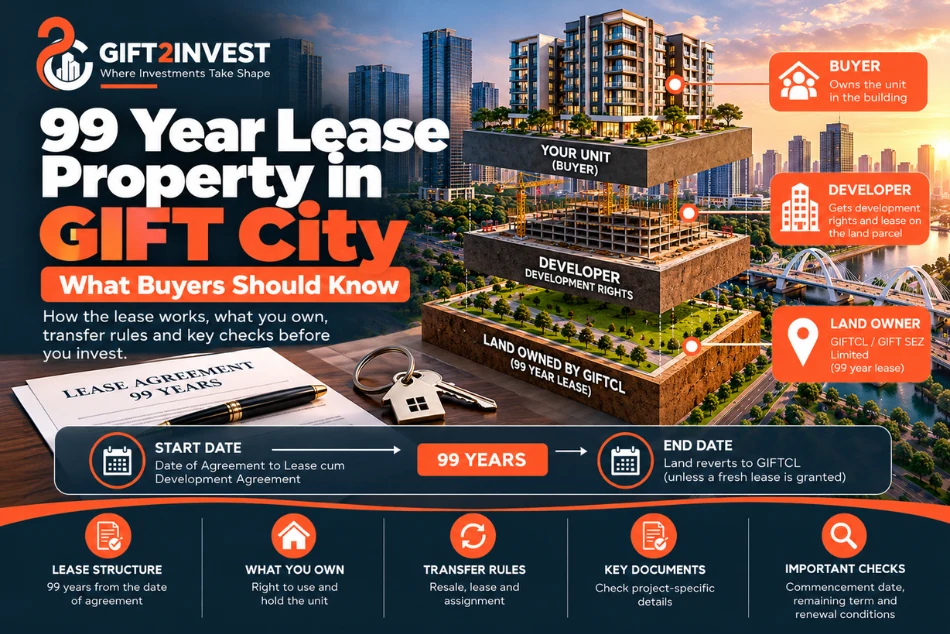
GIFT City’s land sits with the Gujarat International Finance Tec-City Company Limited (GIFTCL), the Gujarat government’s special purpose vehicle for the project. The 261-acre SEZ portion is held through a wholly owned subsidiary, GIFT SEZ Limited. Developers receive development rights and a lease on a land parcel. Buyers then purchase units from those developers.
This guide explains how that chain works, using GIFTCL’s published allotment policy as the anchor. It shows where documents differ from project to project, and it ends with questions to put to a developer before you pay a booking amount. It’s educational, not legal advice.
The Lease Structure at a Glance
| Point | What the Published Documents Say |
|---|---|
| Who Holds the Land | GIFTCL for the non-SEZ area. GIFT SEZ Limited, its subsidiary, for the 261-acre SEZ area. |
| Standard Lease Term | 99 years from the date of the Agreement to Lease cum Development Agreement. |
| Land Rent | Rs. 10 per sq. m. per year on the land parcel. |
| What the Developer Gets | Development rights on the parcel, including the right to sell, lease or use the premises built. |
| At the End of the Term | The land parcel goes back to GIFTCL, unless GIFTCL and the Government of Gujarat agree a fresh lease. |
| Which Projects It Covers | The policy applies to new allotments from 15 September 2024. Earlier projects follow their own agreements. |
Source: GIFTCL Pricing and Allotment Policy for Land and Development Rights, effective 15 September 2024, hosted on giftgujarat.in. SEZ-side terms can differ, so check the documents for your project.
What Is a 99-Year Lease Property?
A lease gives you the right to hold and use a property for a set period, on the conditions written in the lease. The owner of the land is the lessor. The person holding the lease is the lessee. A lease deed records the parties, the premises, the term, any rent, and the rules each side must follow.
The Transfer of Property Act, 1882 does not prescribe a general maximum lease term; a 99-year lease may be valid in India if it complies with applicable law and the instrument is properly executed and registered.
Freehold is different. A freeholder owns the land with no end date attached. A leaseholder owns a defined set of rights for a defined time.
So “99 years” describes a term. It doesn’t promise renewal, and it doesn’t make the interest identical to freehold. Two leases with the same number can carry very different rights, depending on their wording.
An illustration, not a real property. Say a lease starts on 1 April 2024. A 99-year term then runs to 31 March 2123. If you buy a unit eight years later, about 91 years remain. The clock started with the original lease, not with your purchase. That’s why the commencement date matters more than the headline figure.
Does GIFT City Property Have a 99-Year Lease?
For land allotted under GIFTCL’s published policy effective 15 September 2024, the standard term for new allotments is 99 years.
Still, don’t stretch that into a blanket answer for every unit. Three things can differ.
- Project vintage. The policy covers new allotments. Projects allotted earlier follow their own agreements.
- One lease deed filed with the US SEC for a GIFT SEZ building shows a 30-year term, with renewal up to 99 years subject to Board of Approval consent.
- Timing. In a GIFTCL tender for a 754,000 sq ft SEZ tower, the lease deed was to be signed only after construction was complete.
Next, separate the land from the unit. The developer holds the lease on the land parcel. You buy a unit inside the building. Your interest comes through the developer, and the instrument that gives it to you could be a sale deed, an assignment or a sub-lease. Ask which one applies, and what it says about the land lease behind it.
There’s one more timing point. Under the policy, the 99 years run from the date of the Agreement to Lease cum Development Agreement. That’s a developer-level date. A tower takes years to build and sell, so a buyer taking possession later inherits a term that began before they arrived. The shortfall is small against 99 years, but it’s why you should ask for the start date, not just the length.
Think of it as reading a timetable. The headline says 99 years. The start date tells you when the clock began, and the end date tells you where it stops. Both should appear in documents you can hold.
Ask for copies or certified extracts of the key papers: the allotment letter, the Agreement to Lease cum Development Agreement, any lease deed or sub-lease, your agreement for sale, the RERA record and the occupancy certificate. A brochure or a sales team’s verbal assurance is not a substitute for any of them.
One clarification. Our guide on the GIFT City lease deed covers a different document: the registered lease an IFSC unit signs for its office. This article is about the land and tenure behind the property you buy.
Leasehold vs Freehold Property: Key Differences
A long lease can be a good asset. It simply comes with different rules. The table sets out the main points.
| Issue | Leasehold | Freehold | What to Verify |
|---|---|---|---|
| Term | For a stated period | No fixed end | Start date and remaining term |
| Land | Held under lease; land stays with the lessor | Owned outright | Who the lessor is and what interest passes to you |
| Transfer | Usually allowed, sometimes with conditions | Generally open | Consents, fees and process in your documents |
| Renewal | Depends on the deed and the lessor | Not needed | Whether a right exists and who decides |
| Dues | Land rent and related charges may sit in the chain | Property tax and local charges | Who pays and how it’s recovered |
| End of Term | Land reverts unless a fresh lease is agreed | Ownership continues | Handback terms and treatment of buildings |
Neither tenure wins in every case. Freehold isn’t always on offer, particularly in planned districts built on state-owned land. And a long lease isn’t a weak asset by default.
Financing deserves a quick check. Banks set their own policies, and a common approach is to keep the loan tenure within the remaining lease term. With a lease this long, that’s rarely the tight constraint. Still, ask your lender which documents it wants and whether it has funded in GIFT City before.
Compare like with like when you weigh two projects. Put the start date, remaining term, renewal wording and transfer conditions side by side. Two towers a short walk apart can sit under different instruments, and the difference only shows up in the paperwork.
What Rights Does a Buyer Have Under a 99-Year Lease?
Your rights come from the deed and the law, not from the number 99. Understanding any 99 year lease property means reading the clauses that cover these areas:
- Use and occupation. The use must match the zone and approvals. SEZ space is meant for SEZ-registered occupiers, while DTA space follows ordinary domestic rules. Our guide on SEZ vs DTA property explains the split.
- Section 108(j) of the Transfer of Property Act generally permits a lessee to transfer, mortgage or sub-lease the leasehold interest, subject to the contract, applicable law and any relevant restrictions.
- Leasing out. Check whether renting the unit needs consent, and whether zone rules limit who can occupy it.
- Alterations. Building changes follow the GIFT Area Development Control Regulations. Under GIFTCL’s policy, structures above ground stay within the approved building footprint.
- Common areas. Access, amenities and charges are set by project rules.
- Maintenance. GIFT City’s district cooling and utility systems carry recurring charges. Get the per sq ft figure in writing.
Ask the developer for written confirmation of resale, transfer, mortgage and leasing conditions. If your project cites a dual-use permission, ask for its exact wording and how it applies on resale.
Lenders and future buyers will read the same clauses you do. A clean, registered chain of documents makes a unit easier to finance and easier to resell. Gaps, such as a missing consent or an unclear instrument, are what slow a sale down years later.
Also ask about land rent. The Rs. 10 per square metre figure is set for the parcel the developer holds. Find out how land-related obligations are handled over time, and whether any part reaches owners through maintenance or other charges.
What Happens When a 99-Year Lease Expires?
Start with GIFTCL’s own wording. Its policy says the land parcel is to be handed back to GIFTCL when the lease period ends, unless GIFTCL and the Government of Gujarat agree to grant a fresh lease on terms acceptable to them.
In plain terms, renewal is possible but not promised. It rests on agreement, not on the buyer’s say-so. And nothing in that wording turns the land into freehold.
Leases generally fall into four groups on this point: automatic renewal, renewal subject to approval, extension by agreement, and no stated right. GIFTCL’s published policy sits closest to extension by agreement. Your own deed may say something different, so read it.
Then ask the practical questions. What happens to the building on the land? What notice is required? Must dues be cleared before handback? The policy is silent on how buildings are treated, so look for it in your documents.
Renewal is a clause to read, not a right to assume.
Now the context, which is good news for today’s buyer. Take a lease that began in 2024. It ends in 2123. No buyer today will see that date. The nearer-term effect is on resale. As a lease shortens over the decades, buyers and lenders tend to look harder at the remaining term. For a district that is still filling in its master plan, that is a long way off.
A 99-year lease can provide a long period of use, but the actual remaining term depends on the commencement date and the terms of the specific lease.
Can a 99-Year Lease Property Be Sold, Transferred or Inherited?
Generally yes, subject to the documents. GIFTCL’s policy gives developers the right to sell, lease or use the premises they build. Individual owners then resell under their own agreements and the general law.
Sale and assignment move the interest to a new buyer, usually for a price, with documents registered. Gifting and inheritance work differently and may carry different paperwork and fees. Subletting leaves the lease with you and gives someone else occupation.
A leasehold interest may pass to legal heirs on the lessee’s death, subject to the lease terms, applicable succession law and any project-specific conditions.
Resale in GIFT City is still a developing market. Secondary deals are thinner than in an established Ahmedabad corridor. That makes tidy paperwork more valuable here, because a buyer with a clear document trail is easier to find and quicker to close.
Some limits are explicit. For institutions building for their own use, GIFTCL’s policy caps sub-leasing at 25 per cent of built-up area to non-group entities. That doesn’t apply to an individual apartment owner. It does show that allotments carry conditions.
Before you sign, check transfer charges, no-objection requirements, dues clearance, and whether the remaining term will matter to the next buyer or their bank. NRI buyers follow the standard RBI rules for property purchase. Our guide for NRI office buyers covers the basics.
Buyer Due-Diligence Checklist Before Buying in GIFT City
For any 99 year lease property, work through these in order.
- Confirm tenure in the signed document. Note the commencement date, the end date and the remaining term.
- Read the whole chain. That means your agreement for sale, any lease or sub-lease, the allotment papers and every amendment.
- Verify the roles. Identify GIFTCL as allotting authority, the developer as lessee, the seller, and the entity named on the RERA record.
- Check transfer terms. Look at resale, mortgage and leasing conditions, plus fees and consents.
- Read the renewal and expiry clauses. Include handback and the treatment of buildings.
- Ask about recurring costs. Cover maintenance, service charges, taxes and any land-related dues.
- Confirm financing. Ask your lender what it needs for a leasehold interest in GIFT City.
- Check approvals and zone. Verify RERA, the building sanction, the occupancy certificate where relevant, and whether the unit is IFSC or DTA.
- Get independent legal review. Do it before you pay any non-refundable amount.
For the wider process, see our guides on how to shortlist projects in GIFT City and the mistakes to avoid when buying.
Questions to Ask the Developer or Seller
- What is the exact tenure, and which date does it run from?
- Can the unit be resold, mortgaged or leased out, and what permissions or charges apply?
- Is renewal or extension provided for in writing? Is it automatic or at the lessor’s discretion?
- What does the deed say happens at expiry?
- Are there unpaid dues, disputes, restrictions or lender conditions on this unit?
- How are land-related charges handled between the developer and owners?
Ask for the answers and the supporting documents in writing. Verbal assurances don’t protect you.
Wrapping Up: Read the Deed, Then Decide
A 99 year lease property in GIFT City sits on a clear, published framework. The stated term is only one input. Your rights, the transfer conditions, renewal and expiry all live in the documents for your exact unit.
Confirm the commencement date, get answers in writing, and have a property lawyer review the papers. With the master plan still filling in, units backed by clean documentation will be the easiest to resell later.
Frequently Asked Questions
Q1) What Does a 99-Year Lease Mean in Property?
It means you hold rights in a property for a fixed term of 99 years, on the conditions in the lease. It describes the term, not ownership of the land.
Q2) Is a 99-Year Lease Valid in India?
Yes. The Transfer of Property Act doesn’t set a maximum term. A lease for more than a year must be made by a registered instrument.
Q3) Is a 99-Year Lease the Same As Freehold Ownership?
No. Freehold has no end date and includes the land. A lease runs for a stated period and the land stays with the lessor.
Q4) What Happens After a 99-Year Lease Expires in India?
It depends on the deed and the lessor. Under GIFTCL’s policy, the land parcel goes back to GIFTCL unless GIFTCL and the Government of Gujarat agree to grant a fresh lease.
Q5) Can Leasehold Property Be Sold or Transferred?
Generally yes, unless the lease or project rules restrict it. Check the consents, fees and process in your own documents.
Q6) Does Every Gift City Property Have a 99-Year Lease?
Don’t assume so. The published policy sets 99 years for new allotments from 15 September 2024. Earlier and SEZ-side arrangements can differ, so verify your project.
Q7) Can a 99-Year Lease Be Renewed?
Not automatically under GIFTCL’s published policy. A fresh lease needs agreement from GIFTCL and the Government of Gujarat. Your deed may add its own terms.
Sources and References
Checked 22 October 2026. Policies, forms and project terms change. Verify them with GIFTCL, the developer and a qualified property lawyer before relying on any point above.
GIFTCL, Pricing and Allotment Policy for Land and Development Rights (effective 15 September 2024), hosted on giftgujarat.in
https://api.giftgujarat.in/public/downloads/Others/Final-Pricing-policy.pdf
GIFT City official portal
https://giftgujarat.in
Lease Deed filed as Exhibit 10.25 with the US SEC (GIFT SEZ building; 30 years renewable up to 99 years; land held by GIFTCL and GIFT SEZ Limited)
https://www.sec.gov/Archives/edgar/data/2042648/000110465924132385/tm2426910d6_ex10-25.htm
Construction World, GIFT City seeks bids for construction of 754,000 sq ft commercial tower
https://www.constructionworld.in/amp/latest-construction-news/real-estate-news/gift-city-seeks-bids-for-construction-of-754000-sq-ft-commercial-tower/66563
Transfer of Property Act, 1882, Sections 105, 107 and 108, India Code
https://www.indiacode.nic.in
Tata Capital, What is leasehold property (loan tenure and lease term)
https://www.tatacapital.com/blog/?p=30419
Gujarat RERA, project registration verification
https://gujrera.gujarat.gov.in
GIFTCL, Pricing and Allotment Policy for Land and Development Rights (official published policy)
https://api.giftgujarat.in/public/downloads/Others/Final_Policy_clean_version__for_upload_26092024.pdf
India Code, Transfer of Property Act, 1882 (official text, including Sections 105, 107 and 108)
https://www.indiacode.nic.in/bitstream/123456789/14648/1/tpa.pdf
Source Note: This article is general information, not legal, tax or investment advice. Tenure and transfer terms depend on the documents for each project and unit. Confirm your position with a qualified property lawyer and a CA before you transact.