
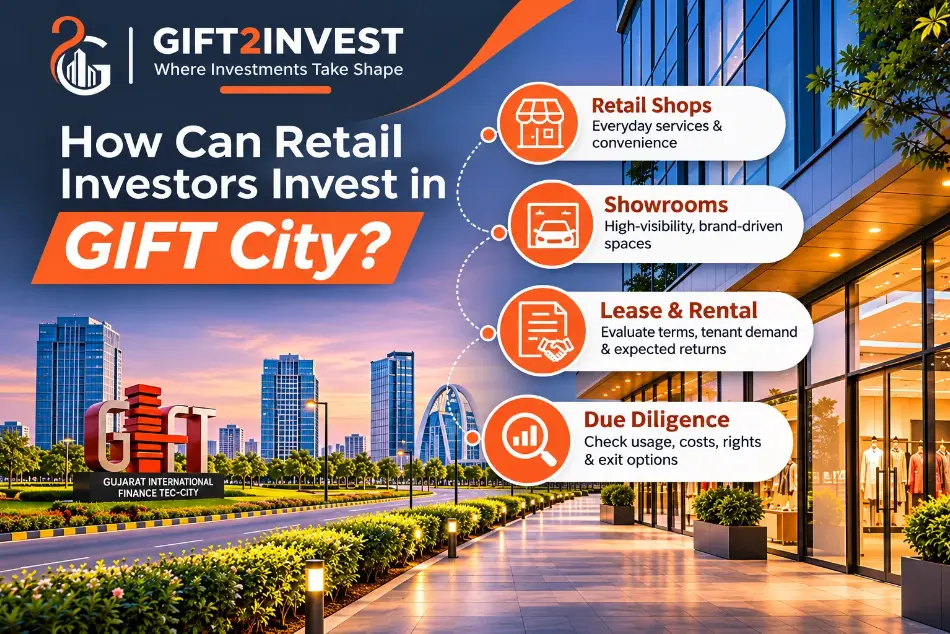
How Can Retail Investors Invest in GIFT City? Start With the Unit, Not the Brochure
How can retail investors invest in GIFT City through property? The practical route starts with a shop, showroom or other retail-use unit, and a short list of checks that matter more than the price per square foot.
Retail here works differently from a high-street shop in Ahmedabad. GIFT City is a planned business district. Its residential share is planned at about 22% of the proposed built-up area, so customers may come largely from people working or living in and around the buildings.
That makes permitted use, frontage, tenant demand, tenure and running costs the real drivers of a retail investment. A cheap unit that cannot legally host your tenant is not cheap.
This guide covers the property route only. It does not cover funds, bonds or other IFSC financial products. Not every building permits every retail activity, so treat each point below as something to confirm in writing for the exact unit.
Start with the screening table. The sections after it explain each line.
| Factor | What the Investor Should Verify |
|---|---|
| Unit and Area | Exact unit number, carpet area, chargeable area, frontage and floor |
| Permitted Use | Written confirmation that the intended retail or showroom activity is allowed |
| Rights and Tenure | Nature of interest, tenure if applicable, transfer conditions and remaining term |
| Total Acquisition Cost | Price plus applicable taxes, registration or transfer charges and other fees |
| Rental Evidence | Comparable rent, lease terms, tenant demand and vacancy assumptions |
| Recurring Costs | Maintenance, common-area charges, insurance, taxes and other owner costs |
| Location Quality | Visibility, access, parking, occupancy, tenant mix and competition |
| Exit Options | Transfer restrictions, likely investor pool and realistic resale considerations |
Why Consider GIFT City for Retail Property Investment?
GIFT City covers about 886 acres between Ahmedabad and Gandhinagar. Planning figures in its own tender documents point to roughly 62 million sq ft of development, split about 67% commercial, 22% residential and 11% social space.
The business ecosystem behind that plan is real. IFSCA’s key highlights show 1,147 registrations and authorisations and banking assets above USD 111 billion as of March 2026. Those firms hire people, and people need lunch, errands and services.
The social layer is arriving too. Two foreign universities, Deakin and Wollongong, run active campuses. Jamnabai Narsee School covers K-12. Lilavati Hospital has started outpatient services and is expanding in phases. The Ahmedabad Metro Violet Line serves the city.
Retail infrastructure is gradually developing. D-Mart is already operational in GIFT City, while GIFT City has also issued a request for proposal for a destination mall of at least 750,000 sq ft.
Read that carefully. A service gap can mean demand waiting to be served. A large mall can also pull trade away from small stand-alone units once it opens.
That is the investment question in one line. Planned footfall and demonstrated footfall are different things. Rents, vacancy and resale all vary by building and micro-location, so nothing here should be read as a promise.
What Types of Retail Spaces Can Investors Explore?
Listings use loose labels. Shops, showrooms, “commercial units” and “office or shop” often sit in one list. Each behaves differently as an investment.
Retail Shops
Shops are the smaller formats. Think pharmacies, cafés, salons, convenience stores and service counters for the people nearby.
Frontage matters more than area. A 300 sq ft unit with a clear, visible entrance can outperform a 600 sq ft unit tucked behind a lobby.
Check entrance width, ceiling height, washroom provision and whether the layout lets a tenant fit out sensibly. Ask which activities the building allows. Food, storage and delivery-heavy uses often face extra rules.
If you are searching for retail shops for sale in GIFT City, compare them on these practical points before you compare prices.
Showrooms
Showrooms need display frontage, signage rights and easy customer access. Cars, furniture, electronics and design brands also need loading access and parking or drop-off.
A showroom on an internal corridor serves only people already in the building. One facing a public road can reach passing traffic. Ask about floor loading and signage rules in writing.
A showroom for sale in GIFT City is therefore a different product from a small shop, even when the same developer sells both.
Other Retail or Commercial Units
Some projects mix shops with offices, co-working, banks or food courts. A unit sold as “commercial” may be approved for office use only.
Ask for the approved plan and a permitted-use statement for the exact unit. Food service, clinics and entertainment uses often need separate approvals. Do not rely on a marketing label.
How Can Retail Investors Invest in GIFT City?
There are three realistic routes. Each one needs a different set of questions.
Invest in a Shop or Showroom to Lease to a Tenant
This is the landlord model. You invest in the unit, find a tenant and collect rent.
Start by naming the likely tenants. Café operators, pharmacies, salons, banks’ service counters and brand showrooms each need different frontage and specifications. Then test the rent against comparable evidence, not the asking figure in a brochure.
Allow for vacancy, maintenance and fit-out gaps. Review the proposed lease before you commit.
Zone matters when investing in GIFT City. The Domestic Tariff Area (DTA) does not require an occupier to qualify as an SEZ unit, but the building and unit must still permit the intended activity. SEZ space is subject to the SEZ framework and the occupier’s approved use; do not assume it is available for ordinary retail leasing. Our guide to SEZ vs DTA property in GIFT City explains the split.
Invest in Premises for a Business You Plan to Operate
Here the unit must suit your own trade. Check permitted use, fit-out rules, signage, utilities, opening hours and any activity-specific licence your business needs.
Operating from your own premises can remove exposure to rent increases and lease-renewal risk. It also ties your capital to one location. If the footfall does not arrive, you carry the problem yourself.
Hold a Unit for Longer-Term Resale
Resale depends on clean documents, tenant demand, transfer conditions, pricing and market depth. GIFT City’s secondary market is still thinner than an established Ahmedabad corridor.
A unit with a signed lease and a solid tenant is easier to sell than a vacant one. Do not treat appreciation as assured.
A Simple Sequence to Follow
- Define your objective and budget. Income, own-use and resale need different units.
- Shortlist units by zone, frontage and building occupancy.
- Request the documents listed in the next section.
- Visit the site at more than one time of day.
- Model income, costs and vacancy with conservative numbers.
- Complete a legal and commercial review with a Gujarat property lawyer.
- Pay a booking amount only when terms and refund conditions are clear.
Our guide on how to shortlist projects in GIFT City covers the wider method if you are comparing several buildings.
Looking for a Retail Shop or Showroom in GIFT City?
We can help you explore available retail shops and showrooms in GIFT City based on your business or property requirements.
What Should You Check Before You Invest in Retail Property?
Use the same list for every unit. Consistency is how you spot the weak one.
- Unit details. Confirm the unit number, carpet area, chargeable or saleable area, floor, frontage and access. Compare on carpet area. The gap between carpet and saleable area can be large.
- Permitted use. Get written confirmation that your intended retail activity is allowed. Ask about food, signage, operating hours, storage and customer access.
- Project and title papers. Check the seller’s authority, the rights being transferred, approvals, encumbrances and any transfer or registration requirements. Verify the RERA registration on the Gujarat RERA portal.
- Costs beyond the price. List taxes, registration or transfer charges, maintenance, common-area charges, fit-out, utilities, insurance and brokerage. GIFT City’s district cooling and utility systems carry a recurring charge, so get the per sq ft figure in writing.
- Occupancy and competition. Walk the building. Count open units, empty units and nearby tenants. Look at access routes and ask what retail is planned next door.
- Developer record. Ask for completed projects inside GIFT City specifically. Delivering here involves approvals a standard project elsewhere never meets.
Possession timelines deserve a line of their own. A tower that is still under construction will not generate footfall until offices and homes above and around it fill. Plan your carrying cost for the RERA date, not the sales target.
How to Evaluate Rental Potential and Investment Returns
Separate asking rent from rent actually received. Seek signed leases or recent transactions for similar units in the same building or micro-market. Date-stamp every observation.
Gross rental yield is a screening metric. Divide annual rent by total acquisition cost and multiply by 100. It is not a return.
Net operating income is closer to reality. Deduct recurring owner costs, then allow for vacancy and late or missed rent.
Here is a hypothetical example, not a GIFT City market figure. Say total acquisition cost is Rs. 1 crore and annual rent actually received is Rs. 6 lakhs. Gross yield is 6%.
Now subtract Rs. 60,000 for maintenance and common charges, Rs. 20,000 for other owner costs and one month of vacancy at Rs. 50,000. Net operating income falls to Rs. 4.7 lakh, or 4.7%, before tax and any loan interest.
That gap is why serious investors model net income first. When someone asks how can retail investors invest in GIFT City and earn rent, the honest answer includes this subtraction.
Then read the lease terms that shape income over time:
- Tenant quality and lease length. A longer lock-in with a creditworthy tenant gives more certainty than a short, flexible one.
- Escalation. Look for a fixed annual step or a larger step every few years.
- Rent-free fit-out period. Shop and showroom tenants often ask for one. It delays your first rent.
- Deposit, maintenance and reletting. Know who pays what, and how long a unit might sit empty between tenants.
Rent from a shop is generally subject to Indian income-tax rules. The applicable head and tax treatment depend on the facts and the way the property is let or commercially exploited, so confirm the position with a chartered accountant. The IFSC deduction under section 147 of the Income-tax Act, 2025 applies only to specified eligible income of qualifying IFSC units, subject to statutory conditions. Eligible units may claim a 100% deduction for 20 consecutive tax years out of 25, at their option; this does not create a tax holiday for an individual landlord merely because the property is in GIFT City.
Need Help Understanding Retail Property Options?
Not sure which type of retail unit may suit your requirements? Connect with us to understand available shops, showrooms and commercial spaces in GIFT City.
Location, Footfall and Tenant Demand: What Matters?
Footfall is the whole case for retail. Test it with your own eyes.
Check how easily a customer finds the unit. Is it visible from a walking route? Is there parking or a drop-off point? How far is the nearest working office tower?
Transit needs a careful look. The Violet Line serves GIFT City, but the station sits away from the main office cluster. Shuttle and golf-cart services may cover parts of the last stretch; check the current service, route and timings before relying on them. A 3.33 km extension with three stations inside the city was approved in February 2026, and Ranjit Buildcon emerged as the lowest bidder in July 2026. Those stations are not operating yet.
So a brochure line such as “next to the metro” needs a station name and a walking distance behind it.
Look at actual building occupancy and operating hours, not just population projections. Offices that empty at six o’clock produce a different shop from a residential tower that stays busy through the evening.
Match the unit to the customer. A pharmacy, a quick-service café and a design showroom need very different conditions.
Shilp Centrica shows the point. Shilp’s tower in the Domestic Tariff Area puts retail on the ground and first floors, with offices above and a RERA end date of 31 December 2029. Its shops will depend on how quickly those offices fill. See our 1,800 sq ft office listing in Shilp Centrica for the building’s details.
Visit at lunchtime, at closing time and on a weekend. Ask building management for occupancy and tenant-mix information.
Lease Terms, Ownership Rights and Due Diligence
Do not assume that every GIFT City unit carries the same rights. Ownership, leasehold, allotment rights and sub-lease are different legal interests, and your papers will name the one that applies.
GIFT City’s land policy gives a useful reference. For new allotments from 15 September 2024, GIFTCL’s published policy sets a 99-year lease on the land parcel. Earlier projects follow their own agreements. SEZ-side terms can differ too. Our 99-year lease guide lists the documents to request.
Ask what interest passes to you, which date the tenure runs from and what the deed says about renewal, transfer and mortgage. Check what consent or fee a future sale will need, and what your lender requires.
If you plan to rent the unit out, read the lease you would sign with the tenant. Look at term, escalation, deposit, maintenance duties, default remedies, permitted use, fit-out conditions and termination clauses.
One distinction saves confusion. Investing in a unit is a property transaction. A business that wants to operate inside the SEZ as an IFSC unit follows a separate approval path. Our GIFT City LOA explainer covers that path. A retail tenant in the DTA does not need it.
Have a Gujarat property lawyer review the actual documents before you pay. Verify the allotment letter, the title chain, the approved plan and the building’s occupancy certificate. This article is general information, not legal, tax or investment advice.
Exploring Commercial Property in GIFT City?
Get assistance in identifying available commercial properties and understanding their basic property details, tenure and permitted use.
Common Mistakes Retail Property Investors Should Avoid
- Investing on a brochure. Launch offers and projected returns are marketing, not evidence.
- Assuming any business can trade from any shop. Check permitted use first.
- Treating quoted rent as guaranteed income. Assured-return lines need the agreement, the paying party’s record and the post-guarantee rent.
- Not knowing the interest you hold. Freehold, leasehold and allotment rights are not interchangeable.
- Ignoring competition and exit. A destination mall or new tower can change nearby trade. Resale is thinner here than in mature areas.
- Paying a booking amount too early. Read the key documents and refund conditions first.
Wrapping Up: How Can Retail Investors Invest in GIFT City With Confidence?
So, how can retail investors invest in GIFT City and keep the risk in view? Verify permitted use and the rights you are investing in. Inspect the location at different times. Test rent against evidence. Add up the full cost, then get a lawyer to read the papers.
The district’s foundations are in place: a regulated financial centre, two active university campuses, a metro line and a hospital that has begun outpatient services. The retail layer is still being built, which is why careful unit selection matters more than speed.
Frequently Asked Questions
Q1) Can an Individual Invest in Retail Property in GIFT City?
Resident individuals may generally acquire commercial property where the project offers the relevant unit and the transaction documents permit it. NRIs and OCIs may also acquire eligible immovable property in India, subject to FEMA conditions and permitted payment routes. The position can differ for other non-resident foreign nationals and for particular project or SEZ rights. Confirm eligibility for the specific buyer and unit with a property lawyer and chartered accountant.
Q2) Can I Invest in a Shop in GIFT City to Earn Rental Income?
It may be possible where the unit is offered with rights that permit the transaction and its permitted use and zone allow leasing to your intended tenant. Income is not guaranteed. DTA units may be more suitable for a conventional landlord model, subject to the building’s approvals and the unit’s permitted use.
Q3) Is a Showroom Different From a Retail Shop for Investment Purposes?
Yes. Showrooms need larger floor areas, display frontage, signage and loading or parking. Their tenant pool is narrower and their fit-out heavier. Shops serve everyday trade and usually suit more tenant types.
Q4) How Do I Check Whether a Gift City Retail Unit Is Leasehold?
Read the allotment letter, the agreement for sale and any lease, sub-lease or conveyance. They name the interest being transferred. A property lawyer should confirm it against the underlying land documents.
Q5) What Costs Should I Include When Comparing Retail Units?
Include price, taxes, registration or transfer charges, maintenance, common-area charges, insurance, fit-out, brokerage, leasing costs, vacancy allowance and any financing cost.
Q6) Are Rental Returns Guaranteed?
No. Returns depend on tenant demand, rent achieved, occupancy, costs, documentation and market conditions. Treat any fixed figure as a claim to verify.
Sources and References
- GIFT City official website, project background, tenders and updates: https://giftgujarat.in/
- IFSCA, GIFT IFSC Key Highlights (as on March 2026): https://www.ifsca.gov.in/
- GIFTCL, Pricing and Allotment Policy for Land and Development Rights (effective 15 September 2024): https://api.giftgujarat.in/public/downloads/Others/Final-Pricing-policy.pdf
- Construction World, GIFT City expands social infrastructure to attract global talent (Destination Mall RFP): https://www.constructionworld.in/policy-updates-and-economic-news/gift-city-expands-social-infrastructure-to-attract-global-talent/93200
- DFU Publications, Avenue Supermarts (D-Mart) gets a berth in GIFT City (25 February 2022): https://www.dfupublications.com/news/retail/avenue-supermarts-d-mart-gets-a-birth-in-gift-city
- Gujarat Metro Rail Corporation, Ahmedabad Metro Phase II project overview: https://www.gujaratmetrorail.com/project-overview2/
- PMIndia, Cabinet approves extension of North-South corridor from GIFT City to Shahpur (February 2026): https://www.pmindia.gov.in/en/news_updates/cabinet-approves-extension-of-existing-north-south-corridor-from-gift-city-to-shahpur-of-gujarat-metro-rail-corporation-limited-gmrc/
- DeshGujarat, Ranjit Buildcon lowest bidder for GIFT City-Shahpur extension (25 July 2026): https://deshgujarat.com/2026/07/25/ahmedabad-metro-phase-2b-ranjit-buildcon-emerges-as-lowest-bidder-for-gift-city-shahpur-extension/
- GIFT City, Foreign universities at GIFT IFSC (Deakin and Wollongong): https://giftgujarat.in/updates/foreign_universities_at_GIFT_city_a_new_era_of_global_education_in_india
- Lilavati Hospital, GIFT City facilities: https://www.lilavati-hospital.com/facilities.php
- Business Standard, Union Budget 2026-27: GIFT City tax holiday extended to 20 years (1 February 2026): https://www.business-standard.com/budget/news/centre-doubles-gift-city-tax-holiday-20-years-126020100926_1.html
- Gujarat RERA, project registration verification (Shilp Centrica: PR/GJ/GANDHINAGAR/GANDHINAGAR/Others/CAA12608/081123): https://gujrera.gujarat.gov.in/
- Transfer of Property Act, 1882, India Code: https://www.indiacode.nic.in/
- Reserve Bank of India, Master Circular on acquisition and transfer of immovable property in India: https://www.rbi.org.in/commonperson/English/scripts/Notification.aspx?Id=845
- Income Tax Department, Income-tax Act, 2025, as amended by the Finance Act, 2026 (Section 147): https://www.incometaxindia.gov.in/documents/d/guest/income_tax_act_2025_as_amended_by_fa_act_2026-pdf
- Press Information Bureau, Cabinet approval for Ahmedabad Metro extension from GIFT City to Shahpur (24 February 2026): https://www.pib.gov.in/PressReleasePage.aspx?PRID=2232125
Source Note: This article is general information, not legal, tax or investment advice. Confirm unit details, permitted use, tenure and tax treatment with the developer, Gujarat RERA and a qualified property lawyer and chartered accountant before you transact.