GIFT City Real Estate for Investors: Why Commercial Deserves Its Own Analysis
Most GIFT City real estate coverage treats commercial and residential in the same breath. One section for offices, one for homes, same broad conclusions for both. That framing misses what makes commercial real estate here genuinely different from every other market in India.
GIFT City real estate for investors — specifically on the commercial side — operates on a demand logic that has no equivalent in Bengaluru, Mumbai, or Hyderabad. The tenants in the IFSC boundary are not there by preference. They’re there by regulatory requirement. And that single fact changes the entire investment analysis.
This article focuses only on commercial office space. Residential is a different market with different drivers. If you’re evaluating a commercial investment in GIFT City, here’s the breakdown that actually matters.
The IFSC vs Non-IFSC Commercial Distinction — The Most Important Variable
There are two commercial real estate markets inside GIFT City, and they behave very differently.
IFSC-notified commercial space sits within the International Financial Services Centre boundary. Entities that operate here — banks, fund managers, insurance firms, exchange members, aircraft leasing SPVs — are there because IFSCA licensing requires a physical presence within the IFSC. They cannot operate from the Domestic Tariff Area and claim IFSC regulatory benefits. The address is part of the operating license.
That creates a structural demand floor with no equivalent elsewhere in India. When the IFSCA adds a new permitted activity — family offices, virtual asset providers, foreign universities — it creates a new class of tenants who need IFSC space. Demand is policy-driven, not sentiment-driven.
Non-IFSC commercial space in GIFT City — within the Domestic Tariff Area — works more like a quality IT park. Good infrastructure, better than average tenant mix, but demand responds to general economic conditions rather than regulatory expansion. Not a bad market, but a different one.
Every commercial listing you evaluate needs this zone check as the first step. It determines your tenant universe, your pricing power, and your vacancy risk profile.
In IFSC commercial, vacancy is a function of regulatory pace. In DTA commercial, it’s a function of the market. These are different risks, not the same risk with different labels.
Grade-A Institutional vs Co-working vs Managed Offices
Within IFSC commercial space, there are three broad product categories, each with a different investment profile.
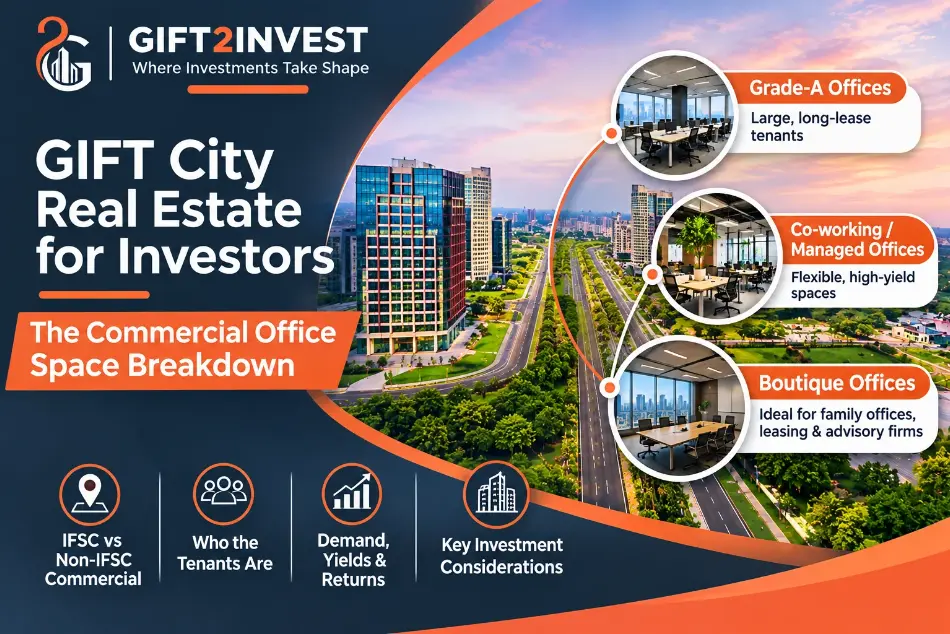
Grade-A institutional floor plates target large financial entities — full floors or multi-floor tenancies taken by international banks, fund management firms, or insurance operations. These are long-lease tenants, typically 5 to 10 year commitments, with institutional-grade fit-out requirements. Server room capacity, power redundancy, financial-grade broadband latency, and physical security requirements all feature. Entry price is highest in this segment. Vacancy risk is lowest.
Co-working and managed office space targets smaller entities — compliance offices, representative presences, small fund management teams, fintech companies. Per-square-foot rental yield is higher than Grade-A because the operator earns the premium for flexibility. Occupancy is more variable. This segment has grown quickly as GIFT City’s entity count has expanded past the threshold where every new entrant can justify a full dedicated office.
Boutique private offices — 2,000 to 6,000 square feet — serve family offices, aircraft leasing SPVs, and advisory firms that need dedicated, private space but don’t need a full floor. This is arguably the most undersupplied product category in GIFT City commercial right now. Demand from wealth management and aviation finance is outpacing purpose-built supply.
Who the Tenants Actually Are and What They Need
Understanding tenant requirements in GIFT City commercial is more specific than in a standard office market because the tenants are specialised.
International Banking Units need proximity to counterparties. An IBU that’s ten minutes from the NSE IFSC trading floor is in a different operational position than one in a peripheral tower. For banks, location within the IFSC cluster matters in ways that don’t apply in a standard business park.
Fund management entities — whether AIFs, IFSCA Fund Management Entities, or family offices — prioritise privacy and connectivity. They don’t need large floor plates but they need reliable, secure environments. Shared lobbies with unrelated businesses are a negative for this segment.
Fintech companies and sandbox participants are the most flexible tenants in terms of space requirements. They’ll work in co-working environments, managed offices, or dedicated small suites depending on their stage. But they’re bandwidth-heavy and need financial-grade internet infrastructure, not standard commercial broadband.
Aircraft leasing and legal advisory firms need meeting room capacity and document security. A transaction-intensive practice generates constant client visits — meeting room availability is a practical requirement, not a nice-to-have.
Foreign university administrative offices, when they arrive, will need combination spaces — faculty offices, meeting rooms, event space. Campus-adjacent commercial rather than deep within the IFSC tower cluster.
Lease Structures in GIFT City Commercial
Commercial leases in GIFT City follow standard Indian lease conventions at the legal level — Leave and License agreements, registration requirements, security deposits — but the tenant profile produces some different practical outcomes.
IFSC entities on institutional leases often require rent in USD or agreement to escalation benchmarked to USD lease rates. This is common with foreign bank branches and some international fund managers. For the landlord, this is either a useful currency hedge or an exposure depending on your position.
Lock-in periods are longer than typical IT park commercial. A global bank setting up an IFSC banking unit is not going to move out after 18 months. Lease terms of 5 years with renewal options are common. That stability is one of the specific advantages of IFSC commercial over general commercial real estate.
Fit-out periods are significant. A Grade-A IFSC tenant may need 6 to 9 months to fit out a floor to their standards — power infrastructure, trading room setups, secure server rooms. During that period, the space is technically occupied but not income-generating. Budget for this in your yield calculations.
Yield Expectations by Segment and Zone
Quality Grade-A IFSC commercial with institutional tenants is currently generating 6 to 8 percent gross rental yield. Net yield after maintenance, property management, and vacancy provisioning runs 4.5 to 6.5 percent for well-leased assets. These numbers compare well against BKC or SBD Bengaluru at current entry prices.
Co-working and managed office formats yield higher gross numbers — sometimes 8 to 11 percent at the operator level — but the investor’s position depends on whether you own the asset or the operating business. Direct ownership of co-working space involves more operational exposure.
Non-IFSC DTA commercial runs lower, typically 4 to 5 percent gross, consistent with quality IT park commercial elsewhere in Gujarat. The case is steady income rather than premium yield.
Capital value appreciation is harder to project precisely. IFSC commercial values have moved alongside IFSCA regulatory announcements — new permitted activities drive demand expectations and values firm up. In quieter policy periods, values plateaued. If you’re underwriting appreciation, model it conservatively unless you have specific visibility on upcoming IFSCA expansion.
What to Check Before Buying Commercial Space in GIFT City
Zone classification — IFSC or DTA — is step one. Confirmed in the GIFT City Development Corporation allotment documents, not just the developer brochure.
Floor specification matters for IFSC tenants. Raised flooring, power redundancy (minimum N+1), dedicated cooling infrastructure, and physical access control are baseline requirements for banking and fund management tenants. Not every commercial building in GIFT City delivers all of these. Verify the mechanical and electrical specifications before assuming your space will attract premium IFSC tenants.
Developer track record in GIFT City specifically. A developer with a strong record elsewhere in India is not automatically reliable in a complex SEZ environment. Check their delivery history for GIFT City projects specifically — completion timelines, handover quality, and post-possession service.
Existing occupancy and lease status on any asset you’re acquiring as an investment. A building that’s 40 percent occupied looks different from one that’s 80 percent occupied with institutional 5-year leases in place. The income visibility is completely different.
FAQs: GIFT City Commercial Real Estate for Investors
Q1) Can I Buy a Single Office Unit Rather Than a Full Floor?
Yes — many GIFT City commercial projects offer unit-based ownership rather than full-floor minimums. Unit sizes vary by project, typically starting from 800 to 1,500 square feet for smaller commercial units. The IFSC zone has larger minimum unit requirements in some Grade-A buildings because the tenant profile demands it.
Q2) Are Commercial Properties in GIFT City Eligible for Any Specific Tax Benefits for the Buyer?
The IFSC tax benefits — income tax holidays, STT/CTT exemptions — apply to entities operating within the IFSC, not to the property owner as an investor. For the property owner, standard Indian income tax rules apply to rental income and capital gains. Consult a CA who understands both IFSC regulations and real estate taxation before structuring your investment.
Q3) What Happens to Commercial Demand if IFSCA Slows Its Regulatory Expansion?
Existing entities stay — they have operational commitments, infrastructure investments, and regulatory relationships that make relocation expensive. But incremental demand slows. IFSC commercial values are policy-sensitive on the upside, not just the downside. That’s a risk to model explicitly rather than ignore.
Q4) Is Co-working Space a Good Investment in GIFT City Right Now?
Depends on whether you’re buying the real estate or the operating business. Owning co-working real estate in GIFT City is reasonable if you have a credible operator with a proven model and a clear lease structure. Operating co-working yourself in GIFT City is a different business requiring hospitality-level management. Don’t confuse the two.
Q5) How Does GIFT City Commercial Compare to BKC Mumbai for Institutional Investors?
BKC has deeper liquidity — more buyers, more sellers, faster exit timelines. GIFT City has higher gross yields and a more policy-predictable tenant base. BKC entry prices are materially higher. For a long-horizon investor who can handle lower liquidity in exchange for better yield and appreciation runway, GIFT City commercial makes more sense. For an investor who needs the ability to exit in 18 months, BKC’s liquidity advantage matters more.