GIFT City SEZ Benefits: What the Zone Offers a Business
GIFT City SEZ benefits are a big reason financial-services firms look at Gujarat before they look at Singapore or Dubai. The zone sits inside the 886-acre GIFT City master plan and runs on its own customs, GST and approval rules. Some of those rules are generous. All of them come with conditions.
The ecosystem behind the zone is real. IFSCA data summarised in September 2026 shows 1,260 registrations and authorisations as of June 2026, with banking assets of about USD 120.7 billion.
This guide covers customs, GST, income tax, approvals, eligibility and the limits. What a business can claim depends on its activity, its approvals and the law in force. Nothing here is a guaranteed saving.
| Term | What It Refers to | Why It Matters |
|---|---|---|
| SEZ | The Special Economic Zone, notified under the SEZ Act, 2005 | Sets the customs, GST and approval framework for units inside it |
| IFSC | The International Financial Services Centre, which sits inside the SEZ and is regulated by IFSCA | Adds financial-services rules and the IFSC income-tax provisions |
| DTA | The Domestic Tariff Area, the rest of GIFT City | Works under standard Indian rules, with no SEZ provisions by default |
What Is the GIFT City SEZ?
GIFT SEZ is a Multi-Services Special Economic Zone. It covers roughly 261 acres of the master plan. The remaining area is the DTA.
For authorised operations, an SEZ is treated as a duty-free enclave, outside India’s customs territory. Goods and services moving between the SEZ and the rest of India are treated like exports and imports.
Section 18 of the SEZ Act lets an IFSC sit inside an SEZ. So every IFSCA-approved unit at GIFT City is also an SEZ unit. It answers to IFSCA for its financial activity and to SEZ rules for everything the zone governs.
On the SEZ side, the Administrator (IFSCA) exercises the Development Commissioner’s powers for IFSC units. That puts approvals, the Letter of Approval and compliance filings in one office. Our guide to GIFT City SEZ explains the layers in more depth.
Two roles are worth separating. An SEZ unit is a business approved to carry out specific activities. An SEZ developer or co-developer builds and manages the premises. Their incentives differ, and this article focuses on units.
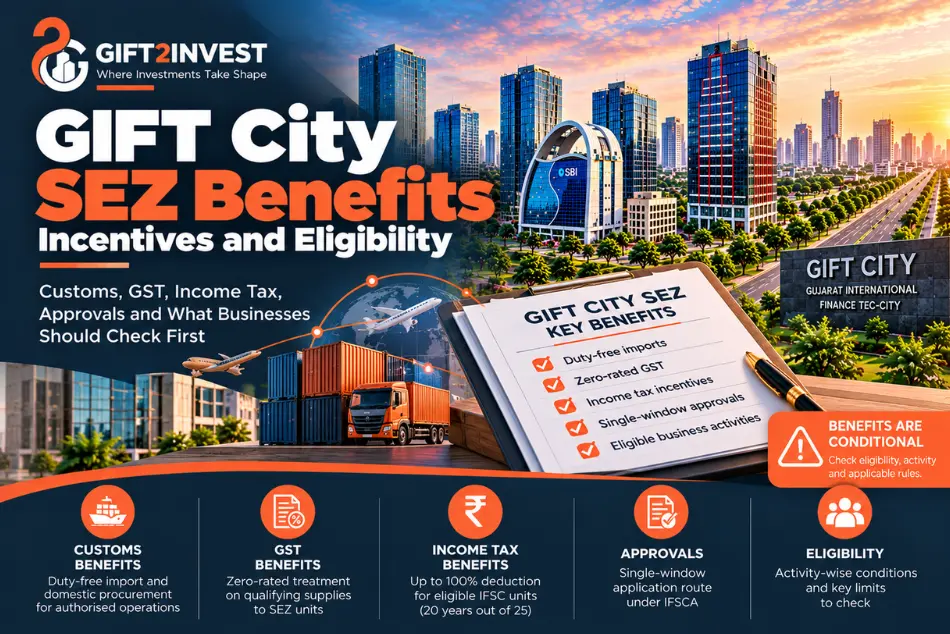
Key Benefits of the GIFT City SEZ at a Glance
GIFT City SEZ benefits fall into a handful of areas. Treat each as something to investigate for your own business, not a promise.
| Benefit Area | What It Can Mean | What to Verify |
|---|---|---|
| Customs | Duty-free import or domestic procurement of goods for authorised operations | Whether the goods are for approved activity, and the documentation route |
| GST | Zero-rated treatment on qualifying supplies to a unit | Whether the supply meets the conditions, and your GST registration |
| Income Tax | IFSC units may claim a 100% deduction for 20 years out of 25 | Eligibility, option year and the foreign-exchange condition |
| Approvals | Single-window application route and one SEZ approving office | Which approvals still sit outside the window |
| Operations | Reliable utilities, district cooling and a regulated ecosystem | Building specification and maintenance cost |
| Foreign Exchange | Freedom to operate in foreign currency under the IFSC framework | Unit-level conditions and net foreign-exchange earnings |
Customs Duty and Procurement Benefits
The SEZ Act allows duty-free import and domestic procurement of goods for the development, operation and maintenance of SEZ units, subject to authorised operations and applicable procedures. Import-licence requirements and customs examination depend on the goods, applicable restrictions and customs procedures; SEZ status does not remove every control.
Goods supplied by a supplier in the DTA to an SEZ unit may qualify for zero-rated treatment or other applicable benefits when statutory conditions and documentation requirements are met. The unit’s customs treatment also depends on authorised operations and the applicable procedure.
The key phrase is authorised operations. The benefit follows the approved activity, not the address.
Illustrative Example
A fund management entity with an approved SEZ unit buys servers and networking hardware for its GIFT City premises. If the goods are for its authorised activity and it follows the SEZ procurement and documentation procedure, duty-free treatment can apply. If the same entity buys goods for a separate office outside the zone, the benefit does not follow.
For a services business, the practical gains tend to sit in capital goods and technology. Think trading infrastructure, servers, secure networking and fit-out equipment for approved premises. A manufacturer sees more of the benefit on raw materials, which is why SEZ material written for factories overstates what a fund manager will use.
Documentation matters as much as eligibility. Units keep records of what was imported or procured, what it was used for and where it sits. Gaps surface in reviews.
The flow also runs the other way. Under Section 30 of the SEZ Act, goods and services cleared from the SEZ to the DTA are treated as imports and attract applicable duties.
You may read about Budget 2026-27 allowing concessional DTA sales. That one-time measure covers eligible SEZ manufacturing units, from 1 April 2026 to 31 March 2027. It is not aimed at financial-services units.
GST Benefits and Zero-Rated Supplies
Under Section 16 of the IGST Act, 2017, supplies of goods or services to an SEZ unit or developer for authorised operations can qualify as zero-rated supplies, subject to applicable conditions. Exports are also zero-rated supplies.
Zero-rated is not the same as exempt. The supplier keeps its input tax credit. It can usually supply without paying IGST under a bond or letter of undertaking, or pay IGST and claim a refund.
The supply must be for the unit’s authorised operations. The paperwork usually includes the unit’s declaration or an endorsement under the GST rules. An SEZ unit also needs a separate GST registration for its SEZ address.
Illustrative Example
A DTA software vendor supplies licences to an IFSC unit for its approved activity. The vendor treats the sale as zero-rated and files accordingly. The same vendor selling to the unit’s affiliate in the DTA charges GST in the normal way
SEZ status alone does not zero-rate every transaction. A unit selling services to customers in the DTA follows the rules for that supply. IFSC units also have separate GST relief on specified services, so check the current notification for your activity.
Timing also matters. Invoices, endorsements and refund claims follow set deadlines under the GST rules. A unit that treats them as year-end housekeeping tends to lose time and cash flow.
A tax adviser who works on SEZ and IFSC filings should map your transactions before you rely on any of this.
Income-Tax Benefits and Limitations
Three different provisions get mixed up here. Keep them apart.
Section 10AA is the SEZ export-income deduction. It has a sunset. Units that commence activity on or after 1 April 2020 cannot claim it. A firm setting up in GIFT City today should not plan around 10AA.
The IFSC provision is separate. From 1 April 2026, Section 147 of the Income-tax Act, 2025 replaces the corresponding Section 80LA framework. For eligible IFSC units, it allows a 100% deduction on qualifying income for 20 consecutive tax years out of a 25-year period, subject to statutory conditions and the assessee’s option. The 25-year period is counted from the year of registration in the IFSC. The earlier limit was 10 years out of 15.
Budget 2026 provides for a 15% rate on eligible IFSC business income after the deduction period ends. A 9% minimum alternate tax rate may apply to qualifying IFSC units that satisfy the applicable conditions, including the convertible-foreign-exchange requirement where relevant. Confirm both against the current Act before you model them.
The deduction attaches only to income that qualifies under Section 147 and the applicable rules. Confirm the conditions for the specific activity and income stream, including any applicable convertible-foreign-exchange requirements, before claiming it.
It does not reach a landlord, a property buyer or a DTA business. Our GIFT City tax benefits article covers the tax side in full, and a chartered accountant should confirm your position.
Approvals, Administration and Operational Facilities
The setup path is long but structured. The usual order looks like this:
- Choose premises and obtain a PLOA from the developer.
- File the Common Application Form on the SWIT portal. The SEZ part flows to SEZ Online.
- Clear Unit Approval Committee review and receive the LOA.
- Execute the BLUT, now possible as an e-BLUT, and receive the Eligibility Certificate.
- Register the lease deed within six months of the LOA date.
- Complete RCMC, IEC, final IFSCA registration and employee ID cards, then commence operations.
Some steps overlap in practice, so confirm the order for your case. The LOA is valid for one year for project implementation. Once operations begin and are intimated, validity extends to five years from commencement.
The single window helps. IFSCA says it will reach out within 7 working days of a complete submission and will strive to decide within 45 days. Those are targets, not guarantees. SWIT does not replace every approval, and domestic regulator NOCs or GST steps still run through their own channels.
Operationally, the city was built for institutions. It has an underground utility tunnel, district cooling, automated waste handling and a 24/7 command centre. Two foreign universities, Deakin and Wollongong, run active campuses. Lilavati Hospital has started outpatient services, and the Ahmedabad Metro Violet Line reaches the city.
Utility infrastructure is a potential operational benefit. Financial-services firms place a high value on continuity of power and connectivity. In GIFT City, utility systems were planned into the district; actual reliability and any reduction in an occupier’s backup spend depend on the building, service arrangements and operating experience.
Why does timing matter? The SEZ footprint is finite, and IFSCA keeps adding permitted activities. Each addition brings a new group of firms looking for approved premises.
Who Can Benefit From GIFT City SEZ?
The zone is built for regulated financial services and the businesses around them. Typical units include banks, fund managers, insurers, capital-markets participants, aircraft and ship leasing entities, fintech firms and family investment structures.
International groups often come here to run a regulated Indian arm, a treasury or a fund platform. Global in-house centres and ancillary service providers also operate here, subject to what IFSCA permits.
Overseas family offices and diaspora-led groups form a growing category. IFSCA’s family investment fund framework now includes a structure for foreign family wealth, and the first Foreign Family Investment Fund was approved in April 2026. Such entities still need their own approvals and premises.
Eligibility is activity-specific. The LOA names what a unit may do. Operating beyond it needs an amendment first.
Not every GIFT City business qualifies for the same GIFT City SEZ benefits. A company with a GIFT City address but no LOA is not an SEZ unit. A DTA company is not an IFSC unit.
If you are comparing office space, check eligibility before you check rent. Our SEZ office space guide walks through what to confirm.
GIFT City SEZ vs DTA
Neither zone is better in the abstract. The right one depends on your activity, your customers and how you plan to buy and sell.
| Factor | Eligible SEZ Unit | DTA Business |
|---|---|---|
| SEZ Provisions | May apply, subject to conditions | Not available by virtue of DTA status |
| GST Treatment | Depends on the transaction and the rules | General GST rules apply |
| Customs Treatment | Special SEZ provisions may apply | General customs framework applies |
| Approvals | LOA, BLUT and SEZ compliance, plus IFSCA where relevant | General business approvals apply |
| Typical Customers | Foreign and IFSC clients, plus regulated activity | Domestic clients and general business |
A firm serving mainly Indian customers may find the DTA simpler. A regulated entity serving offshore clients usually needs the SEZ and IFSC route.
Property buyers should note the occupancy rule. SEZ space is meant for SEZ-registered entities. An investor who wants a conventional landlord model usually looks at DTA space. We explain this in SEZ vs DTA property in GIFT City.
Limitations, Compliance and Common Misconceptions
The benefits are conditional. They depend on the approved activity, the documents on file and ongoing compliance.
Units file periodic reports, including a Monthly Performance Report on SEZ Online. They are generally expected to maintain positive net foreign-exchange earnings over the applicable approval period, subject to specific exemptions or rules for the activity. Employees need SEZ ID cards, and cards for departing staff must be surrendered promptly.
A few misconceptions come up often:
- “An office in GIFT City gives me SEZ status.” It does not. Approval does.
- “Every purchase is duty-free.” Only goods for authorised operations qualify.
- “SEZ and IFSC tax benefits are the same.” They are separate provisions with separate conditions.
- “The tax holiday reaches property owners.” It belongs to the operating unit.
- “Domestic sales work like exports.” Clearances into the DTA attract duty and tax.
Premises are part of compliance too. The lease deed must be registered within six months of the LOA date, and missing that date can bring Unit Approval Committee action. Delay costs more than the stamp duty ever saved. Understanding the full set of GIFT City SEZ benefits means understanding these obligations alongside them.
Rules change. IFSCA updated its SEZ compliance FAQs in August 2026, and the e-BLUT process only began in February 2026. Always check the live source before you file.
Wrapping Up: Making Sense of GIFT City SEZ Benefits
GIFT City SEZ benefits are real, and they are specific. Customs relief, zero-rated GST and the IFSC tax holiday each reward a business that is approved, documented and operating inside its authorised scope.
The window for good premises and early positioning may be worth evaluating now. The extended 20-year deduction framework took effect on 1 April 2026, but eligibility, qualifying income and the 25-year period depend on the unit’s registration and circumstances. Check eligibility first, then choose the space.
Frequently Asked Questions
Q1) What Are the Main Benefits of the GIFT City SEZ?
Duty-free import and procurement for authorised operations, zero-rated GST on qualifying supplies, a single-window approval route and, for eligible IFSC units, a 20-year income-tax deduction. Each depends on conditions.
Q2) Who Is Eligible?
Businesses that hold a Letter of Approval for a permitted activity inside the SEZ. Financial-services units also need IFSCA authorisation for their regulated activity.
Q3) Are Benefits Available to Every Company in GIFT City?
No. DTA companies and firms without an LOA do not get SEZ provisions simply by having a GIFT City address.
Q4) What Customs Duty Benefits May Apply?
Duty-free import and domestic procurement of goods for the unit’s authorised operations, with documentation. Goods cleared into the DTA attract duty.
Q5) What Does Zero-Rated GST Mean for an SEZ Unit?
Supplies to the unit for authorised operations carry no GST burden, and the supplier keeps its input tax credit. It is not the same as an exemption.
Q6) Are SEZ Benefits the Same As IFSC Tax Benefits?
No. SEZ provisions come from the SEZ Act and customs and GST law. IFSC income-tax benefits come from a separate provision for eligible IFSC units.
Q7) What Is the Difference Between GIFT City SEZ and DTA?
The SEZ is a duty-free enclave for approved units. The DTA works under standard Indian rules and can host any domestic business.
Q8) How Does a Business Apply to Set Up an SEZ Unit?
Most applicants file a Common Application Form on IFSCA’s SWIT portal, which routes the SEZ portion to SEZ Online. Activities not yet on SWIT file directly on SEZ Online.
Q9) Does Setting Up an Office Automatically Give Tax Benefits?
No. Benefits follow approval, activity and compliance, not the lease.
Q10) Where Can Businesses Verify Current SEZ Rules?
On the official GIFT City portal, IFSCA’s website and SEZ India. A CA or lawyer who works on IFSC units should confirm your position.
Sources and References
Checked October 2026. SEZ, customs, GST and tax rules change. Verify the current position before relying on any point above.
GIFT City official portal, Setting up at GIFT City
https://www.giftgujarat.in/business/ifsc?tab=setting-up-at-GIFT-city
GIFT City official portal
https://giftgujarat.in
SEZ India, Facilities and Incentives
https://www.sezindia.gov.in/index.php/facilities-and-incentives
SEZ India, FAQs (salient features, incentives, sunset clause)
https://www.sezindia.gov.in/index.php/FAQ
ICEGATE, SEZ advisories
https://www.icegate.gov.in/advisories/sez
IGST Act, 2017, Section 16 (zero-rated supply), CBIC
https://www.cbic.gov.in
PIB, Union Budget 2026-27: Strengthening SEZs (28 March 2026)
https://static.pib.gov.in/WriteReadData/specificdocs/documents/2026/mar/doc2026328835301.pdf
TaxGuru, Income-tax Act, 2025, Section 147 IFSC tax holiday extension
https://taxguru.in/?p=1022971
Business Standard, Union Budget 2026-27: GIFT City tax holiday extended to 20 years (1 February 2026)
https://www.business-standard.com
Outlook Business, GIFT City tax architecture, Section 147 and MAT (1 May 2026)
https://www.outlookbusiness.com/spotlight/news-wire/gift-city-is-not-a-tax-shelter-it-is-a-tax-architecture-and-the-difference-matters
IFSCA, SEZ Compliance FAQs Booklet, Version 2.0 (August 2026)
https://ifsca.gov.in/CommonDirect/GetFileView?id=b64bc220b28b988fb41d045999291d03&fileName=FAQ_Administrator__IFSCA__V2_20260820_0613.pdf&TitleName=Legal
IFSCA, SWIT portal, How to Apply
https://swit.ifsca.gov.in/Home/HowtoApply
IFSCA, Q1 FY 2026-27 data (as of 30 June 2026), summarised by ABC Live, 7 September 2026
https://abclive.in/2026/09/07/gift-city-ifsca-weekly-regulatory-brief-7-september-2026
Ministry of Commerce and Industry, SEZ Act, 2005 and SEZ Rules, 2006
https://www.sezindia.gov.in
Income Tax Department, Income-tax Act, 2025, as amended by Finance Act 2026
https://www.incometaxindia.gov.in/documents/d/guest/income_tax_act_2025_as_amended_by_fa_act_2026-pdf
Income Tax Department, Budget 2026 FAQs: Section 147 IFSC deduction
https://www.incometaxindia.gov.in
IFSCA, How to Apply
https://ifsca.gov.in/Pages/Contents/HowToApply
CBIC, IGST Act, 2017, Section 16
https://cbic-gst.gov.in/hindi/IGST-bill-e.html
PIB, one-time concessional customs-duty relief for eligible SEZ manufacturing units
https://www.pib.gov.in/PressReleasePage.aspx?PRID=2247628&lang=1®=3
SEZ India, SEZ Act, 2005
https://sezindia.gov.in/sez-act
Note: This article is general information, not legal, tax or investment advice. Confirm your position with a qualified CA or SEZ lawyer before acting.