Understanding GIFT City Real Estate Growth Potential
When people talk about GIFT City, they reach for big words. Transformational. Game-changing. But if you’re deciding where to park serious money — residential, commercial, or office space — you need more than that. You need to understand what’s actually driving GIFT City real estate growth potential, where the demand comes from, and what the risk picture looks like.
This isn’t a beginner’s guide. You already know GIFT stands for Gujarat International Finance Tec-City. You know it’s India’s first operational smart city and IFSC (International Financial Services Centre). You know it sits on 886 acres between Ahmedabad and Gandhinagar. So skip the orientation — and get into the stuff that actually moves property values.
The IFSC Advantage Is Structural, Not a Sales Pitch
Most real estate in India runs on residential demand — families, end-users, NRIs buying homes. GIFT City is different. The engine here is commercial activity, specifically the IFSC framework.
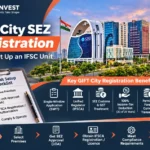
India’s IFSC at GIFT City is the only one in the country with a dedicated unified regulator — the IFSCA (International Financial Services Centres Authority). Banks, insurance firms, fund managers, exchanges — all operating under a single authority with tax incentives that compete genuinely with offshore jurisdictions like DIFC and Singapore’s MAS zone.
What does that mean for real estate? Sustained, policy-backed commercial demand.
Companies don’t lease office space in GIFT City because the views are nice. They come because the regulatory and tax structure makes cross-border financial operations cheaper to run here than from most offshore hubs. NSE IFSC, BSE IFSC, and over 20 foreign banks including HSBC, Deutsche Bank, and Standard Chartered are already operational. That’s not a brochure claim — that’s a tenant roster most Indian commercial markets don’t have.
For anyone evaluating commercial listings on Gift2Invest.com, the question isn’t whether this fills up. The question is at what rent and on what timeline.
Why GIFT City Residential Behaves Differently From the Ahmedabad Market
GIFT City residential doesn’t follow standard Ahmedabad market logic. The city’s main residential market runs on local housing demand — affordable to mid-segment buyers from Paldi, Thaltej, Prahlad Nagar. GIFT City residential is effectively a captive professional and expat market.
Think about who actually needs to live here. A compliance head at a foreign bank setting up their GIFT IFSC operations can’t commute daily from Satellite or Bopal. A fund manager on a two-year IFSC deputation needs housing within the zone or close to it. So does the fintech engineer, the legal counsel, the operations staff.
This creates a narrow but real demand pool — serviced apartments, premium 2BHK and 3BHK formats, and studio units that work for professionals on shorter contracts.
What’s notable is that residential supply in GIFT City has been controlled. There’s been no flood of launches. Inventory has stayed measured relative to the policy backing the zone has received. That’s been good for prices — supply hasn’t consistently outrun demand the way it has in markets like Noida or some Pune micro-markets.
Under-construction residential shows price points that look steep against Gandhinagar sectors or even parts of Ahmedabad. But you’re not buying the same product. The economics of the zone are different.
You’re not comparing Gandhinagar land rates to GIFT City land rates. You’re comparing two different economic ecosystems that happen to share a postal code.
Explore Property Opportunities in GIFT City
Looking to invest in GIFT City? Explore suitable residential or commercial property options based on your requirements and investment goals.
The Master Plan Is Still Mostly Ahead of You — And That’s the Point
Here’s something a lot of property consultants won’t say plainly: GIFT City is still in early-to-mid innings of its development cycle.
The master plan covers 886 acres with approximately 62 million square feet of planned mixed-use development across three zones — the Multi Services Special Economic Zone (MSSEZ), the Domestic Tariff Area (DTA), and the IFSC. Full buildout takes decades. Right now, roughly 35 to 40 percent of that vision is on the ground or under active construction.
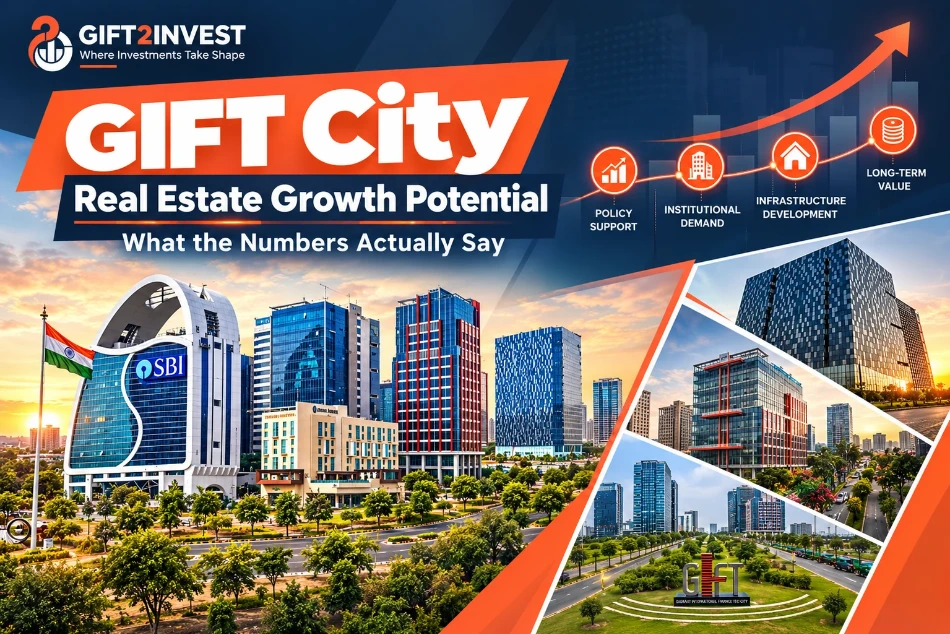
The IFSC zone has the most developed commercial core — the towers you see in every photograph of GIFT City. The DTA and broader residential zones are still filling in. New academic institutions, a hospital, retail anchors, and entertainment zones are being built. None of this is speculative. It’s in the development authority’s own published plans and giftgujarat.in project updates.
If you’re buying at 35–40% development, you have real growth ahead of you, not behind you. The GIFT City real estate growth potential doesn’t come from what’s already built. It comes from the gap between what’s operational now and what the master plan delivers over the next 10 to 15 years.
For investors with a five to seven year horizon, that gap is the investment thesis — full stop.
Commercial Office Space: Who Is Actually Absorbing It
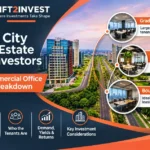
The commercial story is more layered than headlines suggest. Gross leasing has been strong — particularly from financial services firms, fintech companies, and global capability centres (GCCs) of foreign banks. But there’s a distinction that matters: IFSC-notified commercial space versus general commercial space within GIFT City.
IFSC commercial space commands a hard premium because tenants there are regulated entities that must be physically within the IFSC boundary to access the tax and regulatory benefits. You can’t work around that with a mailing address. This creates a structural floor under demand and pricing that has no equivalent in any other Indian commercial market.
Outside the IFSC but within GIFT City, you have IT/ITeS-type demand — companies that want the brand and infrastructure quality without specific IFSC regulatory requirements. This segment behaves more like Ahmedabad IT park commercial real estate. Healthier than five years ago, but different asset class.
When evaluating any commercial listing — office space, commercial floor plates in mixed-use towers — that IFSC versus non-IFSC distinction is the first thing to check. It determines your tenant universe and, therefore, your pricing power.
Infrastructure Quality and What It Actually Does to Property Values
GIFT City runs on a dedicated utility corridor. Underground cabling means no power outages. District cooling eliminates individual air conditioning — and the associated electricity bills. A pneumatic waste collection system means no ground-level garbage. Broadband built for financial-grade latency requirements. CCTV across public areas.
For residential buyers, this is not a list of features on a brochure. It’s a description of daily life that’s genuinely different from a similarly priced apartment elsewhere in Gujarat. No electricity fluctuations. No water tanker dependency. Predictable facility management.For commercial investors, it translates into tenant behaviour. Low operational friction means lower churn. Lower churn means more stable rental income over time.
For commercial investors, it translates into tenant behaviour. Low operational friction means lower churn. Lower churn means more stable rental income over time.
The direct metro link between Ahmedabad and GIFT City is already operational, with ongoing expansion of an internal loop to improve connectivity within the city. As transit density increases, it expands commuter reach and creates a proven ‘transit premium,’ driving stronger real estate demand and long-term value growth. This pattern has played out across major transit-linked commercial corridors in India, and GIFT City is now moving along the same trajectory.
IFSCA Policy Pipeline: Why Real Estate Investors Should Read Regulatory Updates
Most property buyers don’t track regulatory filings. In GIFT City, this is a specific mistake — because IFSCA policy announcements are among the most direct demand-drivers for commercial real estate.
The IFSCA has progressively expanded permitted activities to include aircraft leasing, ship leasing, fund management, bullion trading, foreign currency accounts, and insurance. Each new permitted activity category brings a new class of firms. New firms need office space. Senior hires from those firms need housing.
The policy pipeline isn’t closed. IFSCA has been actively developing frameworks for family offices, virtual asset service providers, and retail-oriented fintech. If even a fraction of India’s large family office wealth shifts to IFSC structures via GIFT City, the numbers on commercial absorption look very different over the next five years.
This is where the GIFT City real estate growth potential story gets genuinely forward-looking — not as speculation, but grounded in regulatory commitments that are publicly documented and already partially executed.
Where Prices Stand and the Direction They’re Moving
GIFT City property prices have moved. Residential prices in premium projects within and adjacent to the IFSC zone have appreciated roughly 20 to 30 percent on a per-sqft basis over the past three years. That’s not uniform across all projects — developer credibility, project specifications, and exact positioning within the zone all produce variation.
Ready-to-move inventory carries a 15 to 20 percent premium over comparable under-construction options. Standard for most Indian markets, but more pronounced here because completed GIFT City stock is genuinely limited.
Commercial capital values have tracked leasing momentum closely. After major IFSCA regulatory announcements, values firmed. In quieter periods, they plateaued. The pattern tells you something: commercial values here are policy-sensitive. That’s a risk and an opportunity simultaneously, depending on how closely you’re paying attention.
Rental yields for quality commercial office assets within GIFT City are in the 6 to 8 percent range, supported by current office rents of around Rs. 65 per sq ft. This is meaningfully higher than comparable Grade-A commercial stock in cities like Mumbai and Bengaluru, with structurally stronger occupancy backed by IFSC-driven demand.
Residential rental yields are currently in the 3 to 4 percent range. The primary investment case remains capital appreciation, with yields expected to improve gradually over the next 2 to 3 years as rental demand deepens and more of the ecosystem becomes operational.
What Investors Usually Get Wrong About GIFT City
Three mistakes come up repeatedly.
The first is market comparison. Comparing GIFT City residential per-sqft rates to Gandhinagar Sector 7 or even Ahmedabad’s Science City is like comparing a Nariman Point tower to an Andheri West office. Geographically proximate. Economically distinct. The zone premium is real and it’s not going away.
The second is holding-cost modelling. If you buy an under-construction unit and the project completes in three to four years, you carry EMI or opportunity cost through that entire period without rental income. The appreciation needs to be strong enough to justify the carry. In GIFT City, the case is there — but model it explicitly rather than assuming it.
Third: always confirm whether your target property is within the IFSC notification boundary or outside it. That one variable determines which tenants can occupy your commercial space under IFSC incentives. It’s not always visible from a listing headline.
Planning to Invest in GIFT City?
Share your property preferences and investment plans to discover opportunities that align with your goals.
The NRI Angle: Why GIFT City Makes Sense Beyond Tax Savings
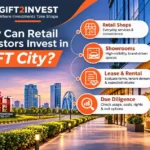
India-based NRIs have historically been the strongest buyer segment for premium residential real estate in cities like Mumbai and Bengaluru. GIFT City is starting to appear on their radar for a reason beyond the obvious IFSC tax angle.
NRIs working in financial services — in Singapore, Dubai, London — increasingly watch GIFT City as their potential re-entry point into India’s financial industry. The IFSC’s global standards are familiar to them. The lifestyle infrastructure inside GIFT City is designed for the professional class they belong to. And the property pricing, while not cheap, is still well below comparable professional-grade residential in the cities they currently live in.
Buying into GIFT City residential is, for some of them, a hedge against an eventual return to India — and a real estate position that’s actually usable when that happens, not a flat that sits empty in a city they no longer live near.
This demand segment is underdiscussed but real. And it’s one reason why the residential market here doesn’t behave like a local end-user market.
The Honest Risk Register
No serious real estate analysis skips risk. Here’s what’s actually on the table in GIFT City.
Execution risk is real. Development timelines have stretched before, and they can stretch again. Buyers of under-construction projects carry this directly. The master plan is ambitious. Delays don’t invalidate the thesis, but they push out your timeline.
IFSC policy dependence is a concentration risk. The commercial trajectory here is tightly tied to IFSCA’s ability to keep deepening its regulatory framework and attracting new categories of financial firms. If that pace decelerates for political or institutional reasons, commercial demand slows with it.
Liquidity is thinner than in mature markets. The buyer pool for GIFT City property is growing but still narrower than Ahmedabad’s main residential corridors. A forced exit in a short window may mean waiting longer than you’d like for the right buyer.
None of these are reasons to walk away. They’re parameters to price in before you commit.
GIFT City Real Estate Growth Potential: The Long Game Worth Playing
India doesn’t have many infrastructure projects where policy foundation, physical infrastructure, and institutional anchor tenants are all simultaneously in place.
GIFT City has all three. The IFSCA regulatory architecture is mature enough to be credible to global firms. The physical infrastructure — smart city systems, IFSC commercial towers, utility networks — is live and operational. HSBC, Deutsche Bank, NSE, BSE, and dozens of other institutions are not running pilots here. They’re running full operations.
The development gap between current state and master plan creates a clear direction for appreciation. Infrastructure additions — most notably metro connectivity — will expand the effective catchment area. IFSCA’s ongoing policy work will generate fresh commercial demand. The NRI professional segment is starting to recognise what this zone offers that other Indian cities don’t.
For anyone building a real estate portfolio with a genuine long-term orientation — not a 12-month flip, but a five to ten year position — the GIFT City real estate growth potential offers something that’s increasingly rare in Indian real estate: a market where the structural tailwinds are institutional and policy-backed, not purely speculative.
Find a Property That Fits Your Goals
Submit your requirements and let us help you shortlist relevant GIFT City properties for self-use or investment.
FAQs
Q1) What Makes GIFT City’s Real Estate Fundamentally Different From Other Indian Markets?
GIFT City is driven by commercial activity through its IFSC framework, not residential end-user demand. Companies like HSBC, Deutsche Bank, NSE, and BSE operate full-scale here because the regulatory and tax structure makes cross-border financial operations cheaper than most offshore hubs — creating sustained, policy-backed demand that no other Indian real estate market has.
Q2) Who Is the Core Buyer and Renter for GIFT City Residential Properties?
It’s a captive professional and expat market — compliance heads at foreign banks, fund managers on deputation, fintech engineers, and legal counsel who need to live within or close to the IFSC zone. This narrow but real demand pool makes the residential market behave very differently from Ahmedabad’s or Gandhinagar’s local housing markets.
Q3) How Developed Is GIFT City Currently, and Does Any Growth Opportunity Remain?
Only about 35–40% of the 886-acre master plan is on the ground or under active construction. Key zones — including hospitals, academic institutions, retail anchors, and entertainment areas — are still being built. For investors trying to understand GIFT City real estate growth potential, this gap between the current state and the master plan’s full vision is the core investment thesis over the next 10–15 years.
Q4) What Is the Difference Between IFSC and Non-IFSC Commercial Space Within GIFT City?
IFSC-notified space commands a hard premium because tenants must be physically within the IFSC boundary to access tax and regulatory benefits — it can’t be worked around with a mailing address. Non-IFSC space within GIFT City behaves more like standard IT park commercial real estate. This distinction determines your tenant universe and your pricing power, so it’s the first thing to verify when evaluating any listing.
Q5) Why Should Real Estate Investors Pay Attention to IFSCA Regulatory Updates?
Each new permitted activity that IFSCA announces — aircraft leasing, ship leasing, bullion trading, family offices, virtual asset service providers — brings a new class of firms into the zone. New firms need office space; their senior hires need housing. The policy pipeline is not closed, meaning IFSCA announcements are among the most direct demand-drivers for GIFT City real estate growth potential on the commercial side.
Q6) What Role Does Infrastructure Quality Play in Property Values Here?
GIFT City runs on underground cabling (no power outages), district cooling (no individual AC costs), pneumatic waste collection, and financial-grade broadband. For residents, this means genuinely different daily living compared to similarly priced apartments elsewhere in Gujarat. For commercial investors, low operational friction means lower tenant churn and more stable rental income. The operational metro link to Ahmedabad further expands commuter reach and supports a transit premium over time.
Q7) Why Are NRIs Increasingly Interested in GIFT City Residential, Beyond the Tax Angle?
NRIs working in financial services in Singapore, Dubai, or London see GIFT City as a credible re-entry point into India’s financial industry — one where global regulatory standards are familiar to them. Property pricing, while not cheap, is still well below professional-grade residential in the cities they currently live in. For many, buying here is a hedge against an eventual return to India with a property that’s actually usable rather than an empty flat in a city they no longer live near.
Q8) What Are the Most Common Mistakes Investors Make When Evaluating GIFT City?
Three mistakes come up repeatedly: comparing GIFT City per-sqft rates to Gandhinagar or Ahmedabad prices (they’re economically distinct, not just geographically different); failing to model holding costs during an under-construction period of 3–4 years without rental income; and not confirming whether a target property sits within the IFSC notification boundary, which determines which tenants can occupy your commercial space under IFSC incentives.
Q9) What Are the Honest Risks an Investor Should Price In Before Committing?
Three main risks worth understanding before acting on GIFT City real estate growth potential: execution risk — development timelines have stretched before and can again, directly affecting under-construction buyers; IFSC policy dependence — commercial demand is tightly tied to IFSCA’s continued ability to attract new categories of financial firms; and liquidity risk — the buyer pool is still narrower than Ahmedabad’s main corridors, so a forced exit in a short window may mean a longer wait for the right buyer. None of these invalidate the investment case, but all need to be explicitly modelled, not assumed away.